
Questions and answers
What inputs does a Ziwei chart require?
Typically record birth year, month, day, hour, calendar and leap-month status. Software may also use place, time zone and sex categories in traditional direction rules. Preserve civil and converted dates; an unknown hour is not midnight. Volume 2 uses month/hour for Ming and Shen, day and bureau for Ziwei, and different inputs for auxiliary stars. A zodiac animal alone cannot specify the chart.
Read the full explanationHow do Ming and Shen palaces differ?
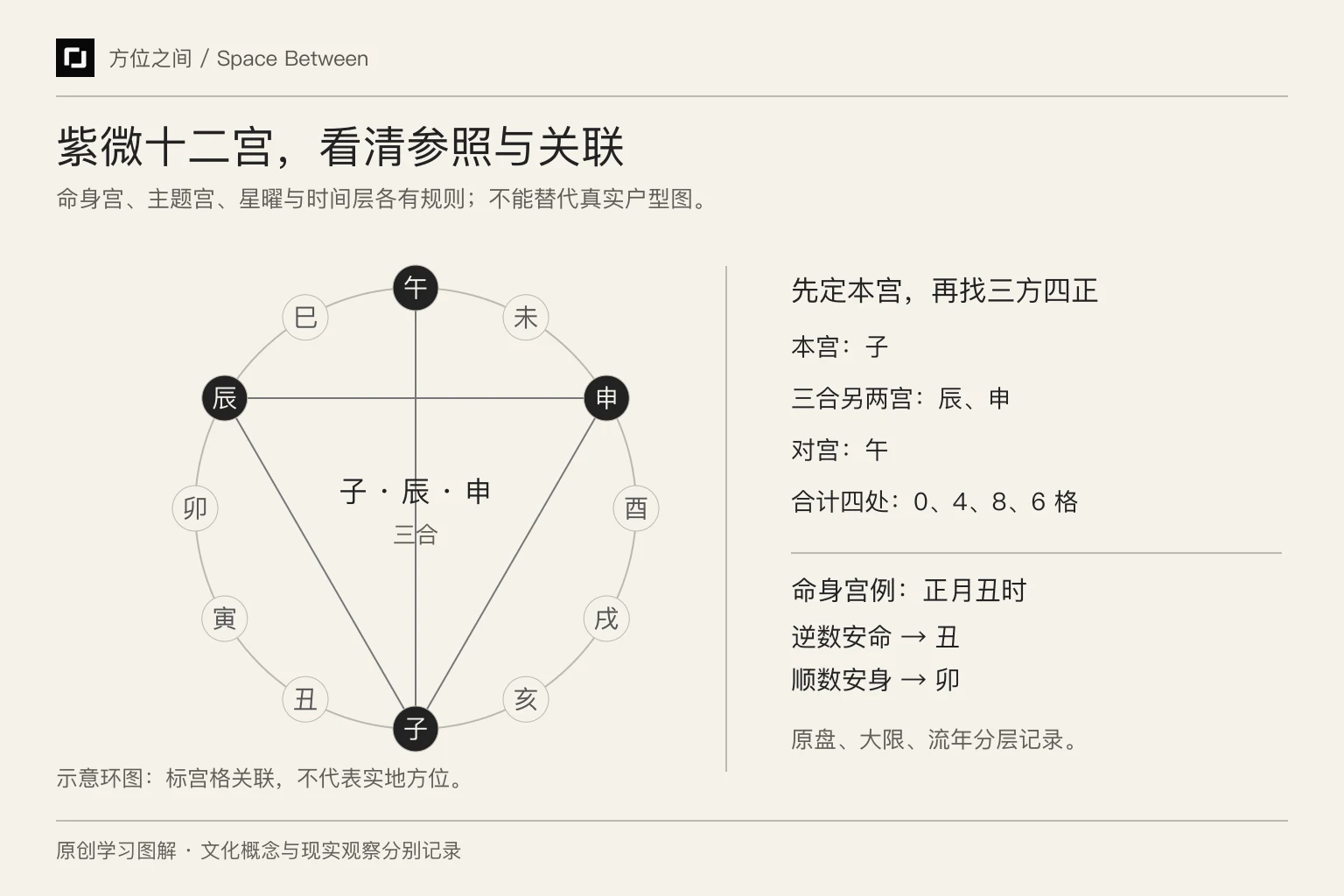
Ming anchors the twelve topic names. Shen is another month/hour-derived marker placed on an existing palace, not a thirteenth box. In volume 2, count months from Yin, then count hours backward for Ming and forward for Shen. First-month Zi hour puts both at Yin; Chou hour puts Ming at Chou and Shen at Mao. This illustrates direction rules, not personality.
Read the full explanationWhat do the twelve palaces describe?
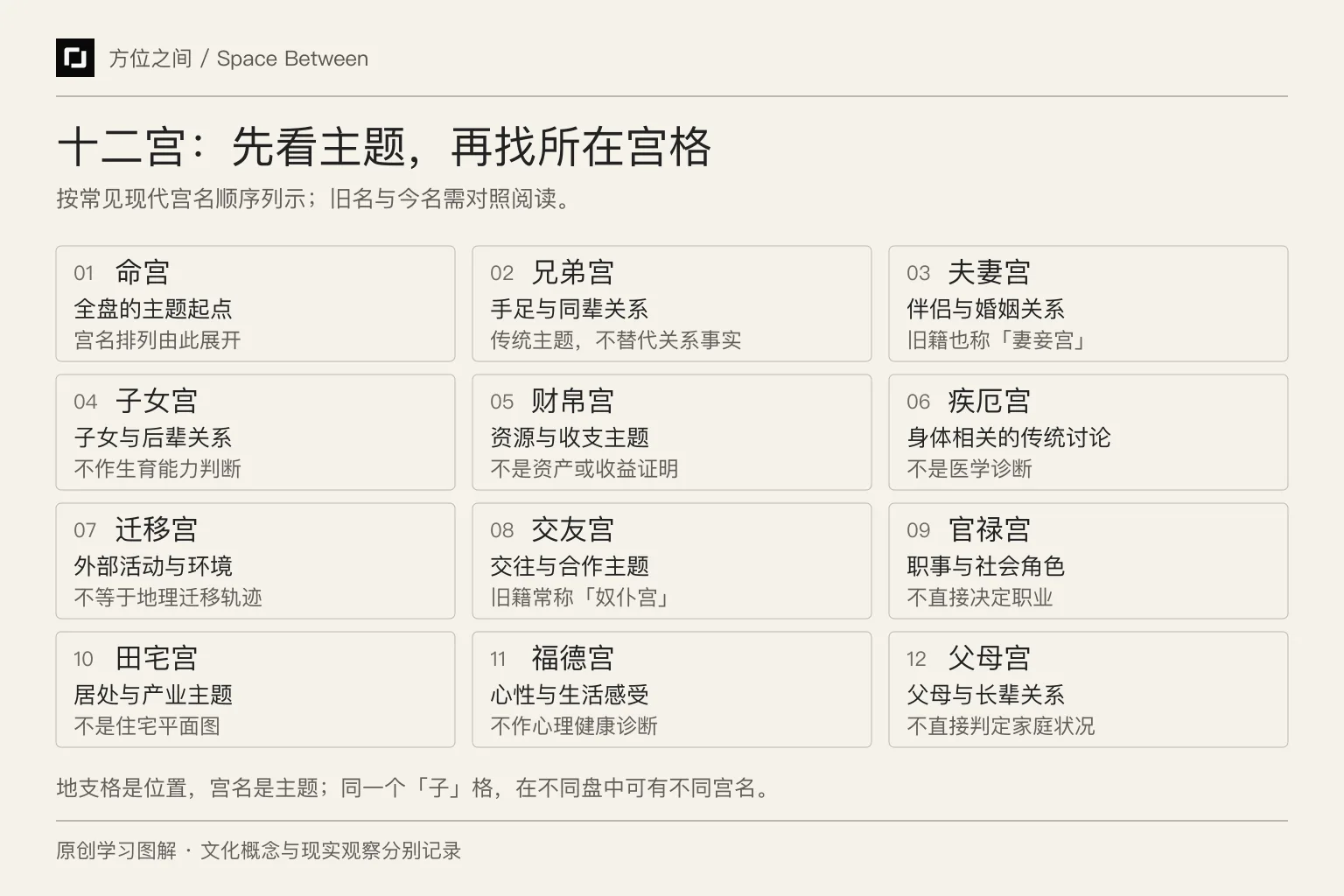
Common modern names are Ming, Siblings, Spouse, Children, Wealth, Health, Travel, Friends, Career, Property, Well-being and Parents. Compare modern names with older terms in the text. They organize traditional topics, not diagnoses: Property is a discussion category, not an actual floor plan. Distinguish each fixed branch position from the topic name assigned to it.
Read the full explanationHow should principal and auxiliary stars be studied?
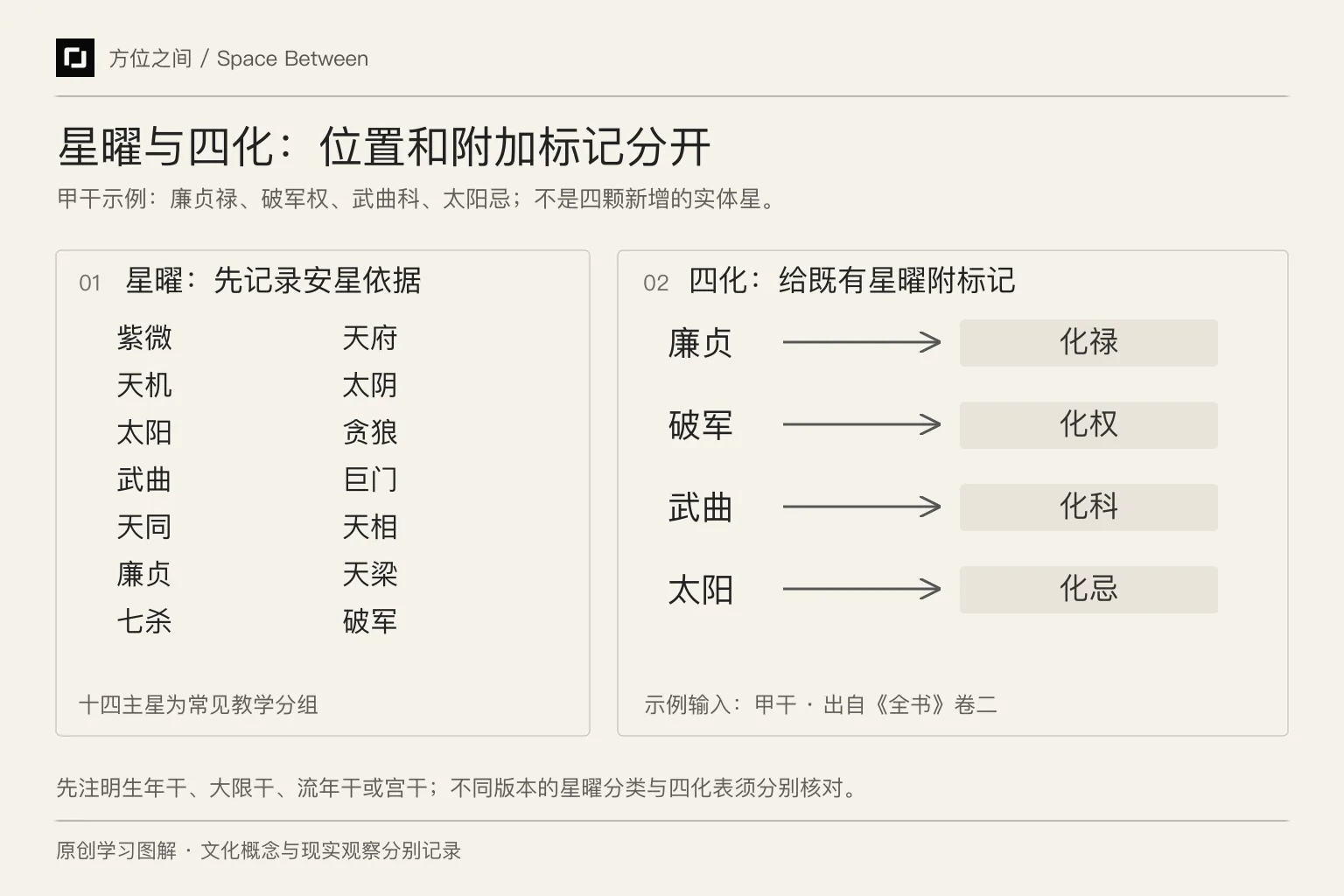
A common teaching group is fourteen principal stars: Ziwei, Tianji, Taiyang, Wuqu, Tiantong, Lianzhen, Tianfu, Taiyin, Tanlang, Jumen, Tianxiang, Tianliang, Qisha and Pojun. Then study Chang/Qu and Fu/Bi. This is a teaching convention; volume 2 also describes eighteen principal luminaries. Record placement inputs and tables before symbolism rather than memorizing unconditional good/bad labels.
Read the full explanationShow more questions
What are the four transformations Lu, Quan, Ke and Ji?
Four transformations add Lu, Quan, Ke and Ji markers to stars using a selected stem table. State whether the stem belongs to birth year, a cycle, a year or a palace. Volume 2’s Jia example assigns Lu to Lianzhen, Quan to Pojun, Ke to Wuqu and Ji to Taiyang. Locate those stars before adding markers. Tables can differ by edition; Ji is not proof of a real disaster.
Read the full explanationHow do I locate Sanfang Sizheng on a chart?
Choose a reference palace, its two trine partners and its opposite. On a branch ring, Zi connects with Shen and Chen, with Wu opposite: four positions including Zi. Zi here is a chart position, not birth hour. Numbering twelve positions 0–11 gives offsets 0,4,8,6. These are chart relations, not compass bearings measured inside a room.
Read the full explanationHow do decade periods, annual layers and the natal chart differ?
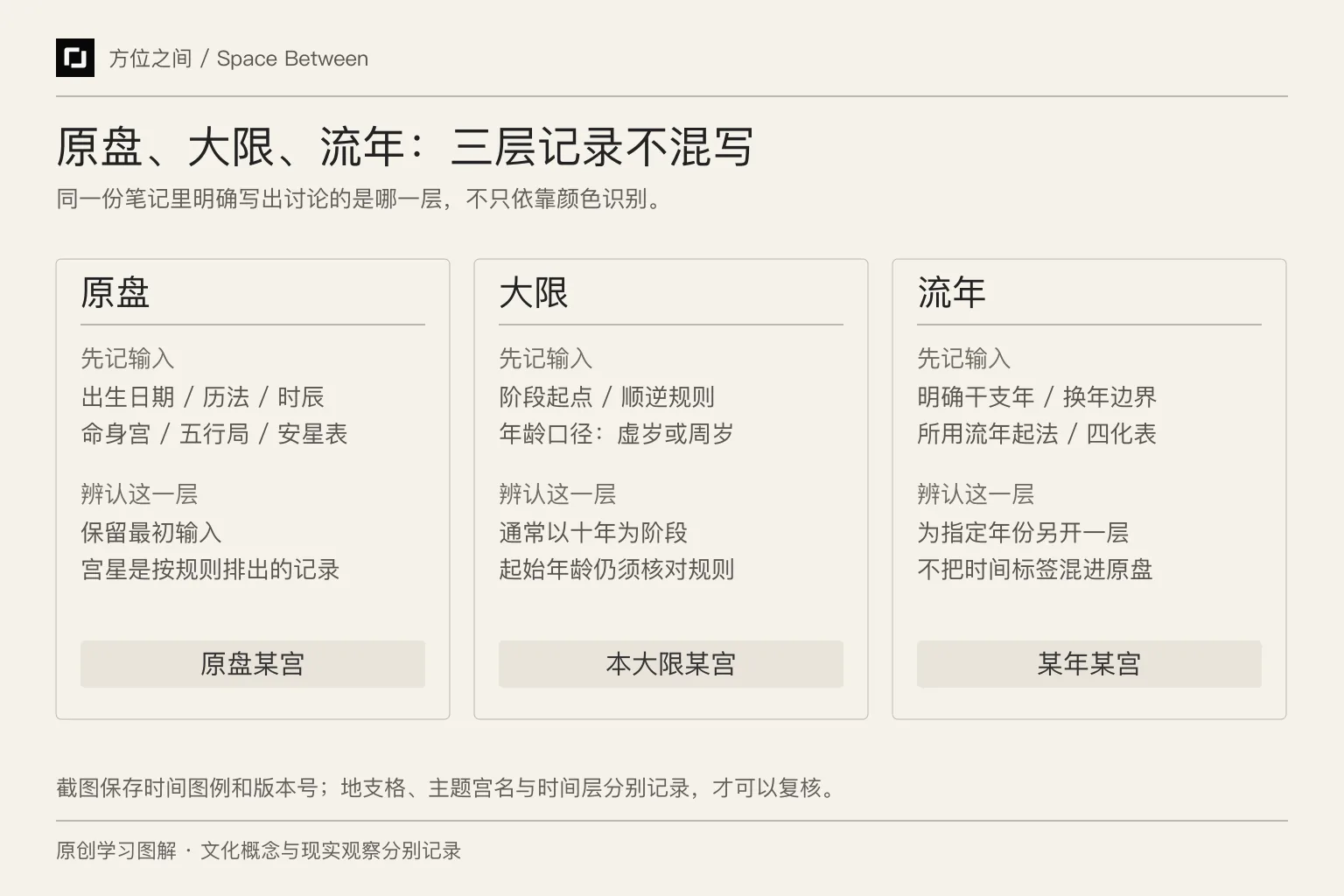
Keep natal palace-star assignments separate from decade and annual layers. Decade periods usually span ten years, but starting age and direction depend on rules. Label whether a palace name belongs to the natal, period or annual layer; fixed branch positions should not move with topic labels. Record annual method and age convention. A screenshot without a time legend is hard to verify.
Read the full explanationIs the Property palace a home’s feng shui plan?
The Property palace is a traditional topic category. It contains no actual wall dimensions, door locations, bearing or road layout. Its position comes from chart rules; a floor plan comes from drawings and observation. Keep symbolic discussion separate from ownership, use and environmental evidence. A star cannot establish a leak, authorize wall removal or determine a purchase.
Read the full explanationWhat should I check when Ziwei apps disagree?
Check calendar, leap month, time zone, daylight saving and hour first, then midnight, leap-month treatment, bureau, transformations and period direction. The transcribed volume 2 has its own leap-month example; that does not make it universal. Recompute one differing step under identical rules. Identical positions with different prose indicate interpretation differences, not necessarily a different chart algorithm.
Read the full explanationAre Ziwei stars real-time astronomical positions?
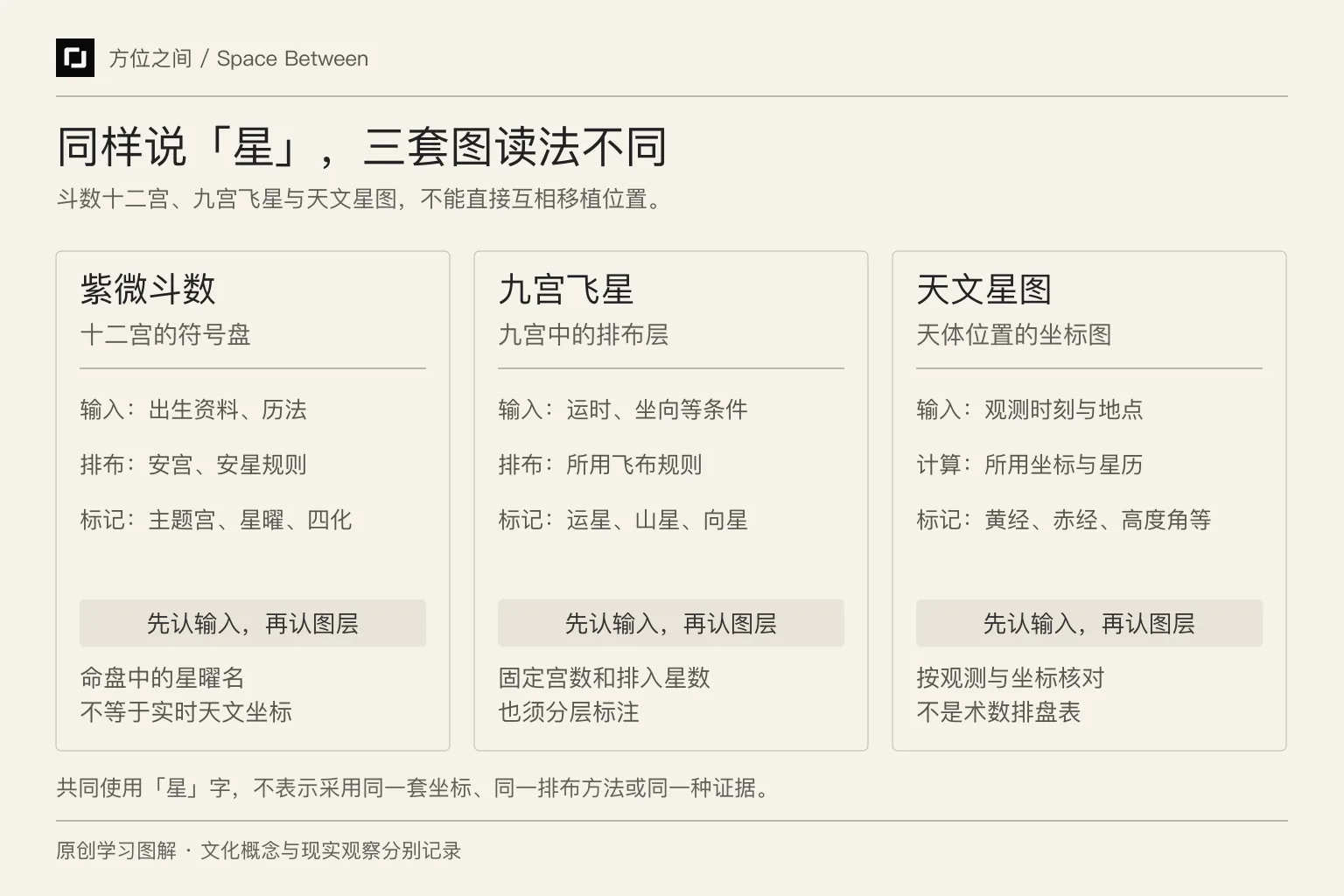
Ziwei uses traditional stellar names, but chart positions come from birth-data assignment rules rather than measured celestial longitude, right ascension or altitude. A sky map needs observing time, location and coordinates. Nine-palace flying stars use another symbolic arrangement based on nine palaces and time cycles; they cannot be transplanted into Ziwei’s twelve-palace structure merely because both use “stars.”
Read the full explanationWhat inputs does a Ziwei chart require?
Typically record birth year, month, day, hour, calendar and leap-month status. Software may also use place, time zone and sex categories in traditional direction rules. Preserve civil and converted dates; an unknown hour is not midnight. Volume 2 uses month/hour for Ming and Shen, day and bureau for Ziwei, and different inputs for auxiliary stars. A zodiac animal alone cannot specify the chart.
How do Ming and Shen palaces differ?
Ming anchors the twelve topic names. Shen is another month/hour-derived marker placed on an existing palace, not a thirteenth box. In volume 2, count months from Yin, then count hours backward for Ming and forward for Shen. First-month Zi hour puts both at Yin; Chou hour puts Ming at Chou and Shen at Mao. This illustrates direction rules, not personality.
What do the twelve palaces describe?
 Enlarge diagram
Common modern names are Ming, Siblings, Spouse, Children, Wealth, Health, Travel, Friends, Career, Property, Well-being and Parents. Compare modern names with older terms in the text. They organize traditional topics, not diagnoses: Property is a discussion category, not an actual floor plan. Distinguish each fixed branch position from the topic name assigned to it.
How should principal and auxiliary stars be studied?
A common teaching group is fourteen principal stars: Ziwei, Tianji, Taiyang, Wuqu, Tiantong, Lianzhen, Tianfu, Taiyin, Tanlang, Jumen, Tianxiang, Tianliang, Qisha and Pojun. Then study Chang/Qu and Fu/Bi. This is a teaching convention; volume 2 also describes eighteen principal luminaries. Record placement inputs and tables before symbolism rather than memorizing unconditional good/bad labels.
What are the four transformations Lu, Quan, Ke and Ji?
 Enlarge diagram
Four transformations add Lu, Quan, Ke and Ji markers to stars using a selected stem table. State whether the stem belongs to birth year, a cycle, a year or a palace. Volume 2’s Jia example assigns Lu to Lianzhen, Quan to Pojun, Ke to Wuqu and Ji to Taiyang. Locate those stars before adding markers. Tables can differ by edition; Ji is not proof of a real disaster.
How do I locate Sanfang Sizheng on a chart?
Choose a reference palace, its two trine partners and its opposite. On a branch ring, Zi connects with Shen and Chen, with Wu opposite: four positions including Zi. Zi here is a chart position, not birth hour. Numbering twelve positions 0–11 gives offsets 0,4,8,6. These are chart relations, not compass bearings measured inside a room.
How do decade periods, annual layers and the natal chart differ?
 Enlarge diagram
Keep natal palace-star assignments separate from decade and annual layers. Decade periods usually span ten years, but starting age and direction depend on rules. Label whether a palace name belongs to the natal, period or annual layer; fixed branch positions should not move with topic labels. Record annual method and age convention. A screenshot without a time legend is hard to verify.
Is the Property palace a home’s feng shui plan?
The Property palace is a traditional topic category. It contains no actual wall dimensions, door locations, bearing or road layout. Its position comes from chart rules; a floor plan comes from drawings and observation. Keep symbolic discussion separate from ownership, use and environmental evidence. A star cannot establish a leak, authorize wall removal or determine a purchase.
What should I check when Ziwei apps disagree?
Check calendar, leap month, time zone, daylight saving and hour first, then midnight, leap-month treatment, bureau, transformations and period direction. The transcribed volume 2 has its own leap-month example; that does not make it universal. Recompute one differing step under identical rules. Identical positions with different prose indicate interpretation differences, not necessarily a different chart algorithm.
Are Ziwei stars real-time astronomical positions?
 Enlarge diagram
Ziwei uses traditional stellar names, but chart positions come from birth-data assignment rules rather than measured celestial longitude, right ascension or altitude. A sky map needs observing time, location and coordinates. Nine-palace flying stars use another symbolic arrangement based on nine palaces and time cycles; they cannot be transplanted into Ziwei’s twelve-palace structure merely because both use “stars.”
How can BaZi and Ziwei be compared without mixing rules?
Use two pages for one birth record: BaZi lists pillars, Day Master, Ten Gods and solar-month rules; Ziwei lists converted date, Ming/Shen, bureau and star tables. Retain the same original time, but do not substitute the Day Master’s phase for the Ziwei bureau or put BaZi Wealth directly into the Wealth palace. Check rules before comparing interpretations; resemblance to a person does not validate a calculation.
Sources and further reading
These sources help clarify the concepts and their origins. Explaining a traditional term does not establish that it can predict outcomes.