
Questions and answers
How should month command and strength be understood?
Month command starts with the adopted solar-term month. Sanming Tonghui distinguishes seasonal phases from hidden-stem timing: which stems a branch contains, when a stem is considered active, and implications for the Day Master are separate questions. Strength readings may consider roots, exposed stems and supportive or draining relations. Counting elements is insufficient; traditional strength is not a physical-fitness measurement.
Read the full explanationWhy can pattern and strength not be read from one character?
A pattern organizes relations under a particular text; strength assesses a reference such as the Day Master under that method. They are separate fields. A Yin month branch alone prompts checks of season and hidden stems but says nothing complete about the remaining pillars, interactions or pattern definition. Record evidence step by step and leave unresolved conditions open rather than assuming defaults.
Read the full explanationHow do major cycles, annual layers and the natal chart differ?
The natal chart preserves birth pillars. Major cycles are phases derived from stated start and direction rules, often ten years each; an annual layer adds a selected year’s stem-branch pair. A ten-year duration does not mean everyone starts at age ten. Record start age or instant, direction, age convention and annual boundary. Keep birth pillars fixed while adding time layers.
Read the full explanationAre Nayin, symbolic stars and Ten Gods the same classification?
Ten Gods compare a Day Stem with another stem; Nayin assigns names to complete sexagenary pairs; symbolic stars add labels using their own lookup rules. Thus Jiazi can contain Jia wood and Zi water yet have the Nayin name Sea Gold without contradiction. These are different layers. Identify the table and input pair for every label; none is a diagnosis of a person.
Read the full explanationHow should month command and strength be understood?
 Enlarge diagram
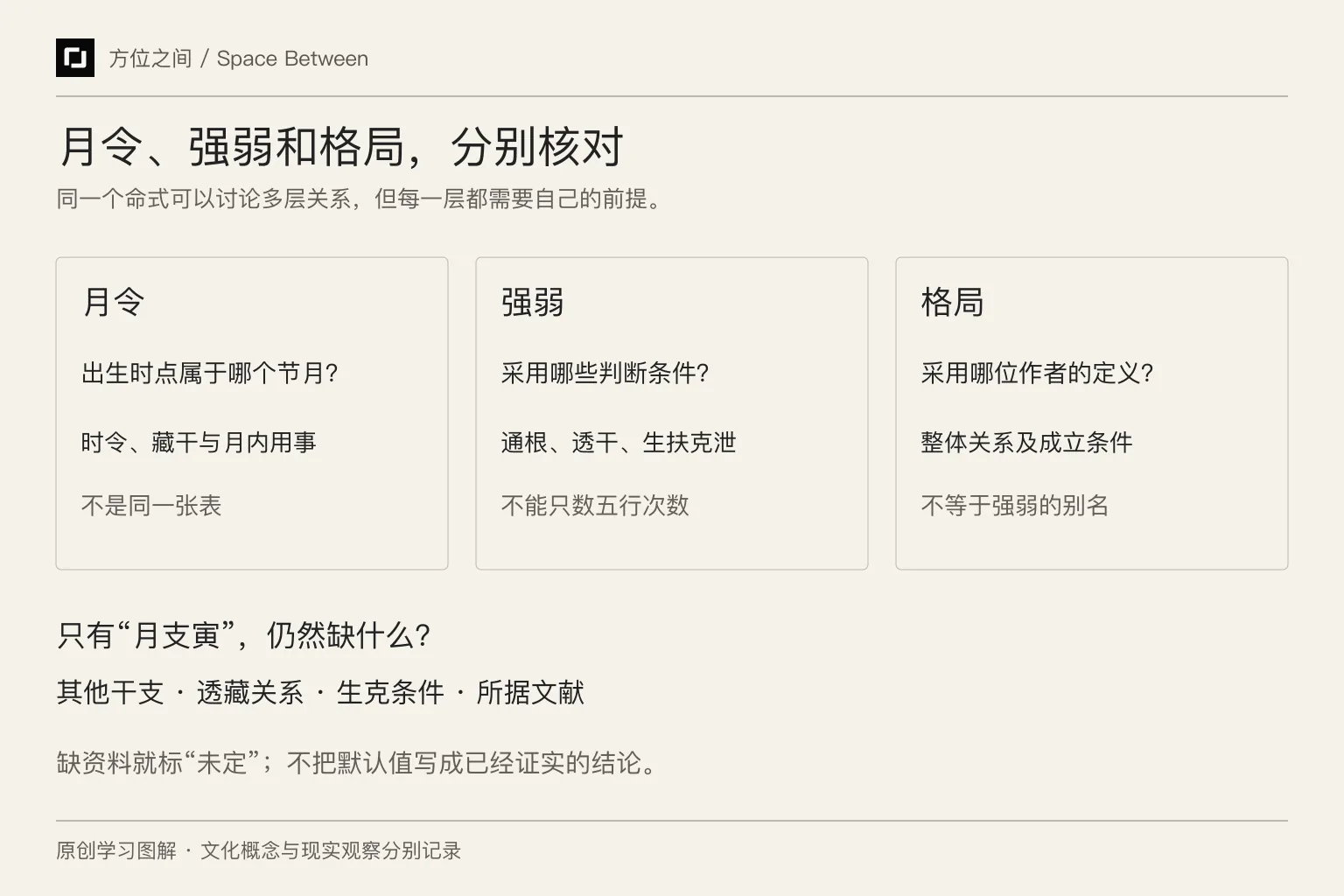
Month command starts with the adopted solar-term month. Sanming Tonghui distinguishes seasonal phases from hidden-stem timing: which stems a branch contains, when a stem is considered active, and implications for the Day Master are separate questions. Strength readings may consider roots, exposed stems and supportive or draining relations. Counting elements is insufficient; traditional strength is not a physical-fitness measurement.
Why can pattern and strength not be read from one character?
A pattern organizes relations under a particular text; strength assesses a reference such as the Day Master under that method. They are separate fields. A Yin month branch alone prompts checks of season and hidden stems but says nothing complete about the remaining pillars, interactions or pattern definition. Record evidence step by step and leave unresolved conditions open rather than assuming defaults.
How do major cycles, annual layers and the natal chart differ?
 Enlarge diagram
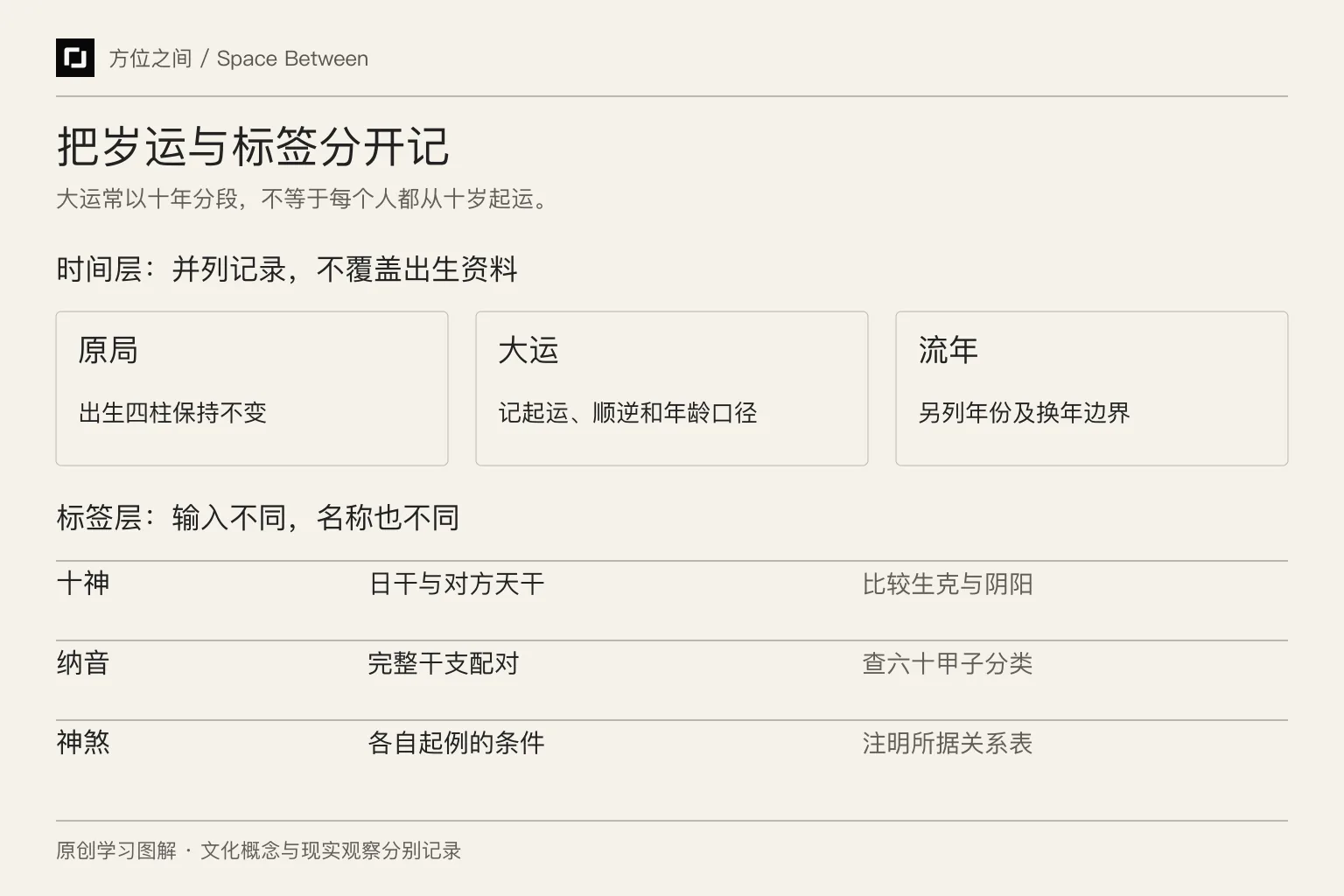
The natal chart preserves birth pillars. Major cycles are phases derived from stated start and direction rules, often ten years each; an annual layer adds a selected year’s stem-branch pair. A ten-year duration does not mean everyone starts at age ten. Record start age or instant, direction, age convention and annual boundary. Keep birth pillars fixed while adding time layers.
Are Nayin, symbolic stars and Ten Gods the same classification?
Ten Gods compare a Day Stem with another stem; Nayin assigns names to complete sexagenary pairs; symbolic stars add labels using their own lookup rules. Thus Jiazi can contain Jia wood and Zi water yet have the Nayin name Sea Gold without contradiction. These are different layers. Identify the table and input pair for every label; none is a diagnosis of a person.
What does a layered reading note look like?
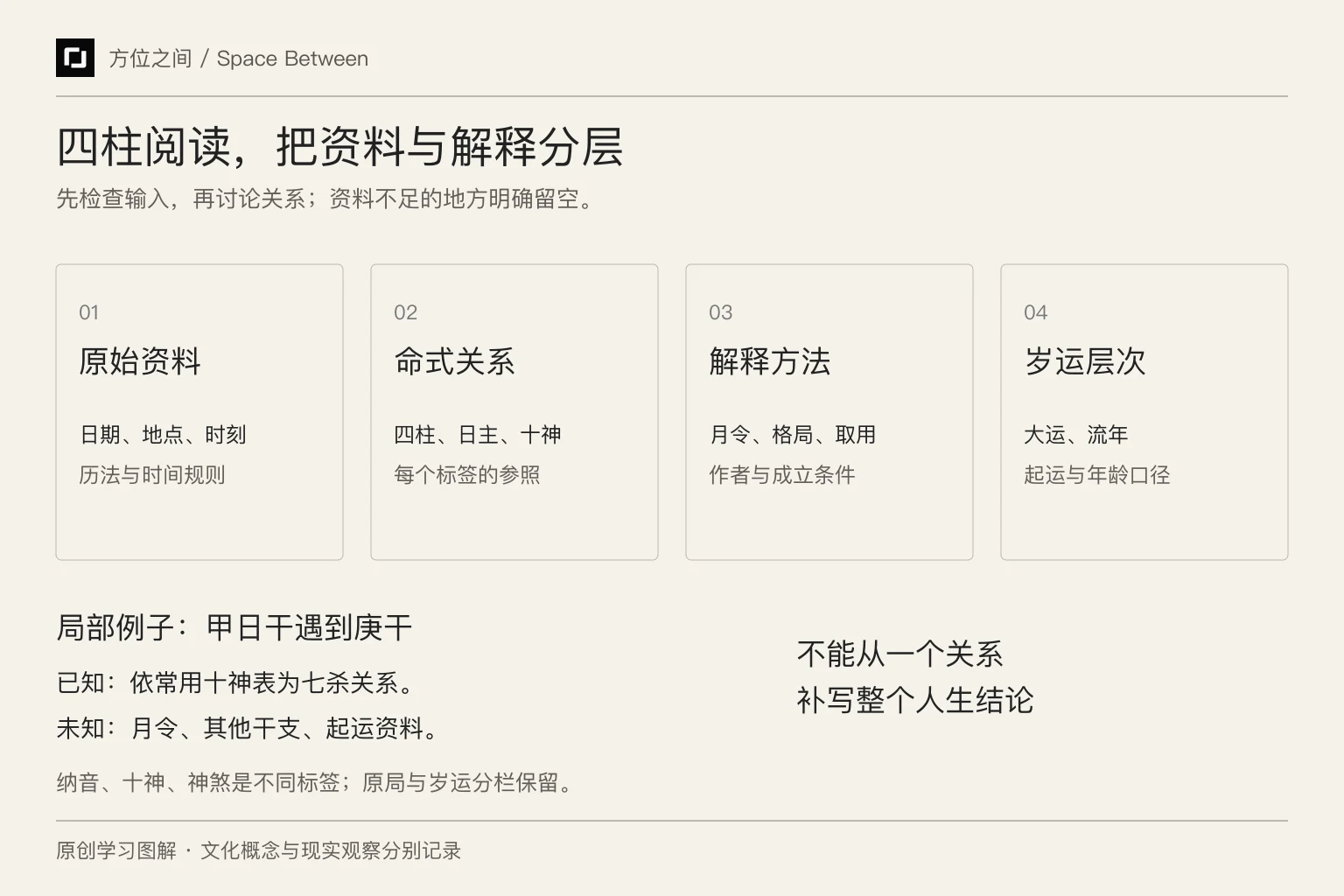
Use four fields: birth records and conversion rules; pillars and relational labels; the author’s seasonal, pattern and selection conditions; separate time cycles. If only Jia Day Stem and Geng are known, the common Seven Killings relation can be named, but season, other characters and cycle start remain unknown. Mark those fields incomplete. A limited, checkable result is more useful than inventing a life story from one label.
Sources and further reading
These sources help clarify the concepts and their origins. Explaining a traditional term does not establish that it can predict outcomes.