
Questions and answers
How do six line positions differ from the Liuyao method?
A hexagram has six bottom-to-top positions. Liuyao Najia adds palace affiliation, stem-branch assignments, relationships and changes to interpret a question. Zengshan Buyi organizes these as distinct chapters, a useful reading order. Diagram calculations can be checked for consistency; historical divination anecdotes are not modern predictive experiments.
Read the full explanationWhat should a casting record contain?
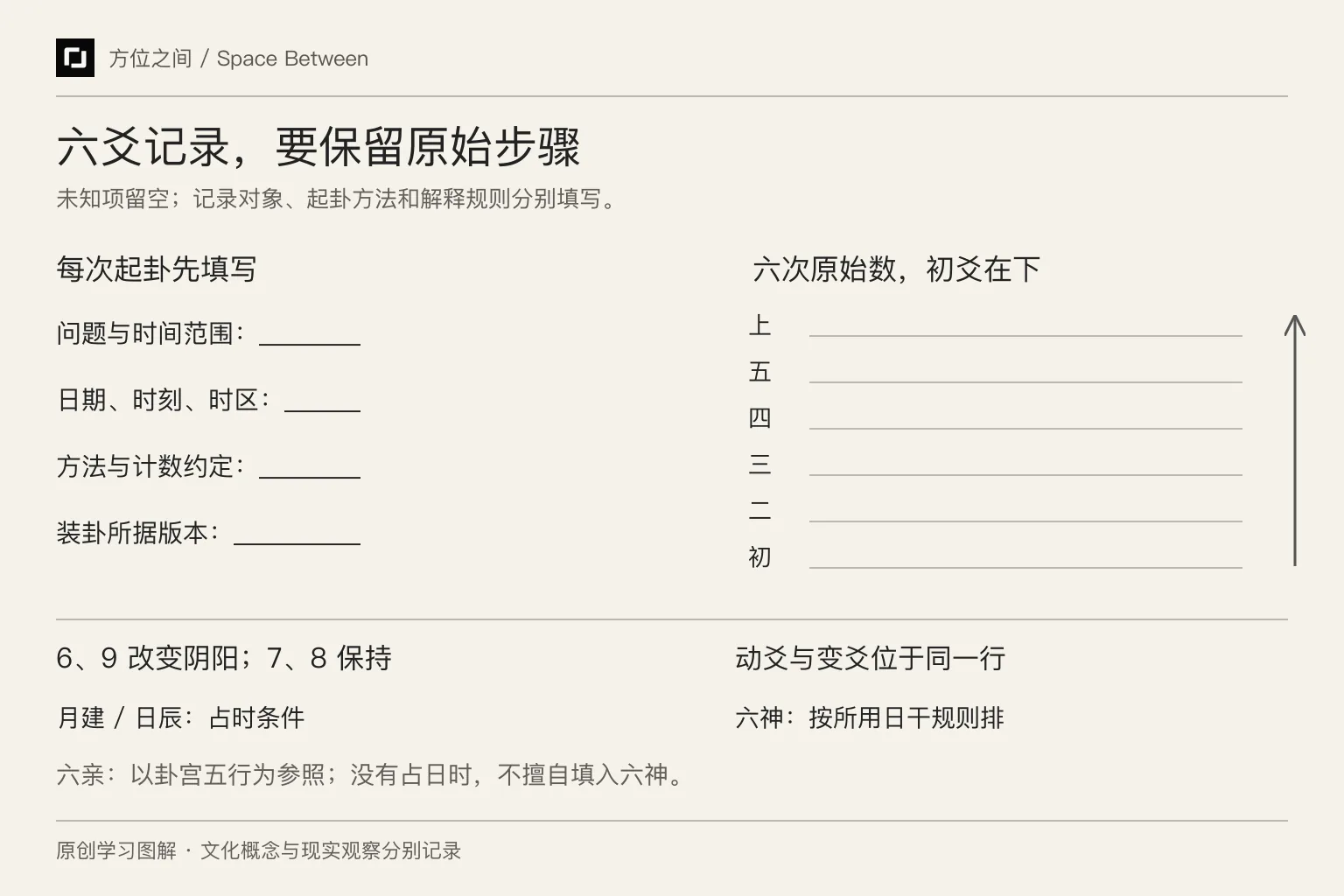
Write one clear question, its subject and time horizon, then date, time zone, method and raw outcomes. With coins, state face-to-number assignments and retain all six results bottom first. A useful template is question | local time and zone | method and convention | six raw results | figure and moving lines | rule edition. Leave unknowns blank and keep names and addresses out of public links.
Read the full explanationWhat do palace classification and Najia each do?
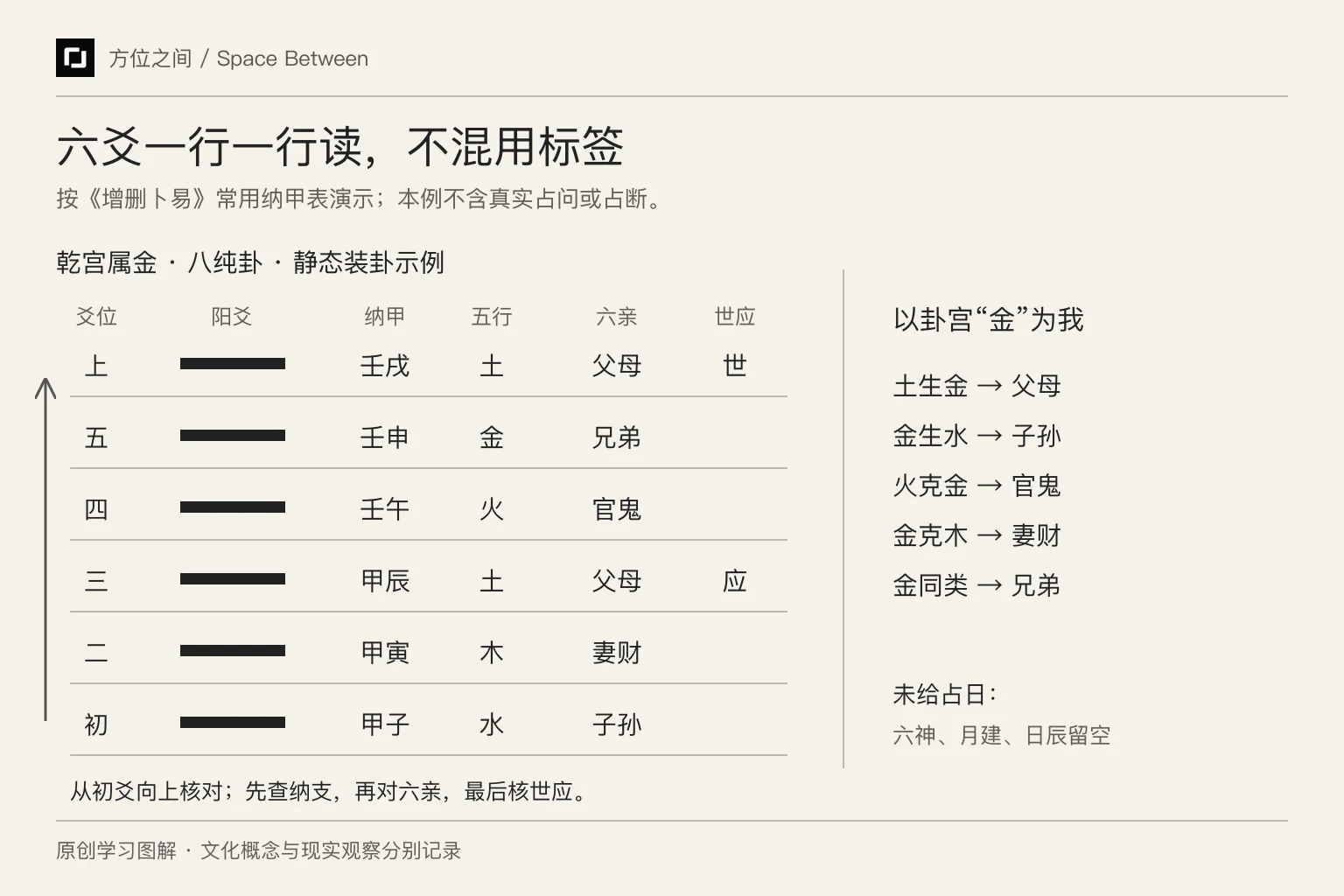
Eight palaces group the 64 hexagrams into eight sets of eight. Palace phase provides the reference for relationship labels; an upper Qian trigram alone does not establish Qian-palace membership. Najia assigns stems and branches to inner and outer trigrams. In pure Qian the bottom three are Jia-Zi, Jia-Yin, Jia-Chen and the upper three Ren-Wu, Ren-Shen, Ren-Xu, listed bottom to top.
Read the full explanationHow are Shi and Ying positions located?
Shi and Ying are assigned from the hexagram’s place in its palace, not by arbitrarily calling the bottom line “self.” In the eight pure hexagrams Shi is at line six and Ying at line three; other figures require the appropriate table. They are three positions apart. Shi commonly references the querent or focal subject, while Ying’s role depends on the question; neither is a good/bad rank.
Read the full explanationHow are relationship labels derived from the palace phase?
Using the palace phase as reference: what produces it is Parents; what it produces Descendants; what controls it Officer/Ghost; what it controls Wealth; the same phase Siblings. These five categories are conventionally called Six Relations and need not each appear. For Qian metal, earth is Parents, water Descendants, fire Officer/Ghost, wood Wealth and metal Siblings. BaZi instead references a Day Stem and polarity.
Read the full explanationDo a moving line and its changed line share a position?
A moving line belongs to the original figure; its changed counterpart occupies the same position in the resulting figure. The position does not move. Polarity and rule-derived labels may change. If Qian’s bottom line becomes yin, compare bottom with bottom, not with the top. Preserve both figures and the assignment table before analyzing changed-line relationships.
Read the full explanationHow should month, day, Six Spirits and relationships be separated?
Month and day are casting-time conditions requiring explicit boundaries; neither replaces the palace or assigned branches. Six Spirits commonly start from the Day Stem and follow Azure Dragon, Vermilion Bird, Gouchen, Tengshe, White Tiger and Xuanwu; Jia/Yi days start Azure Dragon at the bottom. Relationships come from palace phases instead. A line can carry Parents, Azure Dragon and Shi together. The names do not assert physical beings are present.
Read the full explanationCan a home-related casting replace site measurement?
A home casting records a question and symbols; a survey records direction, openings, dimensions, light or noise. These are different kinds of evidence. A textual house association cannot reveal structural loads, leak sources or actual bearings. Keep traditional discussion separate from photos, measurement locations, devices and repeated readings. Resolve structural or safety issues through site inspection and qualified advice.
Read the full explanationHow do six line positions differ from the Liuyao method?
A hexagram has six bottom-to-top positions. Liuyao Najia adds palace affiliation, stem-branch assignments, relationships and changes to interpret a question. Zengshan Buyi organizes these as distinct chapters, a useful reading order. Diagram calculations can be checked for consistency; historical divination anecdotes are not modern predictive experiments.
What should a casting record contain?
 Enlarge diagram
Write one clear question, its subject and time horizon, then date, time zone, method and raw outcomes. With coins, state face-to-number assignments and retain all six results bottom first. A useful template is question | local time and zone | method and convention | six raw results | figure and moving lines | rule edition. Leave unknowns blank and keep names and addresses out of public links.
What do palace classification and Najia each do?
Eight palaces group the 64 hexagrams into eight sets of eight. Palace phase provides the reference for relationship labels; an upper Qian trigram alone does not establish Qian-palace membership. Najia assigns stems and branches to inner and outer trigrams. In pure Qian the bottom three are Jia-Zi, Jia-Yin, Jia-Chen and the upper three Ren-Wu, Ren-Shen, Ren-Xu, listed bottom to top.
How are Shi and Ying positions located?
Shi and Ying are assigned from the hexagram’s place in its palace, not by arbitrarily calling the bottom line “self.” In the eight pure hexagrams Shi is at line six and Ying at line three; other figures require the appropriate table. They are three positions apart. Shi commonly references the querent or focal subject, while Ying’s role depends on the question; neither is a good/bad rank.
How are relationship labels derived from the palace phase?
Using the palace phase as reference: what produces it is Parents; what it produces Descendants; what controls it Officer/Ghost; what it controls Wealth; the same phase Siblings. These five categories are conventionally called Six Relations and need not each appear. For Qian metal, earth is Parents, water Descendants, fire Officer/Ghost, wood Wealth and metal Siblings. BaZi instead references a Day Stem and polarity.
Do a moving line and its changed line share a position?
A moving line belongs to the original figure; its changed counterpart occupies the same position in the resulting figure. The position does not move. Polarity and rule-derived labels may change. If Qian’s bottom line becomes yin, compare bottom with bottom, not with the top. Preserve both figures and the assignment table before analyzing changed-line relationships.
How should month, day, Six Spirits and relationships be separated?
Month and day are casting-time conditions requiring explicit boundaries; neither replaces the palace or assigned branches. Six Spirits commonly start from the Day Stem and follow Azure Dragon, Vermilion Bird, Gouchen, Tengshe, White Tiger and Xuanwu; Jia/Yi days start Azure Dragon at the bottom. Relationships come from palace phases instead. A line can carry Parents, Azure Dragon and Shi together. The names do not assert physical beings are present.
Can a home-related casting replace site measurement?
A home casting records a question and symbols; a survey records direction, openings, dimensions, light or noise. These are different kinds of evidence. A textual house association cannot reveal structural loads, leak sources or actual bearings. Keep traditional discussion separate from photos, measurement locations, devices and repeated readings. Resolve structural or safety issues through site inspection and qualified advice.
How can the six rows of pure Qian be checked?
This static assignment exercise has no casting date. Bottom to top: Zi water Descendants; Yin wood Wealth; Chen earth Parents/Ying; Wu fire Officer/Ghost; Shen metal Siblings; Xu earth Parents/Shi. Check assigned branch first, relationship to Qian metal second, and Shi/Ying last. Without a date, leave Six Spirits, day and month blank rather than inventing them.
Sources and further reading
These sources help clarify the concepts and their origins. Explaining a traditional term does not establish that it can predict outcomes.
- Zengshan Buyi, chapter 3 (transcription)
- Zengshan Buyi, chapter 4 (transcription)
- Zengshan Buyi, chapter 5 (transcription)
- Zengshan Buyi, chapter 6 (transcription)
- Zengshan Buyi, chapter 7 (transcription)
- Zengshan Buyi, chapter 16 (transcription)
- Zengshan Buyi, chapter 17 (transcription)
- Zengshan Buyi, chapter 18 (transcription)