
Questions and answers
How do upper and lower trigrams form 64 hexagrams?
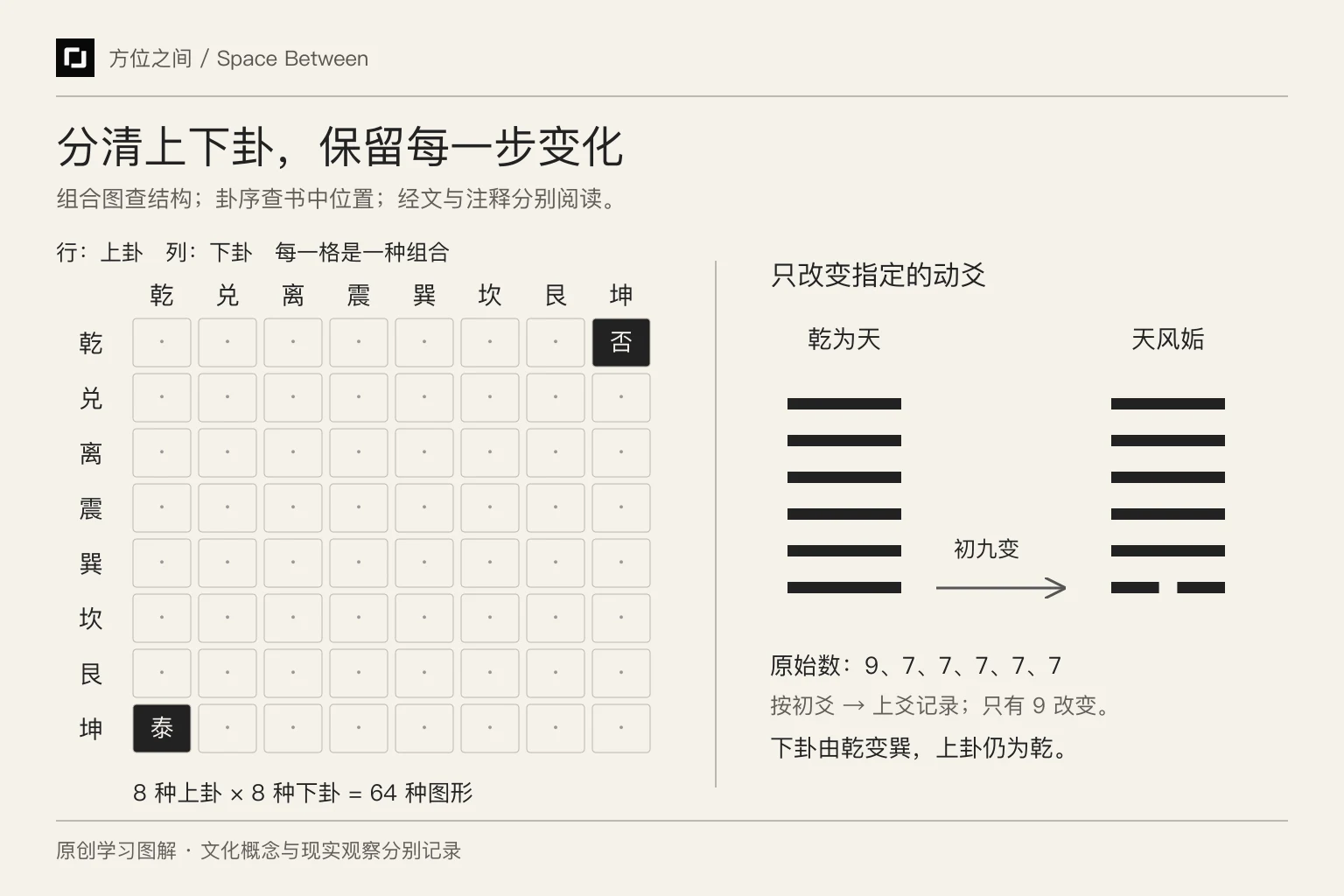
Eight lower trigrams combined with eight upper trigrams yield 64 figures. In our table rows are upper and columns lower: Qian above Kun is Pi; Kun above Qian is Tai. Exchanging positions changes the hexagram. A combination table identifies a figure; the received sequence orders chapters. That sequence is not ascending binary order.
Read the full explanationHow do judgments, line statements and later commentary differ?
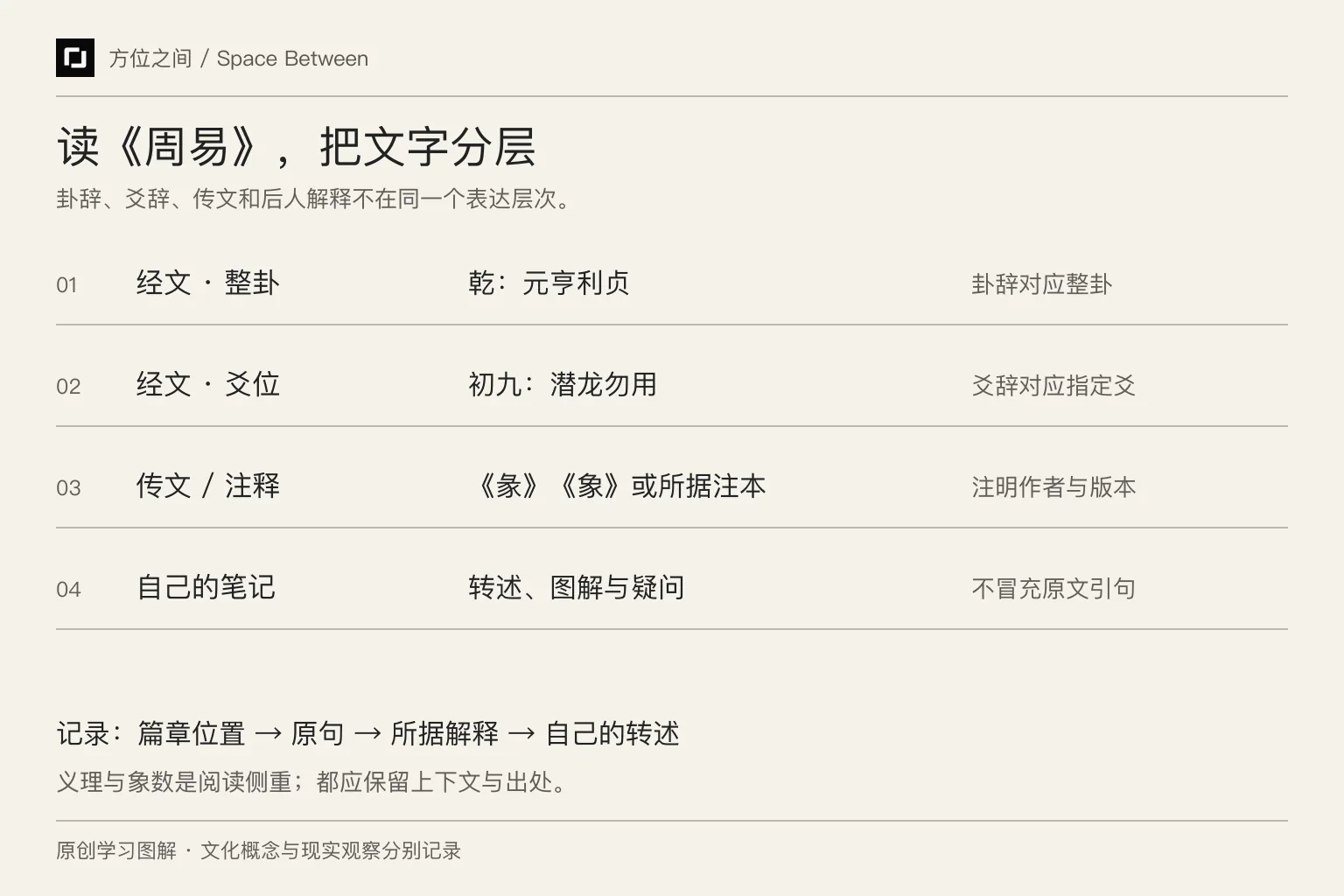
A judgment addresses a whole hexagram; a line statement belongs to a specified position. Tuan and Xiang are commentary layers, while modern translations and personal notes are later still. Qian’s opening judgment and its first-line statement have different scope. Keep four fields: textual location, original phrase, cited commentary and your paraphrase. Never present a paraphrase as a verbatim quotation.
Read the full explanationHow do the original hexagram, moving lines and resulting hexagram relate?
The original figure precedes the change; moving lines are designated positions; the resulting figure flips their polarity. In a common 6/7/8/9 convention, 6 and 9 change while 7 and 8 remain. State the casting method. With multiple moving lines, flip all designated positions before naming the result. Choosing texts to interpret multiple changes depends on the method and is not settled by the diagram alone.
Read the full explanationWhat do philosophical and image-number approaches examine?
Philosophical readings often examine situation, timing, conduct and values; image-number readings focus on figures, sequences, positions and correspondences. These emphases overlap and are not a simple science-versus-superstition split. Read the wording and context first, then identify the diagrams or correspondences a particular author uses. Do not collapse different authors into one universal formula.
Read the full explanationHow should I verify a sourced explanation of a hexagram?
For “Qian, first nine,” verify six yang lines and the bottom position, read that line, then consult its Xiang or a named commentary. Record title, chapter, edition, link and access date before writing your own interpretation and questions. Typography alone does not identify textual authorship. Compare disputed readings in context rather than relying on a search snippet.
Read the full explanationHow do upper and lower trigrams form 64 hexagrams?
Eight lower trigrams combined with eight upper trigrams yield 64 figures. In our table rows are upper and columns lower: Qian above Kun is Pi; Kun above Qian is Tai. Exchanging positions changes the hexagram. A combination table identifies a figure; the received sequence orders chapters. That sequence is not ascending binary order.
How do judgments, line statements and later commentary differ?
 Enlarge diagram
A judgment addresses a whole hexagram; a line statement belongs to a specified position. Tuan and Xiang are commentary layers, while modern translations and personal notes are later still. Qian’s opening judgment and its first-line statement have different scope. Keep four fields: textual location, original phrase, cited commentary and your paraphrase. Never present a paraphrase as a verbatim quotation.
How do the original hexagram, moving lines and resulting hexagram relate?
The original figure precedes the change; moving lines are designated positions; the resulting figure flips their polarity. In a common 6/7/8/9 convention, 6 and 9 change while 7 and 8 remain. State the casting method. With multiple moving lines, flip all designated positions before naming the result. Choosing texts to interpret multiple changes depends on the method and is not settled by the diagram alone.
Example: what happens when Qian’s bottom line changes?
Record 9,7,7,7,7,7 from bottom to top. Only the bottom 9 changes to yin: the lower trigram becomes Xun, while the upper remains Qian, producing Gou, Heaven over Wind. Keeping the original numbers explains which line changed. Reversing their order changes the top line instead and produces a different figure. This is a diagram check, not a personal prediction.
What do philosophical and image-number approaches examine?
Philosophical readings often examine situation, timing, conduct and values; image-number readings focus on figures, sequences, positions and correspondences. These emphases overlap and are not a simple science-versus-superstition split. Read the wording and context first, then identify the diagrams or correspondences a particular author uses. Do not collapse different authors into one universal formula.
How should I verify a sourced explanation of a hexagram?
For “Qian, first nine,” verify six yang lines and the bottom position, read that line, then consult its Xiang or a named commentary. Record title, chapter, edition, link and access date before writing your own interpretation and questions. Typography alone does not identify textual authorship. Compare disputed readings in context rather than relying on a search snippet.
Sources and further reading
These sources help clarify the concepts and their origins. Explaining a traditional term does not establish that it can predict outcomes.