
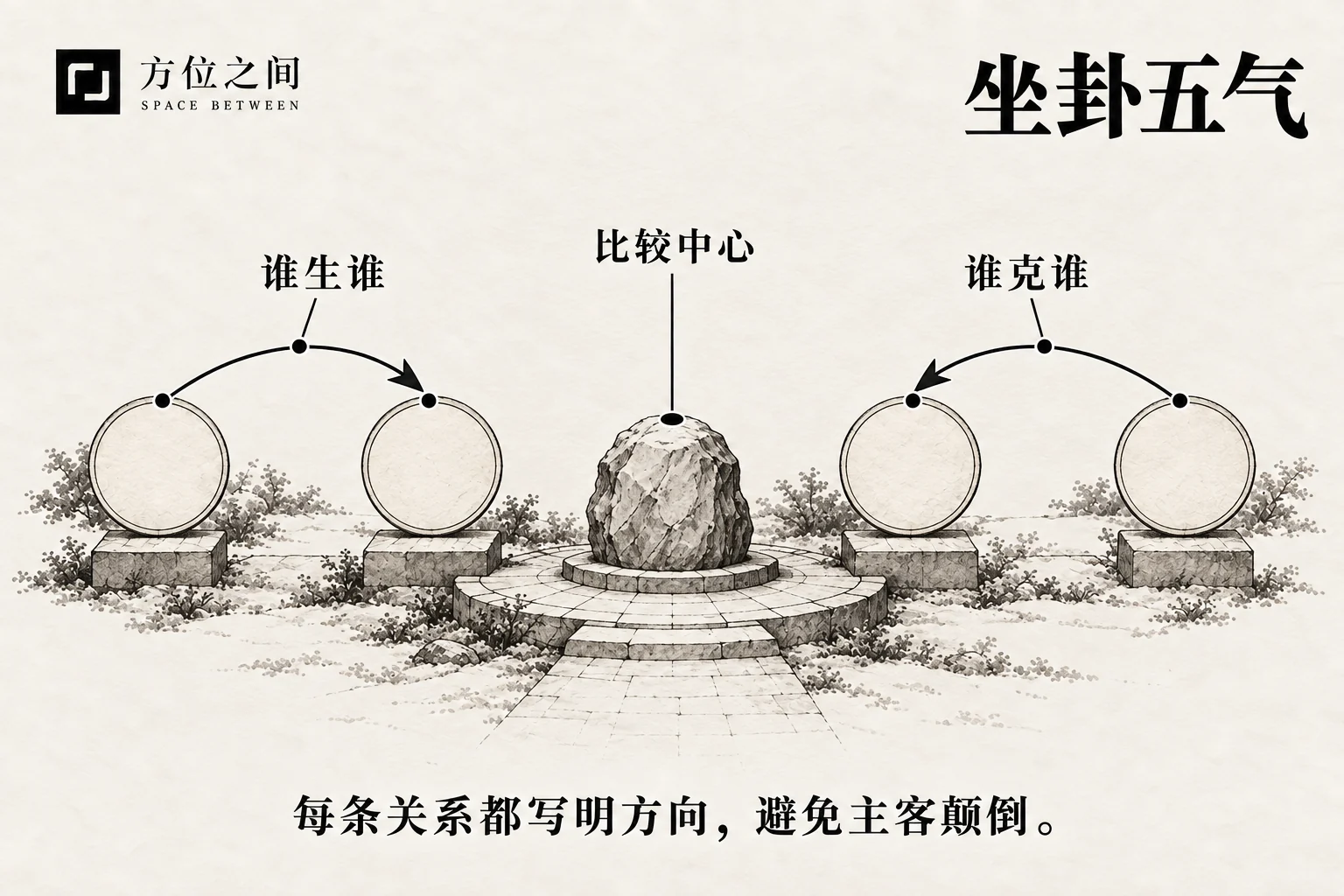
Define the sitting trigram and comparison reference
The sitting trigram follows the trigram containing the house’s sitting direction; it should not be replaced by the location of a door. Record how that direction was established and whether it describes the building or the individual dwelling. A method that brings the sitting trigram’s home-palace star to the center must also specify its starting star and distribution direction. Those steps locate the arriving stars. Here we discuss only the resulting relationships with the central phase as reference, not a complete chart shared by every school.
Expand five labels into directed relationships
The naming convention used here is: an arriving phase generating the central phase is sheng qi; the same phase is wang qi; an arriving phase controlling the center is sha qi; the center controlling the arriving phase is si qi; and the center generating it is tui qi. Generating and controlling are traditional classification relations, not measurements of air or energy. Xie Ji Bian Fang Shu provides background for the five-phase relations, but does not thereby authenticate this entire modern label set as its wording.
A checkable example with wood as reference
Suppose the chosen central star is wood and an arriving star is water. Water generates wood, so this convention labels the relation sheng qi. An arriving metal star controls wood and is labeled sha qi. Fire receives generation from wood and is tui qi; another wood is wang qi; earth, controlled by wood, is si qi. First write the direction, such as water → wood, then add the label. This exposes the error caused by reversing water and wood.
Shared names do not imply identical meanings
Here wang means a same-phase relation; it does not automatically mean a star is timely in a Xuan Kong period. Nor is this sheng qi automatically the sheng-qi direction of Eight Mansions wandering-star rules. Adding period strength requires a separately stated period and rule rather than silently upgrading a label. Historical discussions of host and guest already distinguish the comparison standpoint; modern charts should retain that premise.
Separate cultural labels from observations of a home
These terms explain how a relational chart is constructed; they do not establish that a corner attracts wealth, harms health or changes relationships. When comparing homes, keep a separate record of observable conditions: blocked routes, dim rooms and sources of noise. The two records may be read together, but traditional words such as sha and si cannot replace evidence or justify negative labels for residents.
Sources and further reading
These sources help clarify the concepts and their origins. Explaining a traditional term does not establish that it can predict outcomes.