
Defining features
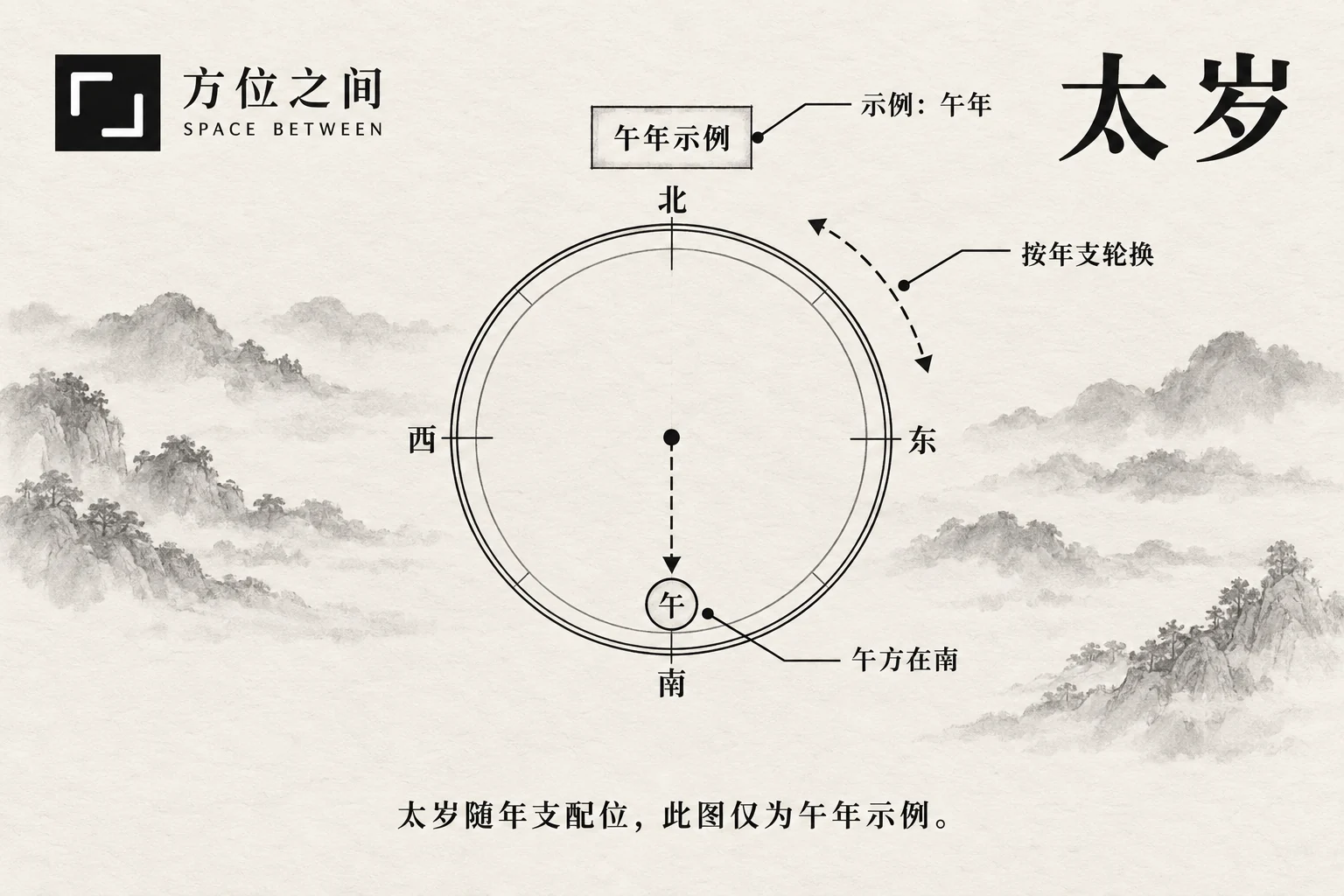
In the annual-deity system, Tai Sui follows the year branch through a twelve-year cycle: Zi years correspond to Zi, Chou years to Chou, and so on. Traditional construction-date selection gives it authority over the year and cautions against disturbance. This symbolic position is not Jupiter’s current bearing in the sky and cannot be located by pointing a phone upward.
How to recognize it
Keep the target date, time zone and year-boundary convention. A Lichun boundary requires the precise solar-term transition; a lunar New Year boundary must be identified separately. For example, once a Wu year is established, Tai Sui is in Wu, the southern Wu sector. In a twenty-four-mountain scheme, the whole southern side is not one precise mountain sector.
Common confusions
“Offending Tai Sui” can also refer to a birth branch’s relationship with the current year. That is a different question from a wall facing its direction. Tai Sui, Sui Po and the Three Sha use different rules. Without a north reference, a defined center and a declared year boundary, the diagram cannot support a reliable directional label.
Folklore and sources
Volume 3 of Xieji Bianfang Shu records Tai Sui’s branch-by-branch movement and distinguishes it from Jupiter. Its prohibitions belong to historical date-selection traditions. The Hong Kong Observatory explains lunar-year and Lichun boundaries, helping check time inputs; this does not demonstrate a measurable disaster-causing force in the Tai Sui direction.
Traditional responses and practical improvements
Respecting the year deity and limiting disturbance are customary wishes for peace; unobtrusive rituals may remain a personal preference. Renovation decisions still depend on structure, utilities, permits and scheduling. Repair leaks or electrical faults promptly instead of delaying because of Tai Sui. Recording the rule and source is more useful for understanding the tradition than buying a prescribed charm.
Sources and further reading
These sources help clarify the concepts and their origins. Explaining a traditional term does not establish that it can predict outcomes.