
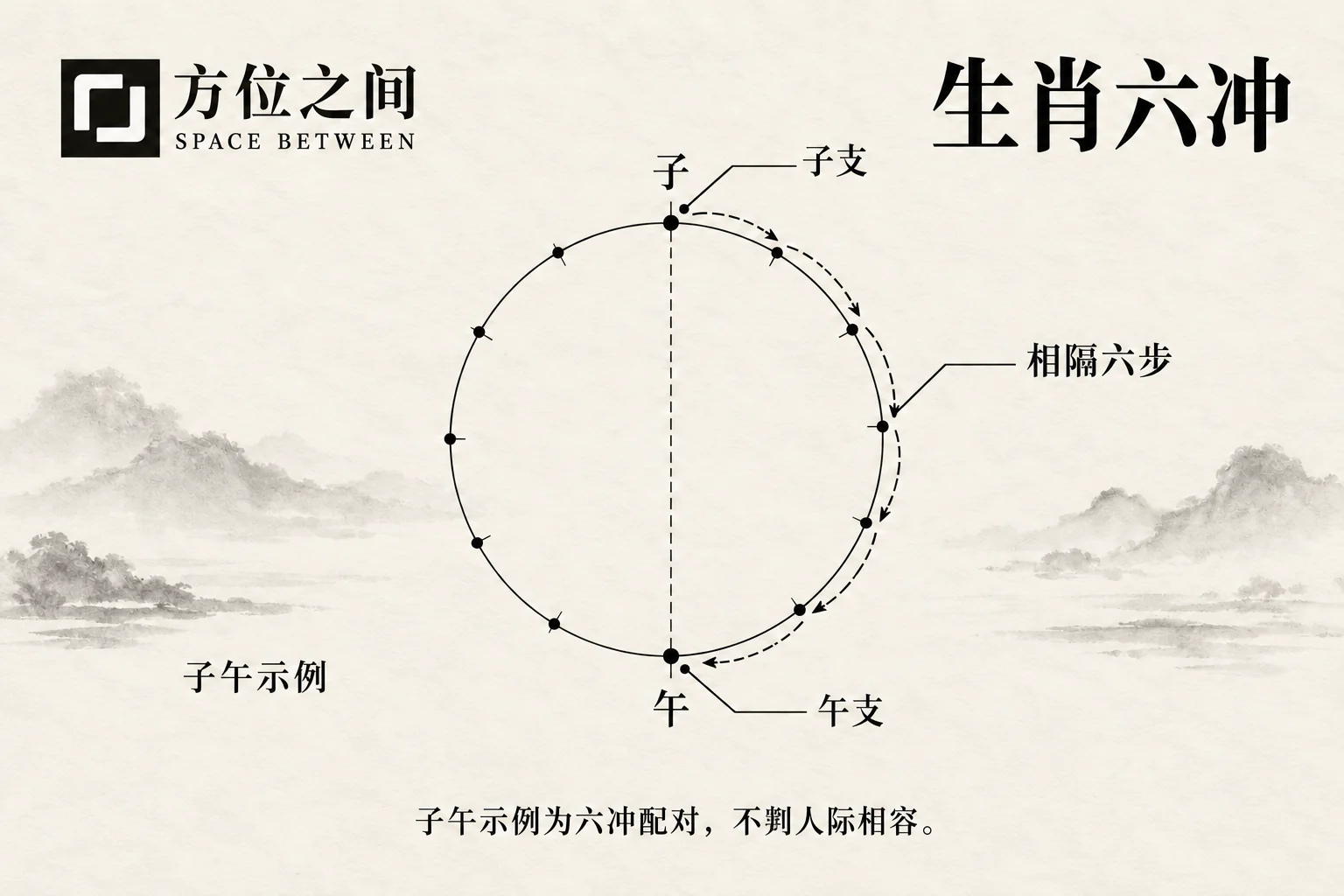
Defining features
The six pairs are Zi–Wu, Chou–Wei, Yin–Shen, Mao–You, Chen–Xu and Si–Hai. Each spans six steps on the twelve-branch circle, or seven positions if the starting point is counted. San Ming Tong Hui explains this opposition; it does not describe zodiac animals physically harming each other. A zodiac animal gives only a year branch, not the year stem or all Four Pillars.
How to recognize it
Ask whether the comparison concerns a birth branch and current year, two people’s year branches, or a day branch and zodiac. Someone established as born in Zi meeting a Wu year simply forms Zi–Wu at the year-branch level. A Wu day said to clash with Zi instead uses the day branch. Births near lunar New Year or Lichun require the original date and chosen year boundary.
Common confusions
Clash, punishment, harm, break and harmony are separate relationships. Repeating one’s birth-year branch is not opposition. Zodiac, building orientation and personal-gua unfavorable directions are not substitutes. Knowing that someone is a Rat does not establish a room’s Jue Ming direction, marriage prospects, character or job ability.
Folklore and sources
The “Clashes” section of San Ming Tong Hui, volume 2, uses the seventh counted position and itself allows conditional, non-universal interpretations. Hong Kong Observatory material distinguishes lunar-year and Lichun boundaries. These sources preserve traditional thought and calendar facts, not a statistical study validating relationships by zodiac pairing.
Traditional responses and practical improvements
Date selection, ornaments and rituals can be voluntary cultural expressions of care. Major decisions should still follow real relationships, health, schedules and contractual conditions. Do not exclude colleagues, dictate marriages or delay necessary matters because of a clash label. Clarify rules and facts when worried instead of purchasing expensive promises.
Sources and further reading
These sources help clarify the concepts and their origins. Explaining a traditional term does not establish that it can predict outcomes.