
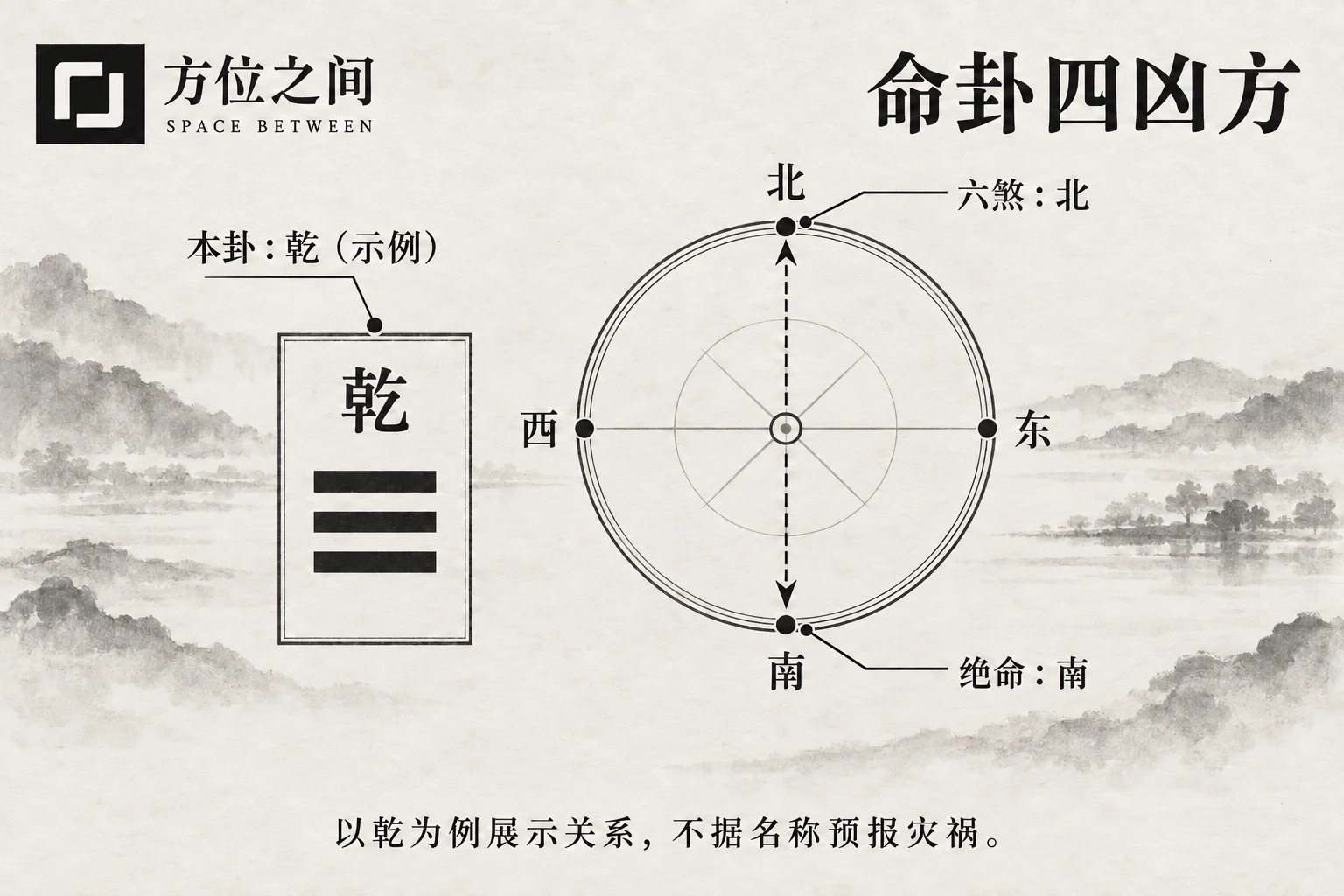
Defining features
Jue Ming, Wu Gui, Liu Sha and Huo Hai each retain their own name and direction rather than merging into a vague “bad sector.” They belong to Eight Mansions wandering-star rules, not the branch-based Three Sha or annual Five Yellow. Different labels for one direction in different tables are not necessarily a calculation contradiction.
How to recognize it
With Qian already established as the base gua, Ba Zhai Ming Jing’s verse gives Li as Jue Ming, Zhen as Wu Gui, Kan as Liu Sha and Xun as Huo Hai: south, east, north and southeast. This checks a relationship table, not anyone’s personal gua. Personal calculations require the birth-year boundary, traditional male/female sequence and the rule assigning central 5 elsewhere.
Common confusions
A house gua comes from sitting/facing orientation; a personal gua uses traditional birth-data rules. A house sitting Qian does not make every resident a Qian person. Record door position, bed position and the person’s facing direction separately. Jue Ming predicts no lifespan, Wu Gui proves no ghosts, Liu Sha is not the Three Sha, and Huo Hai is not an existing accident.
Folklore and sources
Ba Zhai Ming Jing preserves the wandering-star verse and personal-gua methods for checking these assignments. Other interpretations add doors, principal rooms, stoves or building depth; one label is not a complete assessment. This article examines traditional tables and names without turning their fortune language into definite illness or family predictions.
Traditional responses and practical improvements
Choosing seats, bed directions or favorable sectors by a base gua is a symbolic preference. It can remain a personal choice when access, light and comfort are preserved. Do not block an emergency exit, move a bed under a leak or impose lasting inconvenience to pursue a direction. Keep missing data unknown instead of guessing a precise-looking answer.
Sources and further reading
These sources help clarify the concepts and their origins. Explaining a traditional term does not establish that it can predict outcomes.