
Name and background
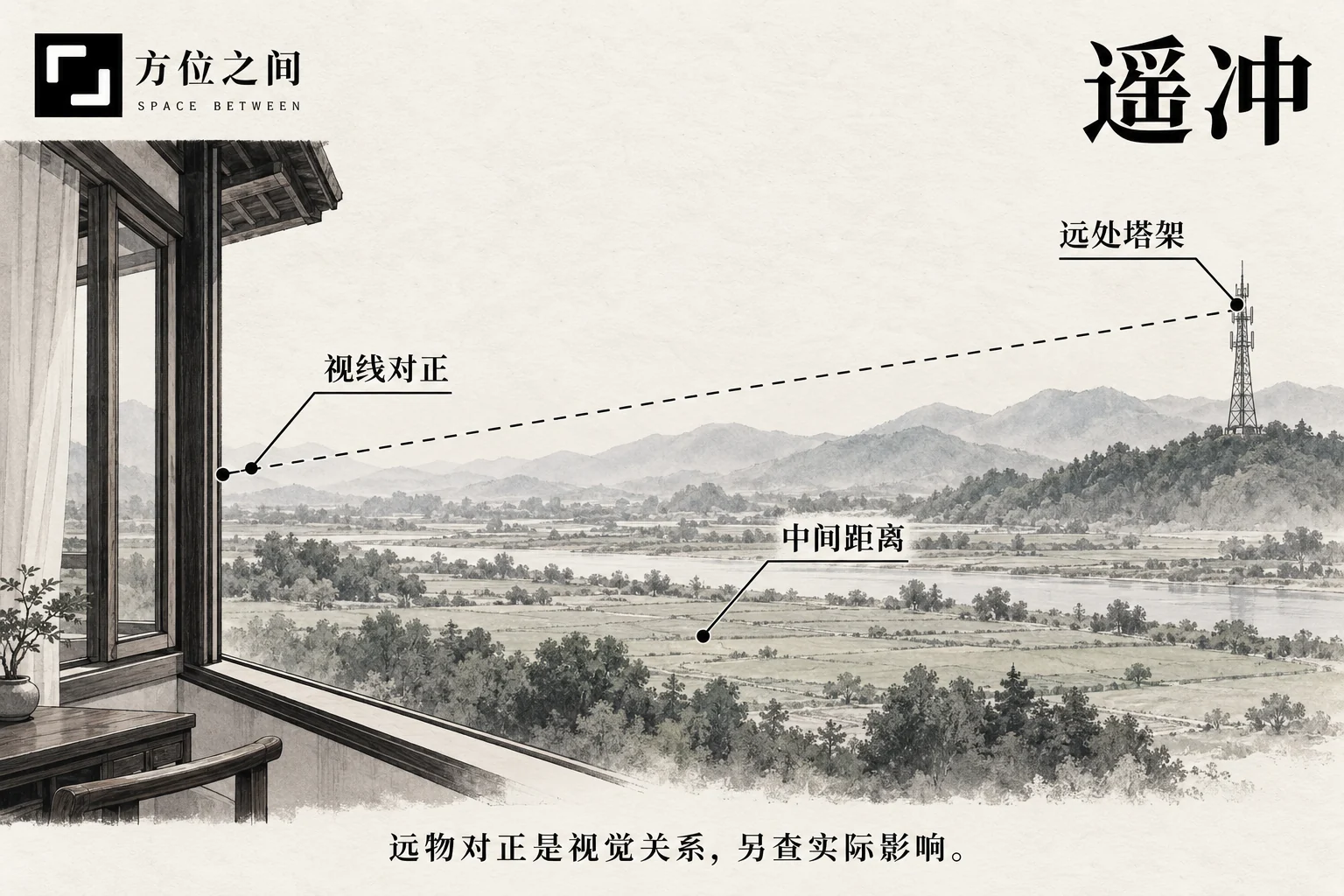
Distant alignment is not an ancient category with an established universal distance limit. Here it describes vertical features aligned with openings. Towers, chimneys, water towers, and monuments may look similar while serving different purposes. Identify the object before treating every slender skyline feature as an attack or a sign that a home is unsuitable.
Typical form and comparisons
A typical view has a nearby window frame, city blocks in the middle, and a distant tower, with all three depths evident. Alignment from the desk may change beside the window or in another chair. The tower stays the same; viewpoint changes. This helps distinguish composition from actual environmental effects.
A telephoto image can enlarge a distant feature and remove surrounding references, making it seem closer. Preserve its actual visual proportion if it is a small mark in the view. A tip mostly screened by another building differs from a nearby full tower dominating the window.
Traditional reasoning and modern observations
Traditional imagery may compare upright pointed forms to arrows or spears, but also graceful upright forms to a scholar’s brush. Interpretation is not simply that visibility is inauspicious; schools consider form, direction, and distance differently. The name emphasizes alignment without turning metaphor into a physical force spanning any distance.
Modern assessment asks what actually reaches the home: light needs an entering path, sound an audible record, and emissions require source, weather, and receptor information. EPA dispersion guidance estimates downwind concentrations from emissions and meteorological inputs, not whether a chimney shares a line with a window frame.
How to identify it
Create a repeatable view record before deciding whether there is another issue. No universal auspicious distance applies to all towers, and distant visibility does not automatically mean continuing exposure.
- Take normal-view photographs from the usual seat and window, retaining frame, foreground, and horizon, and mark the positions rather than isolating an enlarged tower.
- Use maps to check distance and facility purpose, distinguishing chimneys, communications towers, monuments, and construction cranes; silhouettes do not show operating status.
- If there is flashing, sound, or odor, record time, weather, window state, and room. Keep observations even outside the aligned window so the name does not narrow the investigation.
Common points of confusion
Distant alignment is not a measurement of electromagnetic exposure, pollution, or structural safety, nor a nearby post obstructing access. Seeing a chimney does not prove emissions enter the home; seeing no smoke does not rule out all air problems. A photograph placing a tower tip above a bed does not put the tower physically over it. For alignment alone, return to actual scale and experience.
Effects described in traditional beliefs
Bai Heming’s Illustrated Feng Shui: 100 Examples includes both injury imagery for an aligned iron tower and favorable study imagery for a scholar’s brush. Slender forms therefore receive different interpretations. Auspicious and inauspicious meanings belong to their symbolic contexts, rather than mechanically classifying the same vertical line; they do not predict a household’s experiences.
- Injury imagery: when an iron tower is interpreted as an attacking form, the material associates it with bodily harm; it does not establish an identical range for every distant tower.
- Scholar’s-brush imagery: slender forms can also express hopes for academic success. This contrasting image shows why an object name and one alignment line cannot summarize traditional interpretation.
Traditional remedies and practical improvements
Start with what affects daily use: adjust the view if appearance is the only concern, and address light, sound, or emissions separately when evidence exists. Alignment does not make a distant facility something that must be removed; keeping a view you like is equally reasonable.
- If a tower tip distracts you at the desk, shift the seat or turn the desk toward trees or sky, then compare comfort during ordinary work.
- If distant flashing actually enters a bedroom, use suitable blinds or local shading at the light path and record nighttime periods; hiding the tower and reducing light intrusion are different aims.
- For a shop or studio needing display and daylight, adjust reception seating or partial window treatments rather than darkening the whole façade because of alignment, and avoid reflecting strong light at neighbors.
- For odors or recurring fumes, retain time, wind direction, and location records for the facility operator or environmental authority. Ventilation must consider outdoor air; plants and curtains do not replace source control.
- If checking reveals only geometric alignment without a specific disturbance, retain the layout rather than buying supposed long-distance sha blockers. If professional measurement is needed, first specify light, sound, or air as the question.
Illustrative example
Hypothetical example: a studio desk aligns through a window with a tower several blocks away. Phone zoom makes it appear close, though it occupies little of the real view. A side seat removes alignment, with no discernible daytime light or sound issue. Nighttime glare at another window comes from a nearby sign, so shading is adjusted there. The tower needs no treatment, while the actual light source receives a targeted response.
Sources and further reading
These sources help clarify the concepts and their origins. Explaining a traditional term does not establish that it can predict outcomes.