
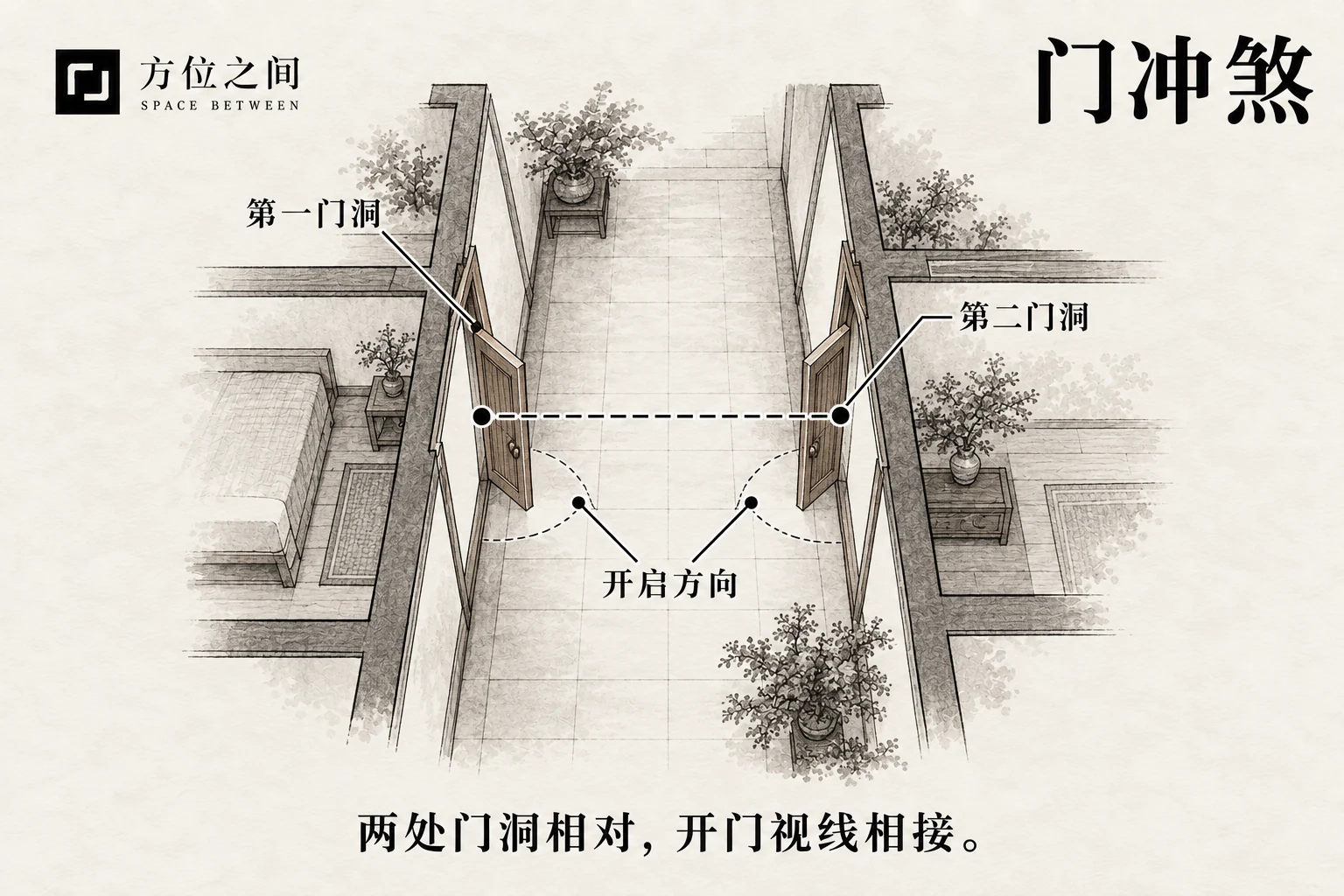
Name and background
Here, “clash” names a face-to-face spatial relationship; it does not make the person opposite an aggressor. Opposing room doors often occur in short halls, while neighboring front doors involve shared space. A rarely opened storage door and a living-room door left open daily also create very different patterns of contact.
Typical form and comparisons
The typical form has substantially overlapping doorway projections, allowing someone in one room to see the other room’s bed, seat or activity directly. Matching centerlines are the clearest example; with partial overlap, describe what is actually visible. Doors opening into their respective rooms do not collide merely because the openings face each other. Collision depends on swing arcs, not centerlines alone.
Traditional reasoning and modern observations
Tradition sees a doorway as a mouth for qi, explaining this taboo through competing mouths or conflicting intake. Within a family, the opposition becomes an image of arguments; between homes, one side is said to gain at the other’s expense. Curtains and internal screens traditionally soften the direct exposure, rather than requiring either household to overpower the other.
Modern checks concern privacy, door noise, light and passage use. With both doors open, movement on one side may enter the other person’s view; whether this is troublesome depends on distance, schedules and furnishing. Closing a door or moving a seat changes these conditions. Opposing openings alone do not predict family conflict, and keeping doors shut permanently is not the only answer for everyone.
How to identify it
Look from both sides and record who experiences which effect and when. A photograph of doors taken only from the hall often misses the actual occupied positions inside.
- Mark opening edges, centers and separation on a plan. Distinguish full opposition, partial overlap and clear offset; do not replace real widths with infinitely extended lines.
- Open both doors as normally used and sit by the bed or desk. Check whether changing, sleeping or working positions are directly exposed from across the hall.
- Draw door swing arcs and walk the passage. Record whether a door is fire-rated, a communal exit or a bathroom door, since these functions determine suitable changes.
Common points of confusion
Two opposing doors are different from a front-to-back line through the entire home. An entrance facing a lift also involves a shared waiting area; a bathroom opposite another door calls for separate checks of extraction, odors and cleaning. Seeing a wall edge after offsetting a door does not establish a more severe “blade.” Names can describe different objects without adding up to escalating predictions of misfortune.
Effects described in traditional beliefs
Duoneng Bishi records a taboo concerning opposing room doors, while Lin Songwei’s signed column explains contemporary interpersonal readings. The following are folk beliefs, not grounds for attributing disputes to doors or holding the other household responsible.
- Within a family: occupants of opposing rooms are said to argue or disagree, often illustrated by parents’ and children’s rooms. The symbolism is of two positions facing off.
- Between neighbors: competing for qi and one household advancing as the other declines are common readings, accompanied by fears of disputes. This reflects an idea of rivalry between entrances, not an actual transfer of financial fortune to a neighbor.
Traditional remedies and practical improvements
Responses can start with screening, moving occupied positions and agreeing on use. Relocating a door is a larger intervention to consider after furniture and everyday habits, and a remedy for one home should not create problems for the other.
- When bedrooms expose each other’s beds: move the bedhead or usual desk seat out of the direct doorway view, or add a short screen inside. Protect private activity while keeping the full access route clear.
- When furniture cannot move: fit an internal fabric curtain that does not obstruct door closure, or agree on closing times around daily routines. A curtain mainly screens views; it does not replace a door’s acoustic or fire-protection functions.
- Where doors or circulation genuinely interfere: have suitable personnel check hinges, closers and opening direction, assessing relocation if needed. Do not remove fire-door closing devices or arbitrarily change a door to swing into a communal corridor.
- When neighboring front doors face each other: keep the entrance buffer within your own boundary and discuss door noise, waiting visitors and shoe storage. Do not direct reflective mirrors at the neighbor or occupy shared space with protective objects.
- For a traditional wish for harmony: Lin Songwei proposes plants beside doors. A few can be placed inside where light is suitable and passage stays clear, forming a gentler visual boundary. Plants do not guarantee dispute resolution, complete air purification or sound isolation.
Illustrative example
Example: parents’ and an adult child’s rooms face across a hall. With both doors open, their beds are visible, but the doors do not collide. Each side shifts its bed or desk slightly and agrees to close doors during rest and use internal curtains while ventilating. This hypothetical example addresses visibility and schedules; it assumes neither existing arguments nor guaranteed harmony afterward.
Sources and further reading
These sources help clarify the concepts and their origins. Explaining a traditional term does not establish that it can predict outcomes.