
Definition and subject
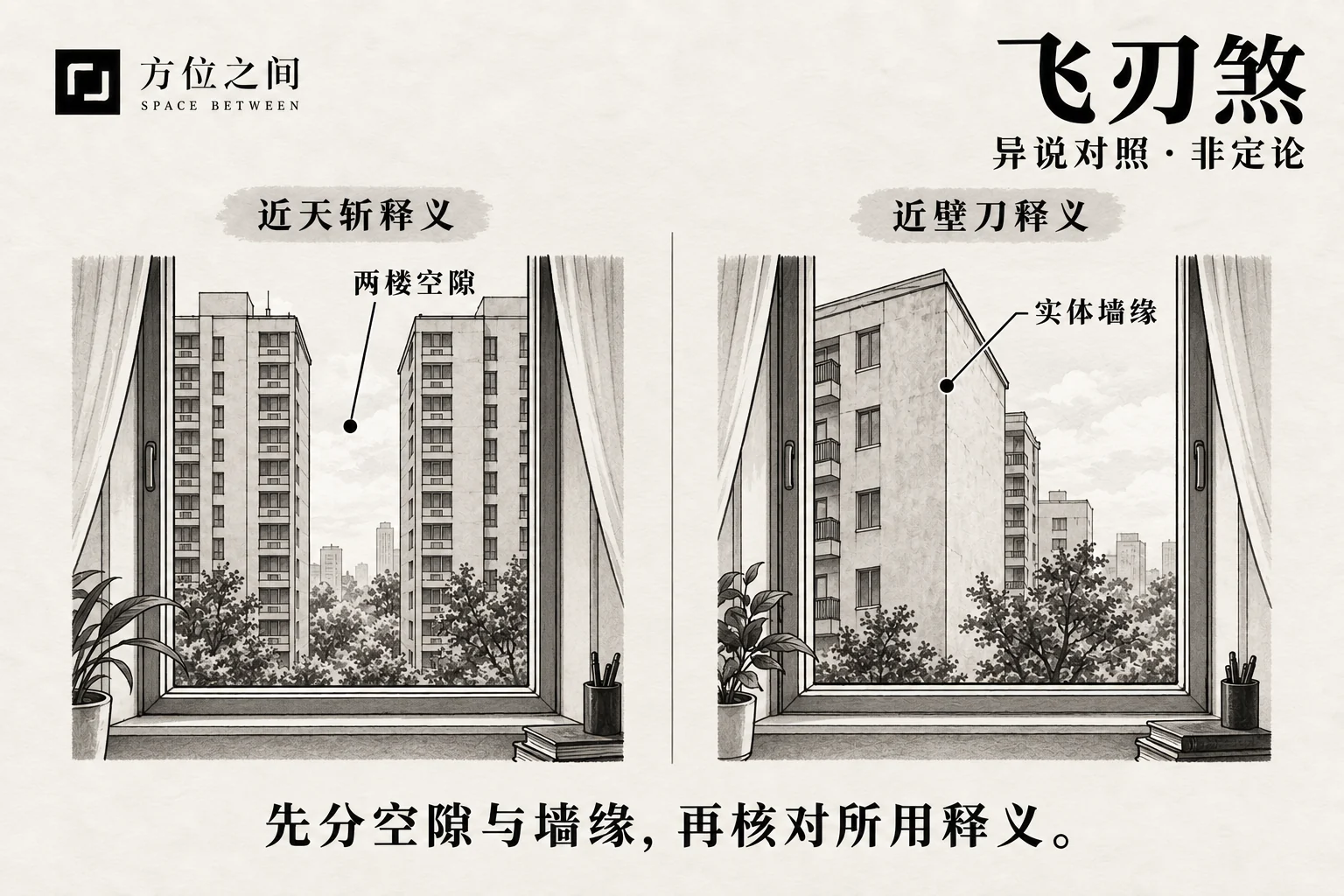
Here, Feiren sha refers to a long narrow gap between neighboring buildings that appears blade-like when viewed from a door or window. Other accounts use the name for a wall edge or projecting end, so the term alone does not specify one shape. The main example uses the space between two buildings, with a solid wall edge shown separately; neither is drawn as a literal flying knife.
How to identify it
From a regularly used window, first identify the physical objects creating the outline: is there a gap between two buildings, or only the edge of one side wall? Record the gap's visible height, width, distance, orientation, and tree screening, then check from another angle. A dark vertical strip in a photograph may be a shadow or facade groove rather than a real passage between buildings.
Versions, folk interpretations, and source limits
The blade metaphor is often extended into injury, disputes, or unsettled fortune. This is folk rhetoric, not an accident prediction. Flying in the name does not mean an object is approaching, and illustrations should not add hovering knives or energy beams. Current material does not establish one cross-school definition. Preserve the object described by the source instead of inventing a separate misfortune to justify another name.
What to check in the actual setting
For a gap between buildings, practical observations include the view, daylight, privacy, and actual air movement. A nearby wall edge also raises questions of contact and maintenance. Gap geometry alone cannot establish wind speed, noise, falling-object risk, or residents' health. Separate what is visible from disturbances that actually occur, recording location, timing, and duration.
Practical improvements and the limits of remedies
For visual unease alone, adjust a usual seat or use appropriate curtains while retaining necessary daylight and ventilation. Record persistent wind noise, falling objects, or maintenance issues and report them to the manager. Do not obstruct a shared gap, build across boundaries, or direct reflected light at neighboring windows. Improvement should address experience and condition, not promise that hanging an object removes a blade.
Similar names and common confusions
The narrow space between two tall buildings substantially overlaps with Tianzhan sha; its detailed checks are relevant. A single side-wall edge is closer to Bidao, or wall-edge sha. This independent Feiren page preserves the competing meanings so readers can identify their object first. It is not a third layer added to narrow-gap and wall-edge effects, nor is it the same as a road described as cutting like a knife.
Sources and further reading
These sources help clarify the concepts and their origins. Explaining a traditional term does not establish that it can predict outcomes.