
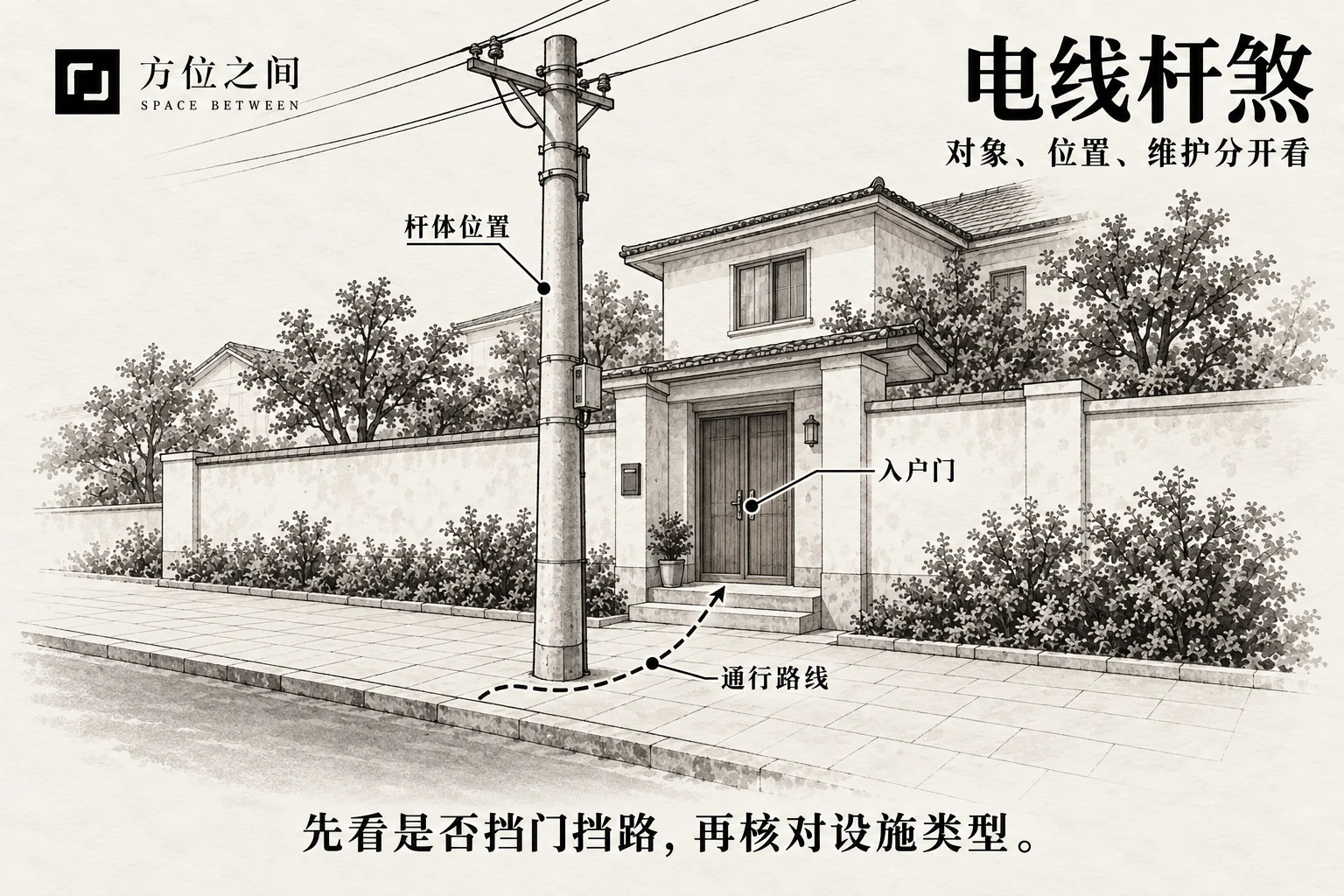
Definition and subject
In modern residential writing, this name usually refers to a utility pole in front of doors or windows, with the pole or attached cables in the main view. It may share the obstruction geometry of a pillar facing a door, or simply be distant public infrastructure. Identify whether it carries power, communications, lighting, or is disused. Similar shapes do not establish identical electrical status or effects.
How to identify it
View the pole from inside and outside the entrance. Record whether it obstructs the door swing, access route, junction sightlines, or signage. Record attached equipment, guy wires, and line heights without approaching or touching them. Keep scale and surrounding roads in photographs rather than using a long lens that visually brings a distant pole to the door. Report leaning, damage, or drooping cables to the responsible manager.
Versions, folk interpretations, and source limits
A pole in front of an entrance may be called Dingxin, pillar-facing-door, or utility-pole sha. Overlapping names do not give one pole multiple layers of fortune or misfortune. Folk unease about a pole is sometimes expanded into predictions of illness or family conflict, which are not established facts. High-voltage lines, communications cables, and lighting poles should not all be assessed using one supposed magnetic-sha rule.
What to check in the actual setting
Practical checks concern access and sightlines, then the facility and environmental conditions. WHO material distinguishes frequency and actual exposure; seeing wires alone cannot determine an individual's health. A changing phone-compass reading is not an appropriate exposure measurement. For a real equipment concern, identify the equipment and site conditions and use the relevant professional channel to verify it.
Practical improvements and the limits of remedies
If access is obstructed, first remove your own entrance clutter and review furniture and usual access arrangements, retaining sightlines for approaching people and traffic. Public poles and lines must be handled through the property owner, manager, or utility. Do not relocate poles, remove wires, or attach objects yourself. Small visual screens must not obscure road visibility or be claimed to block every equipment-related effect.
Similar names and common confusions
Pillar-facing-door sha describes a geometric relationship; this entry adds the utility identity. Wugong concerns repeated crossarms, while distant alignment concerns a remote object. A load-bearing column without cables belongs to a structural discussion. A functioning pole beside the entrance that obstructs nothing need not be altered solely because of an old name. Separate object, position, and maintenance instead of accumulating labels.
Sources and further reading
These sources help clarify the concepts and their origins. Explaining a traditional term does not establish that it can predict outcomes.