
Definition and subject
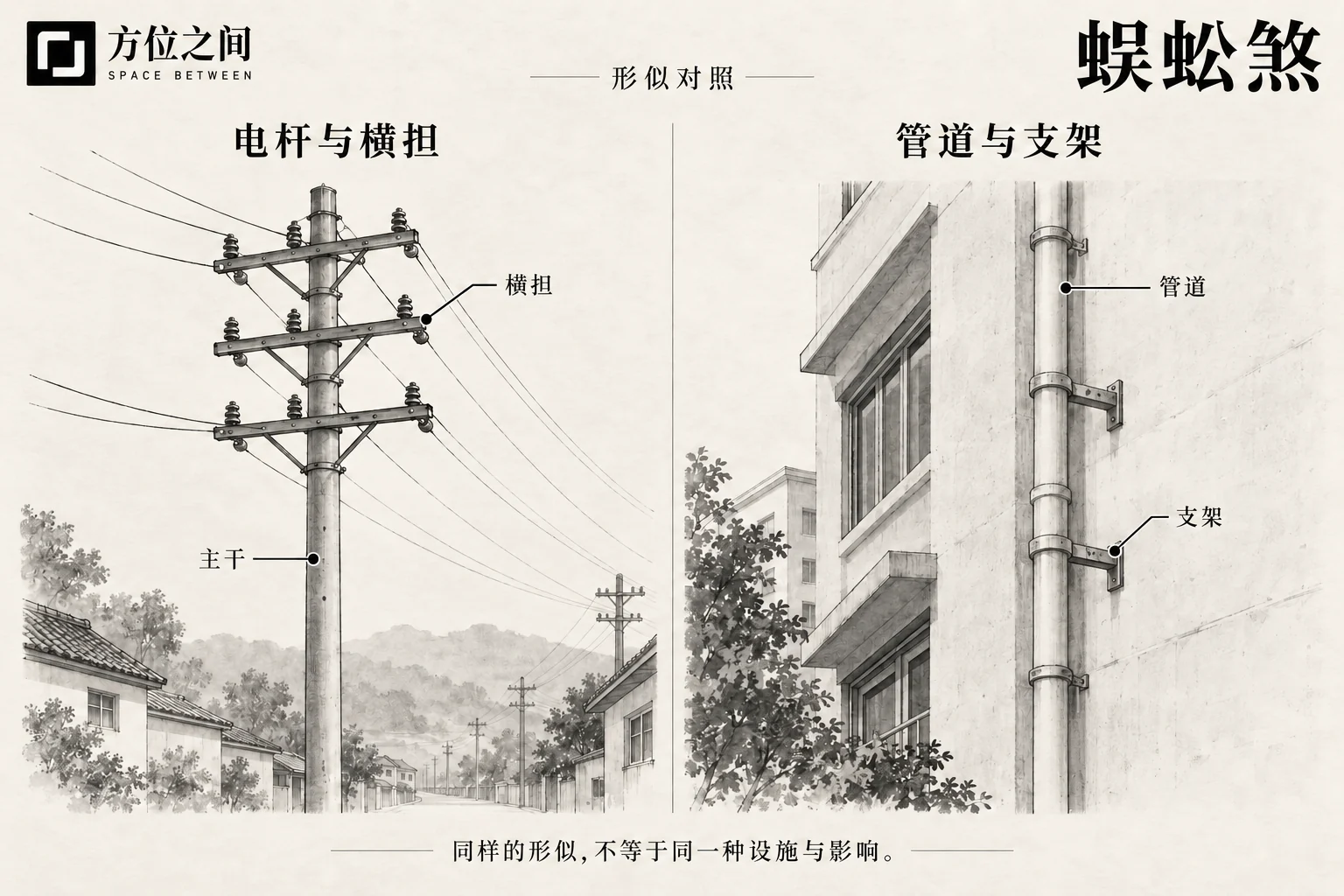
Wugong sha commonly likens a main spine with repeated projecting parts to a centipede's body and legs: utility-pole crossarms, exposed pipe brackets, or repeated side projections are examples. This article uses that visual interpretation without treating every cable, ladder, or railing as the same kind of object. Resemblance alone does not establish its material, purpose, or effects.
How to identify it
From a safe public position, identify the spine and projections, photographing both the whole arrangement and details rather than an isolated fragment. Establish whether they belong to electricity, communications, plumbing, drainage, or decoration. Record proximity to windows, obstruction, movement, and maintenance condition. Do not touch, climb, or move unidentified cables; similar-looking lines need not have the same electrical status.
Versions, folk interpretations, and source limits
Folklore uses the insect-like image to express unease, and some retellings add arguments, illness, or household fortune. Different accounts describe different objects, so this page retains Wugong as a circulating name without inventing a single ancient diagram or fixed consequence. If the text describes water pipes but the illustration shows power lines, the subject has changed; a shared name does not resolve that difference.
What to check in the actual setting
Possible practical issues include blocked daylight, maintenance noise, pipe leaks, and loose supports, each requiring its own check. Electromagnetic fields must be discussed in relation to the equipment and exposure; WHO material cannot be reduced to a claim that all poles and wires pose equal risks. Centipede-like equipment can be well maintained, while equipment without that outline can have real defects. Resemblance is not an inspection.
Practical improvements and the limits of remedies
For a concern limited to the view, change the usual seat or use moderate screening. Report leaks, unusual movement, or detached components to the responsible manager with their location. Do not hang mirrors, ornaments, or plants from poles or pipes, or remove supports to alter the silhouette. Define the improvement in terms of access, sightlines, or maintenance rather than eliminating a shape.
Similar names and common confusions
The utility-pole entry concerns the pole's relationship with doors and windows; Wugong emphasizes one spine with many branches. They can overlap but are not synonyms. Fire-form may also be applied to equipment, yet it is a different, broad symbolic classification. A row of separate buildings without repeated projecting parts should be described by its actual layout rather than called a centipede merely because there are many of them.
Sources and further reading
These sources help clarify the concepts and their origins. Explaining a traditional term does not establish that it can predict outcomes.