
Definition and subject
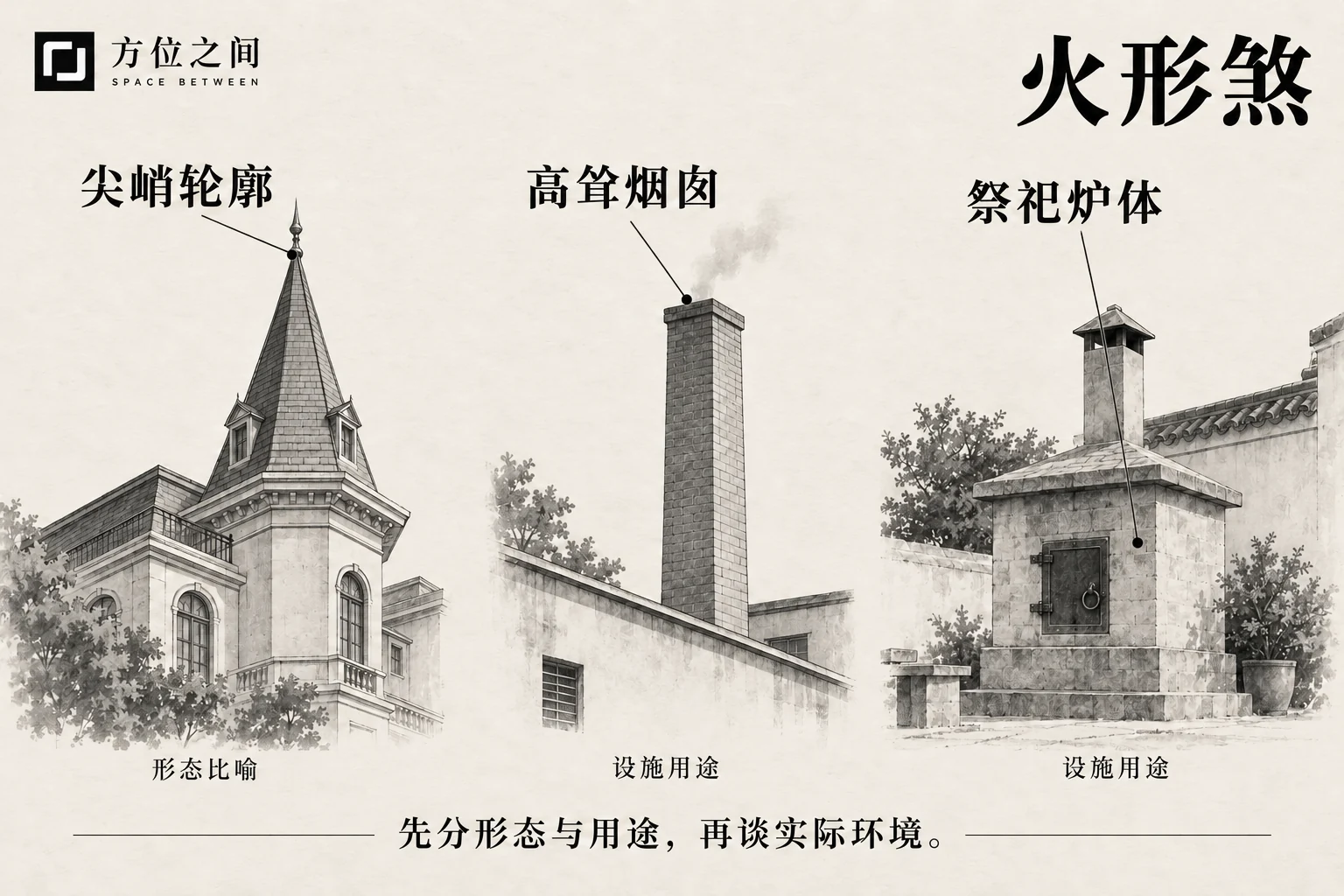
Fire-form sha has no single fixed geometry. Traditional landscape language may assign pointed, steep, or upward-tapering outlines to fire, while modern lists also include chimneys, incinerators, and certain electrical installations. The former is a shape metaphor; the latter names objects by their use or associations. A pointed building and an operating combustion facility should not be illustrated as sharing one physical mechanism.
How to identify it
First state which meaning is intended: a pointed roof, triangular end, or angular silhouette, or equipment actually used for combustion, heat, or electricity. For shape, record the tip, distance, orientation to openings, and obstructions. For equipment, separately record operation times and responsibility. A roof that does not point toward an opening cannot become a direct corner alignment simply through a tightly cropped photograph.
Versions, folk interpretations, and source limits
The traditional five-phase shapes are a language of analogy, comparing forms with wood, fire, earth, metal, and water. They do not imply a measurable fire-like substance in the material. Claims that a fire shape inevitably causes a fire, an argument, or a particular illness are unverified folk inferences. This page distinguishes meanings without assigning every pointed building the same consequence or claiming one exclusive ancient definition.
What to check in the actual setting
Separate visual experience, component stability, equipment heat, actual emissions, and electrical conditions. A decorative spire need not involve combustion, while a ritual furnace may burn offerings without having a pointed shape. Any practical issue must match the real object. Its silhouette cannot replace fire, building, or environmental checks, and an electrical appliance's installation requirements do not change when it is called fire-form.
Practical improvements and the limits of remedies
For persistent visual disturbance, consider seating, curtains, or small landscape adjustments. Ask the manager to inspect loose decoration; record times and conditions for questions about smoke or equipment operation. Do not add water beside electrical equipment, block cooling space, or alter wiring to enact a supposed elemental opposition. Symbolic objects cannot replace the facility's proper operating and maintenance conditions.
Similar names and common confusions
Sharp-corner sha concerns a tip facing an opening; Chongtian concerns a tall chimney; ritual-furnace sha concerns the use of a facility for burning offerings. They may intersect with fire-form but are not identical. An article or diagram should specify the object under discussion. An explanation saying only that fire is strong, without a location or object, is insufficient for a specific spatial change.
Sources and further reading
These sources help clarify the concepts and their origins. Explaining a traditional term does not establish that it can predict outcomes.