
Definition and subject
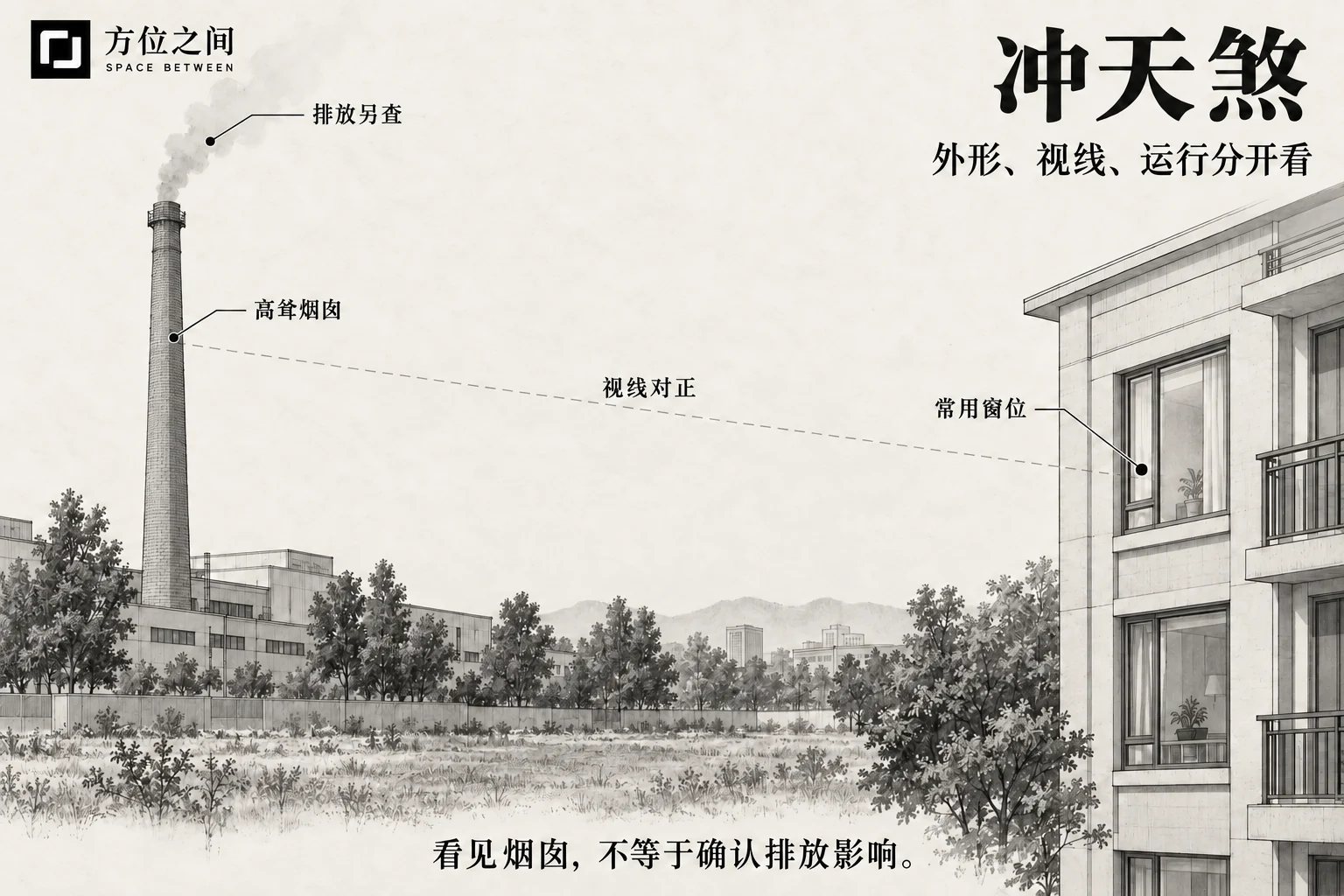
Here, Chongtian sha refers to a tall chimney visible in front of a home, taking its name from an upward-reaching silhouette. First confirm that the object is a chimney rather than a tower, ventilation stack, or disused monument. Height is a feature of its outline; alignment with a door or window is a separate relationship; operation and emissions are a third matter. One label cannot adequately describe all three.
How to identify it
Observe from a regularly used window or balcony. Record the chimney's position within the window frame, obstructions, and visible height, then check from the side whether it really aligns with the opening. Establish its operating status and note the dates, times, and wind direction when a plume is visible. A white plume does not reveal its entire composition, and one smoke-free observation does not establish permanent closure.
Versions, folk interpretations, and source limits
Modern fengshui writing sometimes groups chimneys under Chongtian or fire-form symbolism and associates them with emotions, finances, or misfortune. These are symbolic interpretations. No chimney height or distance threshold common to all versions has been established here, and the name is not attributed to an unverified ancient source. Explaining the association does not establish that a chimney harms the household facing it.
What to check in the actual setting
Separate an imposing view, night lighting, equipment noise, and emissions. EPA information identifies combustion and outdoor air as possible sources of indoor particles; it is not a test result for the chimney in front of you. Persistent effects require consideration of the facility's purpose, operating records, and relevant environmental investigation. Seeing it through a window cannot establish why an individual is ill.
Practical improvements and the limits of remedies
If the main concern is the view, adjust seating or curtains while retaining daylight and normal ventilation. If smoke or odors repeatedly reach the home, record the time, wind direction, and observations, notify the facility or property manager, and seek investigation suited to the actual issue. Screens, mirrors, and symbolic objects do not remove emissions. Do not seal necessary openings simply to hide the outline.
Similar names and common confusions
Chongtian emphasizes the tall chimney as an object; distant alignment emphasizes a remote object lining up with an opening. One chimney may fit both descriptions. Fire-form is broader and need not involve combustion. Overlapping names do not add up to greater danger. A disused chimney may present only a landscape relationship, so choose the explanation that matches its current condition.
Sources and further reading
These sources help clarify the concepts and their origins. Explaining a traditional term does not establish that it can predict outcomes.