
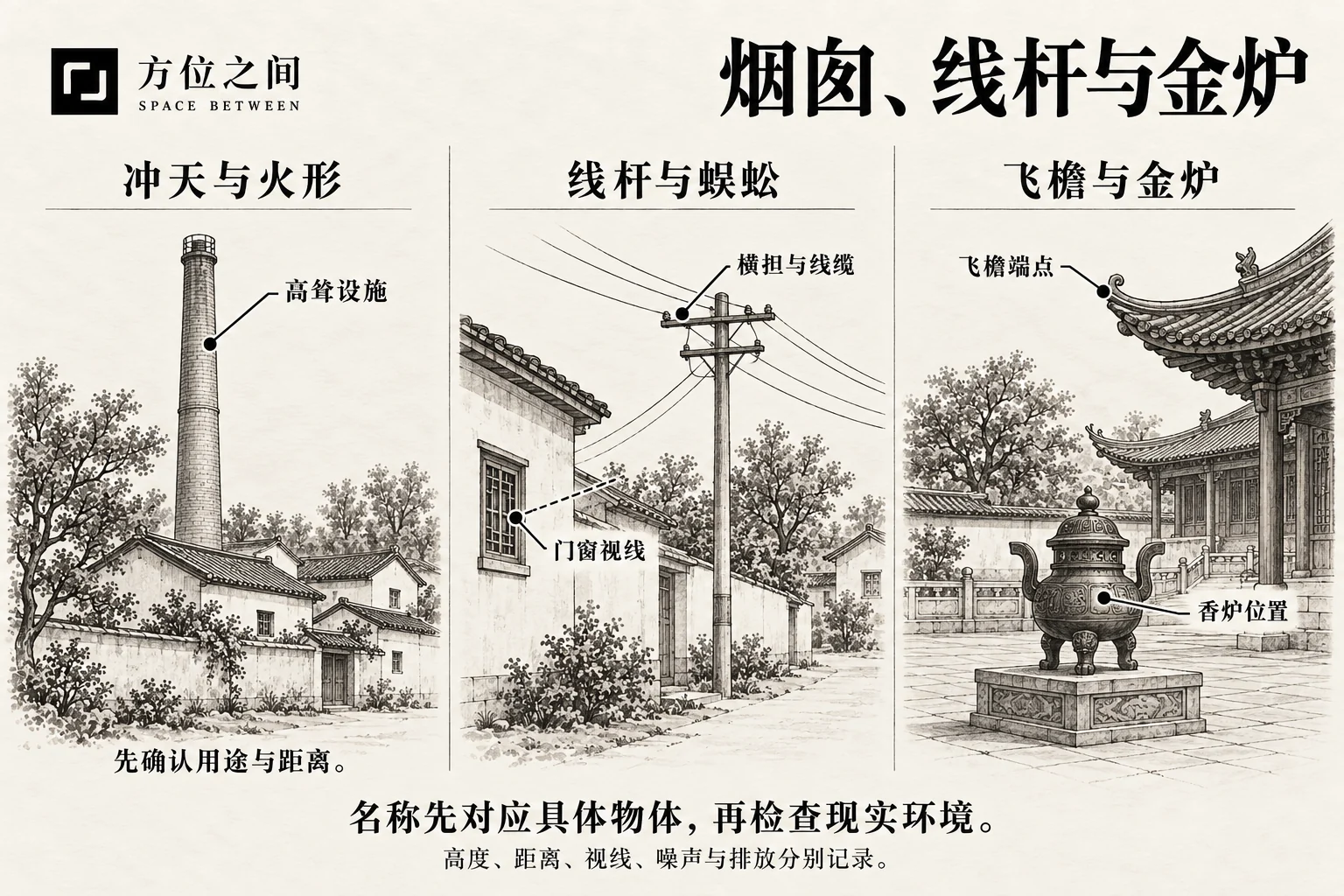
Name, characteristics and scope
Names such as soaring sha, centipede sha, fire-form sha and ritual-furnace sha often group together chimneys, utility poles, pointed elements and ritual burning facilities. Some names refer to visual resemblance, others to a facility's purpose; this does not establish a shared mechanism of danger. Identify the object first, then examine alignment, obstruction, emissions, noise or the actual equipment conditions separately to choose the relevant topic.
How to identify it step by step
Start from the position people actually use, recording shape, spatial relationship and duration separately. These checks distinguish conditions; they are not a universal formula for fortune.
- Soaring sha usually evokes a tall chimney; distant alignment concerns a faraway object lining up visually with a door or window. The same chimney may therefore receive both names.
- Centipede sha often compares utility-pole crossarms or rows of projecting components to a centipede. Confirm whether the object is a pole, wire or pipe; resemblance to an insect is not evidence of radiation.
- Ritual-furnace sha concerns burning furnaces near temples or shrines; projecting-eaves and animal-head sha concern the direction of eaves or ornamental ends. Separate a facility's function from a building's outline.
- Record distance, obstruction, whether smoke is actually present, and when it appears. Visual alignment in a picture is not a measurement of pollution exposure.
How to understand the folk account
Soaring and fire-form interpretations draw on symbols of height, points and fire, while centipede refers to appearance. Some accounts also place petrol stations, high-voltage lines and transmitting equipment under fire-form sha. This breadth does not establish that all such equipment has the same health or financial effects. Nor does the cultural meaning of ritual furnaces and temples prove that nearby residents will suffer misfortune.
What matters in present-day living
The visual effect of building edges, combustion smoke, electrical equipment and road activity are different issues. WHO information on electromagnetic fields discusses frequency and exposure; seeing a wire cannot establish an individual's illness. Questions about actual smoke or equipment should be checked against site conditions, facility management and appropriate professional assessment, rather than substituting a feng shui name for facts.
Traditional responses and practical adjustments
Traditional ideas of avoiding, screening, buffering and separating can be understood as reorganizing sightlines, circulation and activity areas. Try small reversible changes first, then consider permanent alterations if they help.
- Refer questions of shape to the articles on poles, roof ridges, eaves or distant alignment, checking the same geometric relationship.
- For persistent odors or smoke, record the time, wind direction and source, and report specific observations to the responsible manager.
- Do not remove wires, move public utility poles or alter a neighbor's facilities yourself.
- Interior shading or relocating a frequently used spot may improve comfort, but cannot be claimed to block every effect of equipment.
Common misreadings and related names
Roof-ridge sha may refer to a ridge in front or to the rear-ridge alignment called dark-arrow sha; first specify whether the object is in front of or behind the home.
Tree-cluster sha can be compared with tree shade blocking light, and recessed returning-wind sha with recessed or recirculating wind. Follow the actual object to the relevant article.
Flying-blade sha may mean a gap or a wall edge in different accounts. Without a description, it cannot be assigned uniquely to sky-cut or wall-blade sha.
Sources and further reading
These sources help clarify the concepts and their origins. Explaining a traditional term does not establish that it can predict outcomes.