
Name and background
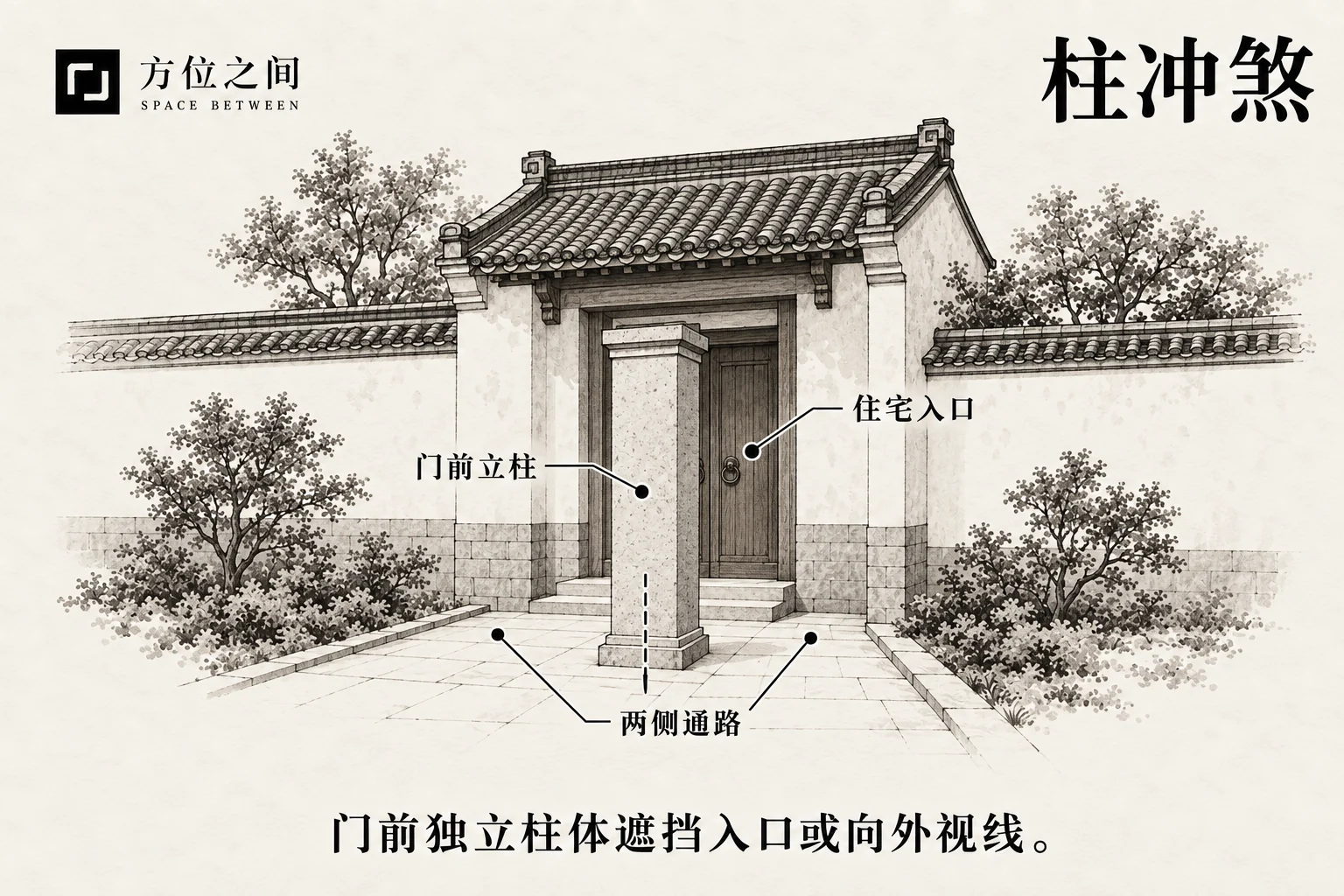
The term describes a form, also called a pillar before the entrance or a pillar screening the door. Its overlap with dingxin is a matter of names, not cumulative harms: one pole does not become three hazards because it receives three labels. The atlas lists front-facing roof-ridge alignment separately to distinguish a post blocking access from an elevated ridge end.
Typical form and comparisons
Typically a nearby freestanding pillar blocks the forward view from inside and requires a turn around one side. The space beyond matters: a broad forecourt may allow easy passage, whereas steps, a carriageway, or a narrow arcade can make the same pillar width consume much of the usable route.
A column beside the doorway supporting a covered porch, clear of the door swing and route, is an important comparison. Round and square columns can both obstruct movement; a square edge does not automatically add wall-blade sha. Examine its direction and actual use.
Traditional reasoning and modern observations
Tradition treats the door as the home’s mouth, so a central pillar suggests blocking or pressing against it. Duoneng Bishi records a taboo about a structural post obstructing a doorway. The relationship matters: pillars support buildings, so their mere presence is not opposed to comfortable dwelling.
In practice, examine visibility, passing, and carrying goods, especially for children, older people, or pushchairs leaving the doorway. Poor lighting, storage beside the pillar, and outward-opening doors may complicate passage. Shadows or photographic perspective cannot substitute for measuring the remaining route.
How to identify it
Identify the pillar’s function before mapping its relationship to the door. Utility poles, structural columns, and decorative posts have different constraints; similar appearance does not permit the same relocation method.
- View from inside and back toward the door outside, marking the actual pillar outline. Distinguish blocking the opening, blocking sight, and merely occupying the photograph’s centre.
- Record door-to-pillar distance, door swing, and clear paths on both sides. Walk the usual route and check turns for pushchairs and large items.
- Recheck at night and busy times: at homes, can approaching people be seen; at shops, do signs, payment points, and customer flows obstruct one another?
Common points of confusion
A tree trunk, elevated ridge end, and indoor overhead beam are different objects and should not be merged by one diagram arrow. Public posts may carry lights, cabinets, or road signs, whose operation needs separate attention. A distant thin pole that barely occupies the view and does not obstruct the route does not match the close doorway obstruction described here.
Effects described in traditional beliefs
Volume Five of Duoneng Bishi links a post obstructing a doorway with household apprehension. It documents the cultural taboo, but supplies neither a standardized modern term nor tables of diseases or fortune by column material. The one supported belief is retained as historical belief, not a conclusion that a pillar produces mental or physical illness.
- Household apprehension: the blocked entrance is associated with worry and difficulty feeling settled. This is general unease, not a basis for adding litigation, divorce, or injury to a particular family member.
Traditional remedies and practical improvements
First improve visibility and passage, then appearance. Shifting the approach slightly can reflect traditional buffering, but hiding a pillar should not add another obstacle. Preserve the proper function of structural columns and public utilities.
- If storage narrows the route, move shoe racks, pots, or promotional stands to preserve a continuous passage for older people, pushchairs, and deliveries.
- If the pillar blends into its background at night, improve non-glare entrance lighting and visual contrast so turns are apparent; obtain management agreement before changing a public post’s finish.
- If shop customers stop at the pillar, move reception or collection to clear indoor space behind and beside it, with clear directions that preserve room for entry and exit.
- If only a usual seat faces the pillar and access is easy, turn the furniture or use a side view to shift the visual focus, retaining light rather than screening the entire door.
- If a doorway change or utility-pole work is needed, first seek assessment from management, the owner, or utility operator. Do not cut structural columns yourself; route changes also require escape and accessibility checks.
Illustrative example
Hypothetical example: a structural column stands before an arcade bookshop, with a promotional rack narrowing its left side, so customers meet book trolleys there. Removing the rack, moving collection inside to the right, and improving lighting clarify both routes. The column and alignment remain. A similar column in a neighboring home’s broad forecourt need not receive the same changes if passage is already easy.
Sources and further reading
These sources help clarify the concepts and their origins. Explaining a traditional term does not establish that it can predict outcomes.