
Name and background
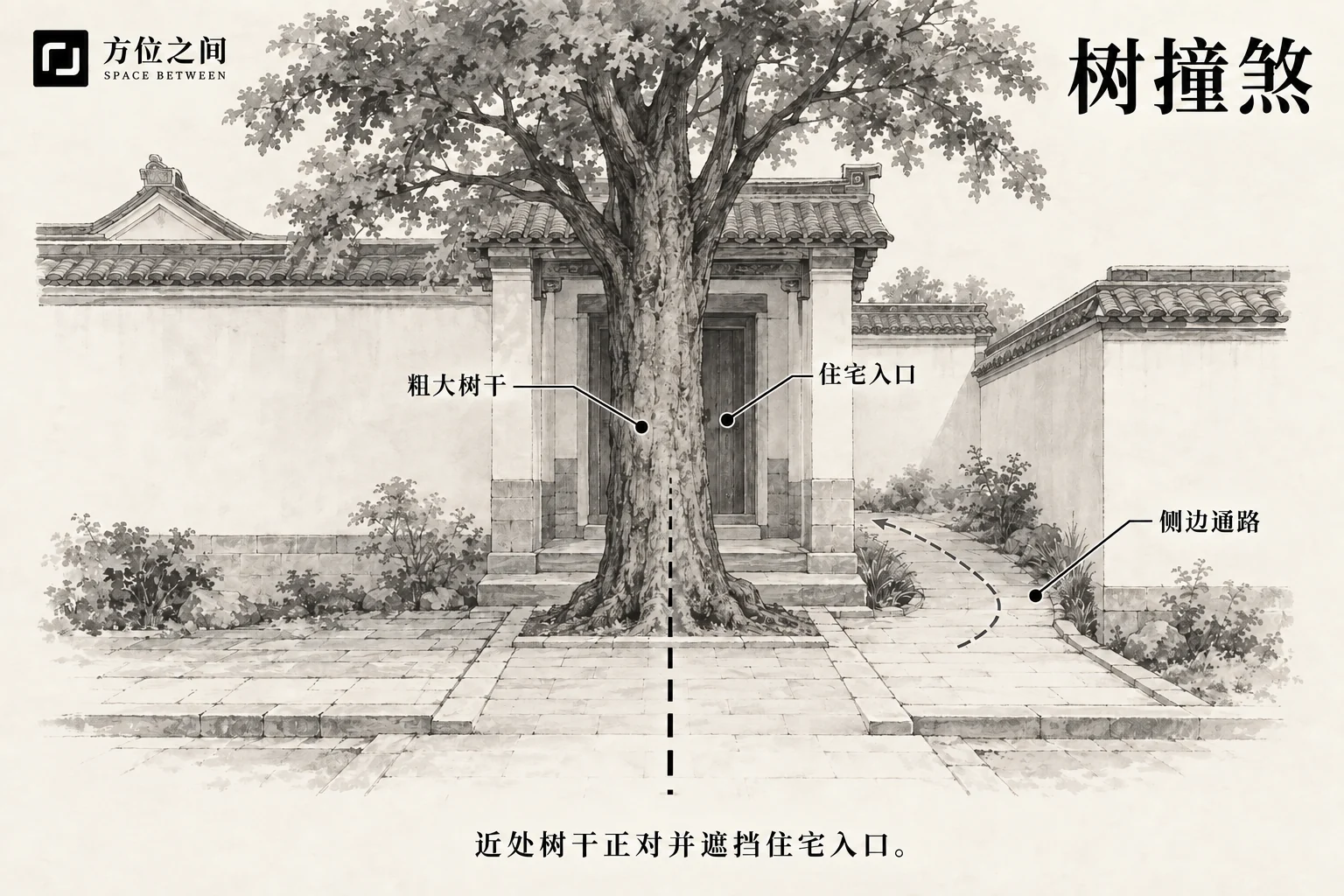
These names concern a trunk directly before an entrance. “Striking” is a shape metaphor, not a tree physically hitting the house. Old texts contain both taboos and favorable planting, and courtyards also use trees for shade and views. The term does not mean older or thicker trees are inherently worse.
Typical form and comparisons
Typically a short setback leaves the trunk directly ahead, requiring turns between it, gateposts, or walls. Clear space after the door opens and visibility around the tree explain use better than perfect photographic overlap. A distant tree with broad paths on both sides is an important comparison.
Crowns can be much wider than trunks, and seasonal foliage changes light. Steps, paving, or tree pits may surround roots. Mapping these layers distinguishes an overhead, underfoot, or frontal issue rather than merging all three into one label.
Traditional reasoning and modern observations
Tradition treats the door as an opening for movement, so a central trunk suggests blockage; dense crowns may evoke darkness. Yet the same texts praise certain trees and green courtyards, showing that position and overall setting matter rather than opposing plants to comfortable dwelling.
Modern assessment separates tree condition from entrance use. A healthy trunk may obstruct access, while a tree clear of the doorway may need dead-branch care. Pruning serves health, clearance, and safety; Hong Kong tree-care guidance advises against topping, root damage, and permanent attachments.
How to identify it
Begin with the entrance actually used daily, not a search for a photograph that maximizes alignment. Appearance can offer clues, but health and stability need suitable assessment.
- Look outward and back toward the entrance, marking trunk edges, door swing, and both paths, including real turns for pushchairs, wheelchairs, or goods.
- Observe shade, branch clearance from buildings, and ground changes near roots separately, noting season and weather rather than inferring year-round conditions from one shadow.
- Note dead branches, obvious cavities, recent changes in lean, or works near roots, and identify the manager. Report concerns rather than pulling branches or digging to test roots.
Common points of confusion
A post resembles a trunk but does not grow, whereas roots, trunk, and crown change. Moving shadows, leaves in drains, and lifted paving each need distinct responses and do not mean a tree blocks the door. Distant woodland is another landscape relationship; wordplay on species cannot describe access or maintenance needs.
Effects described in traditional beliefs
Volume Five of Duoneng Bishi records taboos about large trees before doors or close to windows, alongside favorable locust trees, pomegranates, and greenery. The illness belief below is historical folklore, not grounds to claim a particular tree causes infection or to assess a resident’s health.
- Illness and household unease: the text associates a large tree before the door with epidemic imagery and a tree close to a window with lingering illness. It offers no medical relationship between species, distance, and disease.
Traditional remedies and practical improvements
First organize access and care for the tree, then assess whether relocation or removal is actually necessary. A route around it or reframed view can provide buffering; avoid decorations nailed to trunks, girdling bark, or occupying the root zone.
- Where pots, shoe racks, or goods narrow the entrance, remove movable items first and keep a continuous, clear route around the trunk.
- If foliage hides lights or signs, seek suitable pruning advice and adjust fittings, improving visibility without removing the crown wholesale.
- If only the view from a usual seat is unwelcome, turn the seating while retaining shade and greenery; alignment without access problems is not itself a reason to fell the tree.
- For dead-branch concerns or damaged paving beside outdoor shop seating, move waiting areas and seek assessment, considering paving repair and root protection together rather than cutting roots to level the ground.
- If assessment identifies real tree risk, arrange pruning, support, or other prescribed action, checking protected and public-tree requirements rather than undertaking unauthorized work in the name of sha removal.
Illustrative example
Hypothetical example: an old tree stands before a tea shop, with goods filling the right-hand path. Staff initially assume felling is the only answer. Measuring the route shows that removing the rack creates a broad side approach; tree staff separately treat a dead branch. Customers retain healthy shade and alignment remains. Better access and care, not age or shape alone, guide the response.
Sources and further reading
These sources help clarify the concepts and their origins. Explaining a traditional term does not establish that it can predict outcomes.