
Name and background
In Hanlong Jing, Lianzhen names a mountain form whose pointed rise is likened to flame. It means neither actual fire nor an annual star arriving behind a home. Broken or rugged backing hills are modern descriptions of appearance and terrain. This origin explains why accounts discuss either fierce forms or ancestral mountains and authority.
Typical form and comparisons
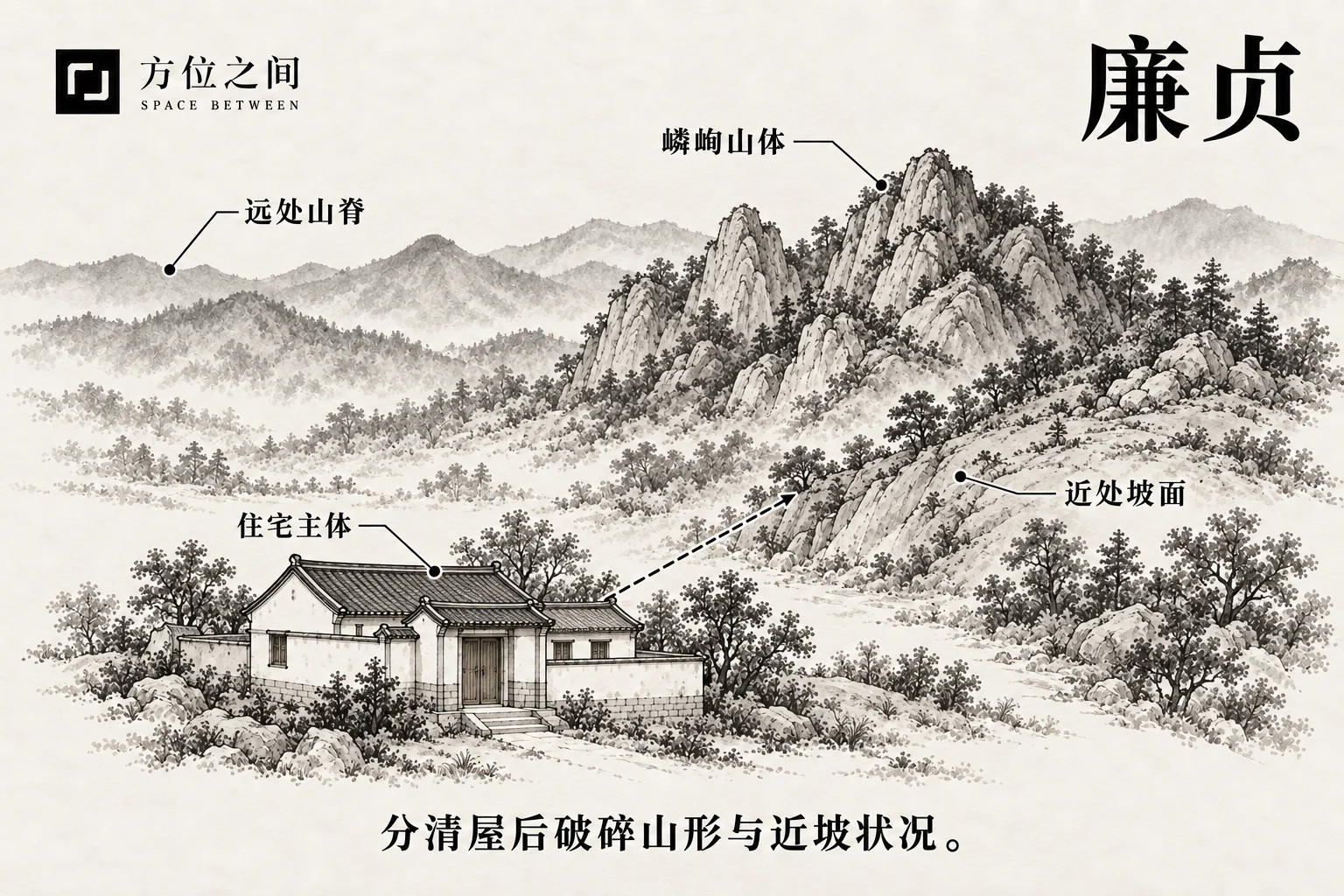
A typical view shows uneven peaks and prominent rock edges, giving an undulating, fractured appearance. Include the continuing ridgeline rather than treating a cropped rock as the whole mountain. Distinguish longstanding natural outcrops, quarry cuts, and newly fallen material after rain.
For a home, note whether the mountain is behind or ahead, across a valley or beside the boundary wall. A distant ridge may form an open view; a nearby slope requires attention to its toe, retaining walls, drains, and building position. Tree cover alone does not establish stability.
Traditional reasoning and modern observations
Traditional form reading follows the range and its transformations, treating a large Lianzhen as a possible ancestor of later forms. Pointedness alone is not decisive: transition to gentler shapes and enclosing terrain matter. Calling one unusual rock Lianzhen compresses a language of long mountain ranges into one local feature.
Practical slope assessment concerns material, gradient, drainage, protection, and change. Jagged outlines do not establish instability, nor smooth surfaces safety. Hong Kong’s slope-maintenance guide includes channels, weepholes, surface protection, and loose debris, focusing on actual features and condition.
How to identify it
Set the observation scale, then map the home and terrain. Record from safe locations rather than climbing unknown slopes or standing under loose rocks to verify a label.
- Include the visible ridgeline and foreground, marking the side of the home and distinguishing distant peaks from the slope beside the building.
- Check maps, slope records, and signs, locating cut slopes, retaining walls, and drains rather than inferring maintenance responsibility from appearance.
- Note new cracks, unusual seepage, blocked channels, or fresh debris, recording time and location for management. One photograph records only one moment.
Common points of confusion
Mountain-form Lianzhen, the fifth-yellow flying star, and natal-chart stars belong to different systems; shared names do not accumulate harms. A pointed building is not a mountain range, and distant peaks do not mean a nearby slope is moving. Name excavation, falling rock, or drainage directly; rugged scenery alone can be discussed as a landscape preference.
Effects described in traditional beliefs
The Lianzhen passage in Hanlong Jing discusses both fierceness and distinction after transformation, not that all visible rock is inauspicious. These two interpretations belong to historical mountain-form belief, not judgments about residents’ character or fate or conclusions about geology.
- Authority and distinction: when an ancestral Lianzhen develops into forms such as Tanlang, Jumen, or Wuqu, the text associates the sequence with command, civil and military talent, and advancement. The emphasis is on a changing range.
- Fierceness and disorder: for close or untransformed Lianzhen, the text also uses predictions of violence and disrupted social order. This severe historical rhetoric does not imply that nearby residents will be angry or criminal.
Traditional remedies and practical improvements
Separate distant scenery from a nearby slope. Traditional attention to the whole landscape encourages looking beyond one fragment; practical maintenance concerns drainage and slope features, not reshaping peaks into auspicious forms.
- For discomfort with a distant view alone, adjust seating or partial window treatments, retaining sky and greenery rather than blocking all daylight over a few rocks.
- For homes or shops beside a managed slope, establish responsibility and inspection arrangements, asking the responsible party to check drains and weepholes.
- After fresh debris or unusual water flow, record from safety and notify management. Avoid the area and seek prompt help for clear danger signs rather than climbing to investigate.
- For guesthouses or shops using a rear yard for seating, check slope-toe management and protection, avoiding platforms over drains or customer seats within maintenance areas.
- Refer proposals for cutting slopes, moving rocks, retaining work, or changing crest drainage to geotechnical professionals. Symbolic decorations can express wishes but cannot replace engineering measures.
Illustrative example
Hypothetical example: a hillside guesthouse sees distant rocky peaks and has a separate cut slope behind its yard. Both are initially called Lianzhen, but a plan distinguishes scenery from blocked drainage on the nearby slope. The responsible party arranges clearing and inspection, and tables move out of the maintenance route. The mountain outline remains while the actual facility is maintained; further unusual rockfall is followed up as a slope issue.
Sources and further reading
These sources help clarify the concepts and their origins. Explaining a traditional term does not establish that it can predict outcomes.