
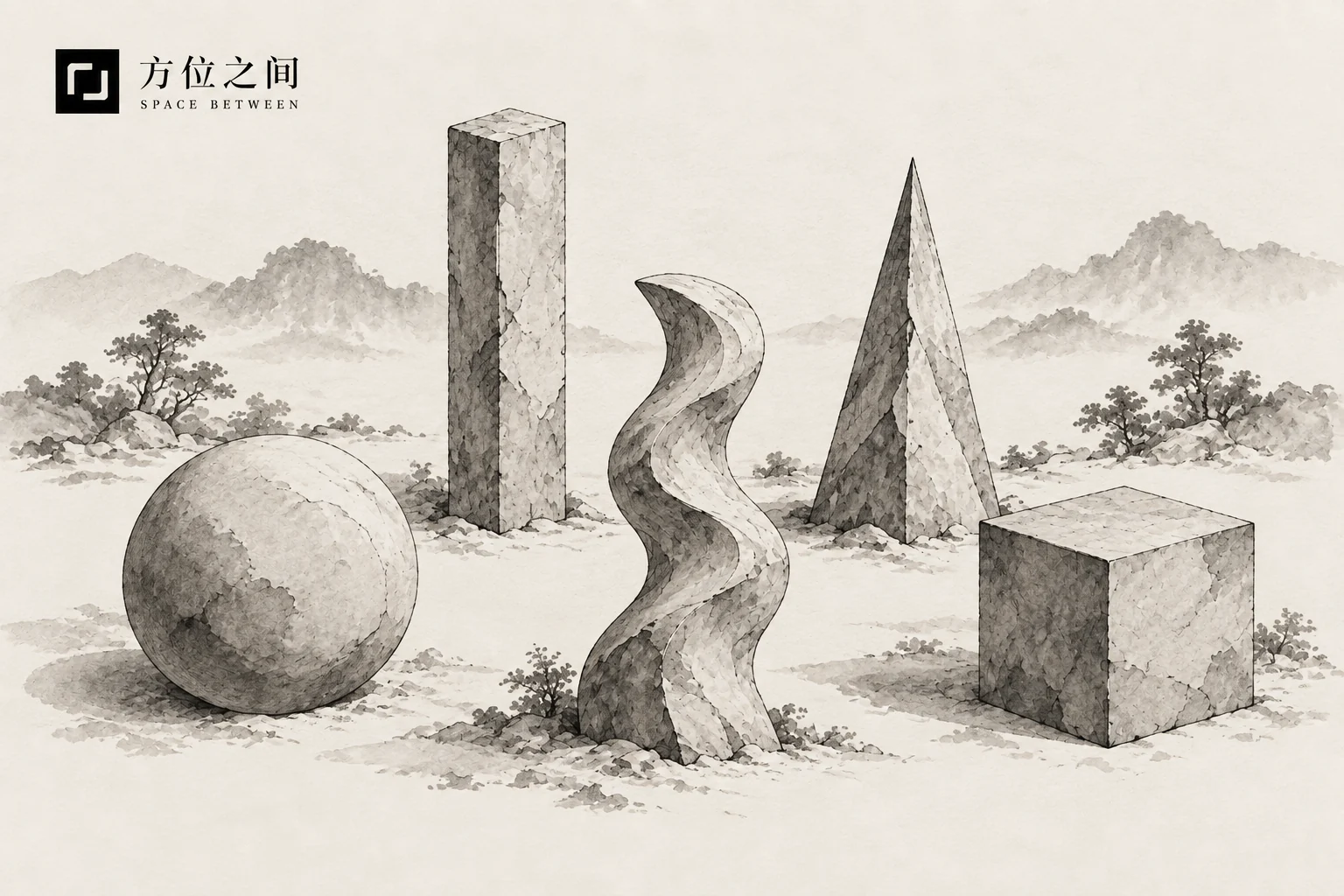
Read the outline before its traditional category
A common introduction summarizes metal as round, wood as long and straight, water as winding, fire as pointed and earth as square. These memorable images compress varied terrain and building outlines; they are not five mutually exclusive geometric types. Dili Xingxin Lu describes elongated wood, rounded metal and square earth while also examining details. Begin with neutral descriptions such as arcs, vertical proportions, bends, pointed tops and flat tops, then state the five-phase classification being used.
Shape, material and direction are not interchangeable
Volume 2 of Xieji Bianfang Shu explicitly discusses some metal-, fire- and wood-mountain descriptions as resemblances of form. A round concrete roof may be called metal-shaped while remaining concrete; a tall metal column does not therefore have to be described as round. Directional phase correspondences, stem-branch nayin and object outlines are separate systems. Keep shape, material and coordinates in different fields instead of allowing one metal label to stand for all three.
One building can have outlines at different scales
Imagine a rectangular building with an arched entrance canopy and a pointed roof ornament. Its overall mass, entrance detail and upper silhouette produce different descriptions without contradicting one another. Mark the whole building, canopy and ornament on one photograph, then add distant and close views to identify the subject of each classification. What can be checked is the scope and outline observed, not a fortune judgment assembled from three shapes.
Five forms are not a universal table for every tradition
Hanlong Jing organizes mountain forms through nine star categories, showing that classifications and scales extend beyond five forms. Moving a shape label into a nine-star, nayin or interior-placement system requires an explicit bridge, not merely a shared phase word. A common error declares all pointed shapes dangerous and all round shapes auspicious, then changes materials or furnishings on that basis. Form language can help compare visual organization, but comfort, structural stability and material performance require assessment of actual conditions.
Sources and further reading
These sources help clarify the concepts and their origins. Explaining a traditional term does not establish that it can predict outcomes.