
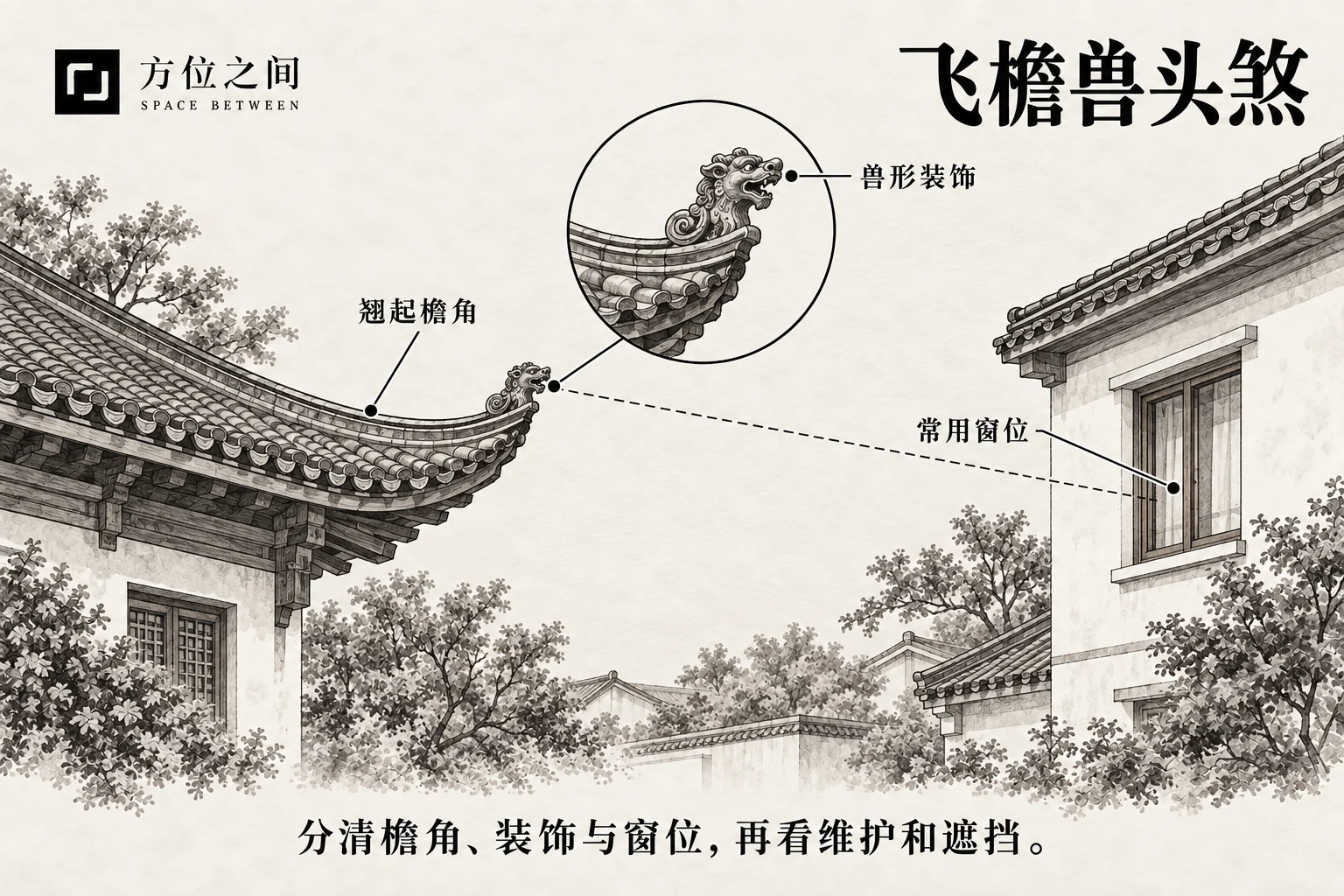
Definition and subject
Modern lists often use this name when a neighboring building's upturned eave, eave end, or animal-shaped ornament faces a home's doors or windows. First distinguish the roof edge, ridge end, and animal attached to an end. A traditional building may have all three, but their heights, projections, and maintenance differ. Merely seeing an animal ornament does not mean it is projecting an influence toward the home.
How to identify it
Observe from the window, balcony, or entrance actually in use, noting which building carries the ornament, its height, relative distance, and direct visibility. Check again from the side to exclude alignment caused by perspective. Look for visible damage, detachment, or dripping water. A nearby eave corner and a small distant roof ornament should not be assessed identically because they occupy similar areas in a picture.
Versions, folk interpretations, and source limits
Animal ornaments may carry local craft, religious, or decorative meanings; they should not all be interpreted as hostile acts toward neighbors. Folk associations between their orientation and disputes or injuries are symbolic, not grounds for predicting consequences from an ornament's appearance. This entry organizes the supplied name without inventing unverified animal legends or a dedicated ritual remedy.
What to check in the actual setting
Check separately whether the view is persistently disturbing, the eave blocks light, rainwater enters your boundary, or the component needs maintenance. Feeling visually pressured is a real experience, but it does not establish that the component will fall. Conversely, an auspicious shape does not remove maintenance concerns. Inspection belongs to appropriately qualified people with authority, not distant guesses about hidden fixings.
Practical improvements and the limits of remedies
If the issue is visual, adjust seating, curtains, or screening that preserves daylight. For dripping or a visibly abnormal component, record its position, date, and photographs, then discuss inspection with the manager or owner. Do not aim bright reflective mirrors or sharp ornaments at neighbors or damage traditional decoration yourself. Changes should address the actual issue and keep neighborly communication cooperative.
Similar names and common confusions
An eave alignment may have no animal ornament, and a roof-ridge alignment may have no upturned eave. This entry specifically retains the decorated end as its subject. If the actual object is a gap between buildings, use the narrow-gap or flying-blade explanation. Eave, animal, and alignment are not three cumulative effects, and historic buildings or temples should not all be treated as unsuitable neighbors.
Sources and further reading
These sources help clarify the concepts and their origins. Explaining a traditional term does not establish that it can predict outcomes.