
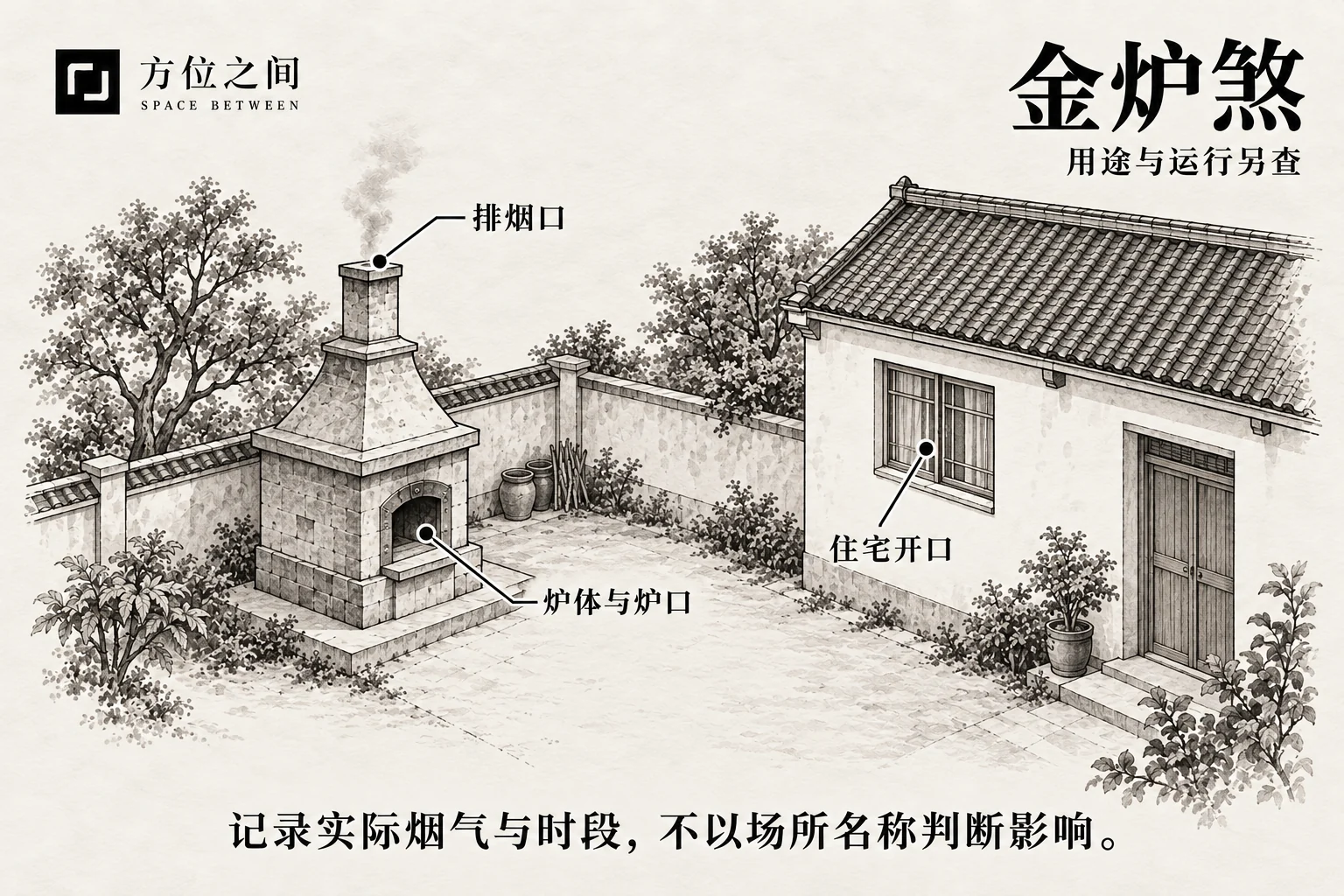
Definition and subject
Here, Jinlu sha refers to a furnace used for burning offerings near a temple, shrine, or other ritual venue entering a home's surroundings. Jinlu names a use: the furnace need not be gold-colored, nor does it mean the entire temple. Assessment should concern the particular furnace, its openings and operation, and its relationship with the home, rather than simply finding a religious site on a map.
How to identify it
From a public position where access is permitted, establish whether the facility operates, where its loading and exhaust openings are, and where the home's windows and air inlets lie. Record the times, duration, and wind direction when smoke is actually seen or smelled. Distinguish festival use from daily operation. Do not enter the furnace or touch hot surfaces, and do not infer combustion composition from a still photograph.
Versions, folk interpretations, and source limits
Folk interpretations may extend fire, incense, and temple imagery into stories about fortune or yin and yang. These are not evidence that neighbors will suffer. Ritual practice and facility management vary substantially by place; the label must not become a judgment of a faith or group. The name is retained for reference without claiming that furnace orientation determines illness, litigation, or wealth.
What to check in the actual setting
Practical observations include recurring smoke, deposited dust, odors, operating hours, and their effects on daily use, together with maintenance and management. EPA lists combustion among particulate sources; that supports observing a real source, not estimating a home's concentration from a folk label. No visible smoke does not prove every indicator is normal, and an odor cannot identify all substances present.
Practical improvements and the limits of remedies
When disturbance persists, keep dated observations and discuss actual operation, maintenance, or emissions with the venue or property manager. Window-opening times and activity locations can respond to outdoor conditions, but permanently closed windows are not a universal answer. Curtains, mirrors, and talismans do not treat emissions. Changes to a shared facility belong to its responsible manager; do not dismantle the furnace or block its openings.
Similar names and common confusions
Jinlu and Chongtian may both involve combustion facilities, but the former emphasizes use and the latter the tall chimney silhouette. Fire-form is a broader symbolic term. Incense burners, fixed offering furnaces, and decorative vessels should not be merged unconditionally. Establish whether there is actual operation and disturbance before choosing an environmental discussion or a purely cultural explanation.
Sources and further reading
These sources help clarify the concepts and their origins. Explaining a traditional term does not establish that it can predict outcomes.