
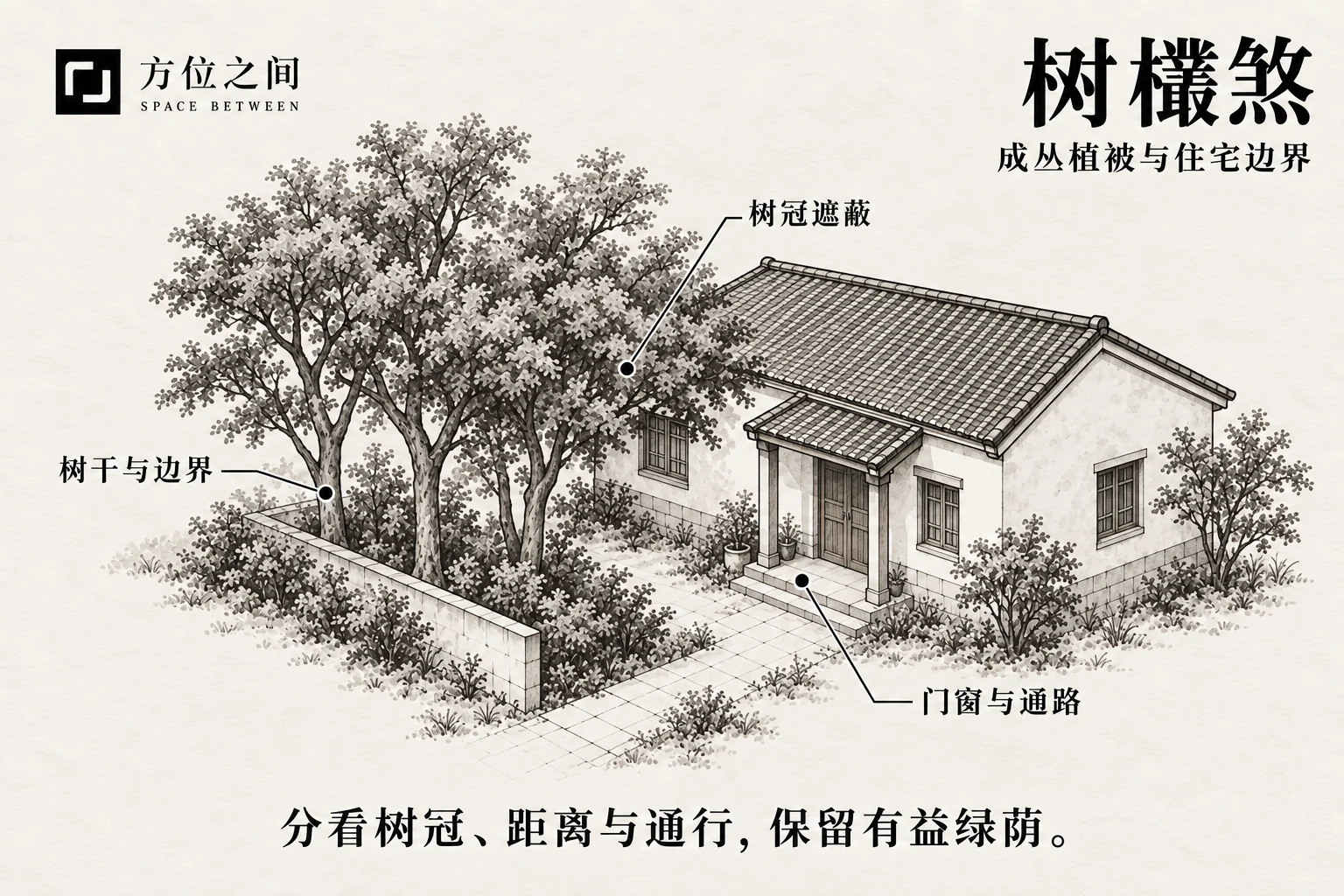
Definition and subject
The character cong refers to clustering. This entry concerns groups of trees near a home that affect the view or openings. It is not the same as a single trunk centered on an entrance, and it does not require every canopy to block all light. Species, size, season, and the home's orientation change the experience; tree count or a traditional name alone cannot determine whether a home is good or bad.
How to identify it
Record trunk distance from the entrance, canopy coverage, branches touching the building, and any effects on everyday paths separately. Photographs at different times and before and after leaf fall can show changes in shade and daylight. Treat fallen leaves, standing water, dead branches, and raised ground as distinct observations. A photograph taken on one overcast day cannot establish that the room is dark throughout the year.
Versions, folk interpretations, and source limits
Folk accounts may connect dense trees with darkness, closure, or confinement, while others praise greenery and enclosure. The same vegetation can receive conflicting interpretations. This entry does not portray trees as entities that drain vitality or predict illness or fortune from clustering. Without an established shared ancient definition, retain the site description rather than inventing a fixed distance threshold.
What to check in the actual setting
Trees can provide shade and landscape value, while locally dense growth can affect particular windows. Tree-care guidance emphasizes suitable growing space, maintenance, and trained inspection; it does not mean every tree near a home is dangerous. Separate daylight, access, branch condition, and contact with the building. Psychological discomfort is not a substitute for arboricultural assessment.
Practical improvements and the limits of remedies
Begin by organizing your own path, clearing fallen leaves where appropriate, and adjusting indoor lighting and seating. Discuss necessary pruning or dead branches with the responsible party and let capable personnel decide the method. Do not top trees, damage roots, or cut public greenery to perform a supposed remedy. Recheck daylight and access afterward while retaining useful shade and landscape qualities.
Similar names and common confusions
Tree-facing-door sha emphasizes one trunk aligned with an entrance, tree-shade concerns light, and Shucong first concerns clustered planting beside the home's boundary. They may coexist but are separate checks. Distant trees without contact or obstruction may simply be recorded as landscape. Woodland, shrub hedges, and potted plants should not all be treated as one identical layout.
Sources and further reading
These sources help clarify the concepts and their origins. Explaining a traditional term does not establish that it can predict outcomes.