
Name and specific form
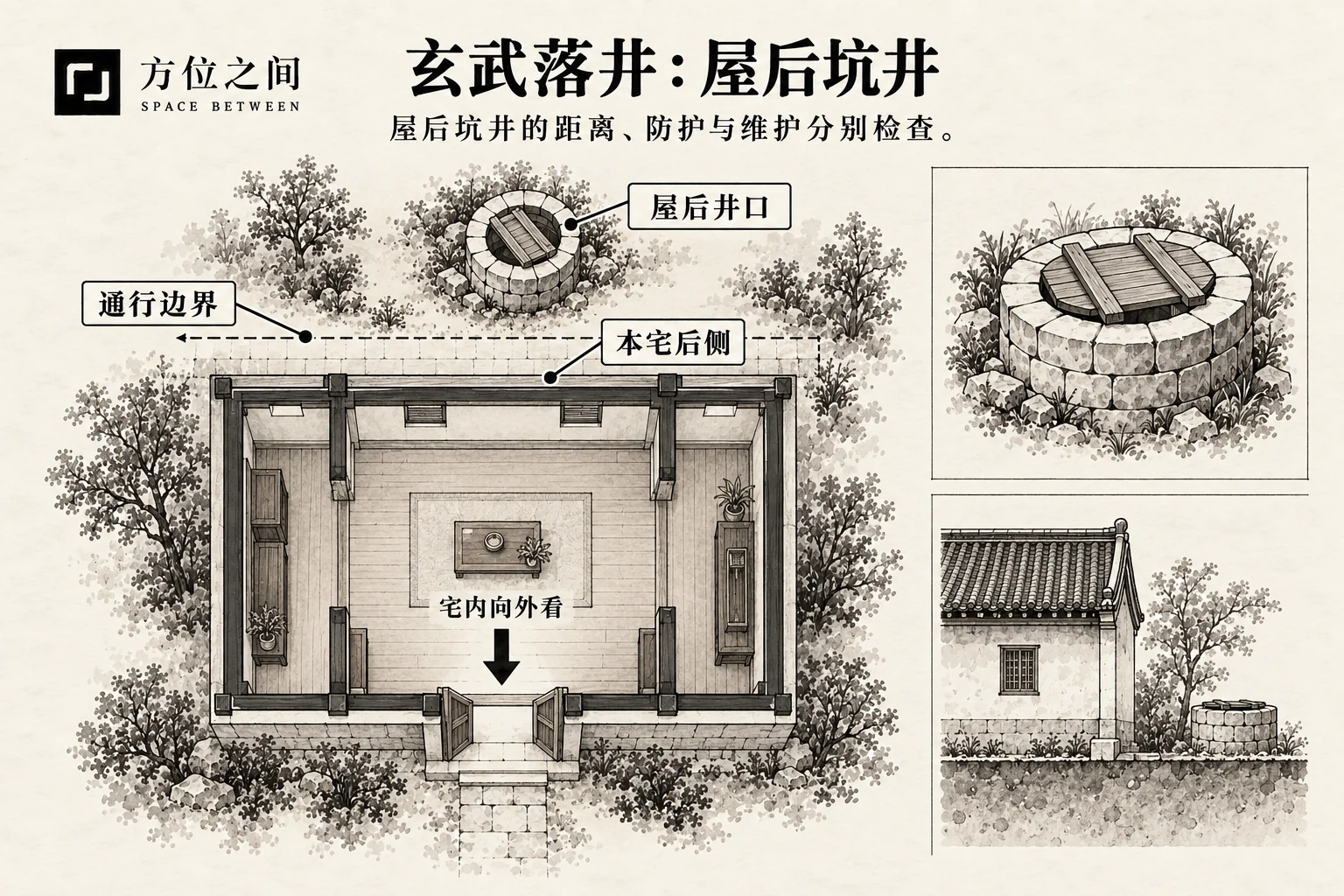
In this list, Black Tortoise falling into a well refers to a deep pit or well at the rear of the main home. The object is an actual opening or level difference, not blank courtyard space on a plan or another name for an indoor lightwell. Mark depth, use and protection as unconfirmed when they are unknown.
How to identify and record it
Identify the home’s front and rear and the pit or well boundary on the rear, then observe from a protected position. Do not approach an unstable edge to estimate depth or treat a cover’s appearance as proof of load capacity. Use management records together with safely visible evidence.
- Identify an operating water well, disused well, construction pit or natural depression.
- Record its distance from entrances, children’s activity areas and everyday routes.
- Check visibility, the condition of protection and who is responsible for maintenance.
Sources, versions and related names
This entry independently organizes the supplied definition of Black Tortoise falling into a well. A source fixing one period and diagram has not been verified. Entering or falling into a well in the name is not an actual accident, and courtyards, lightwells and deep pits must not be equated because they share a word.
Folk meanings and limits of interpretation
Wells can symbolize thresholds, depths or the unknown in folk narratives. That vocabulary can be studied, but a dwelling direction cannot predict who will fall, and accidents must not be blamed on an animal sign or family member. The name provides no physical protection standard.
Practical observation: what determines the effect
Practical concerns are visibility, guards, edge condition and access routes. A disused pit may have unclear purpose, standing water or unclear responsibility, but those conditions require verification. A well-managed distant well differs from an uncovered opening beside a path.
Improvements and what they cannot replace
Focus on management and physical protection: ask the responsible party to identify use, maintain appropriate access separation and lighting, and repair covers or barriers according to the actual facility. Do not enter, dump waste into or blindly fill an unknown opening, which may affect existing infrastructure.
- Organize known facts and unresolved questions rather than using alarming names as a site description.
- Keep protection and routes clearly visible and inspect changes regularly.
- Have an authorized, appropriately capable party handle any pit or well intervention.
Sources and further reading
These sources help clarify the concepts and their origins. Explaining a traditional term does not establish that it can predict outcomes.