
Questions and answers
How is the left side defined?
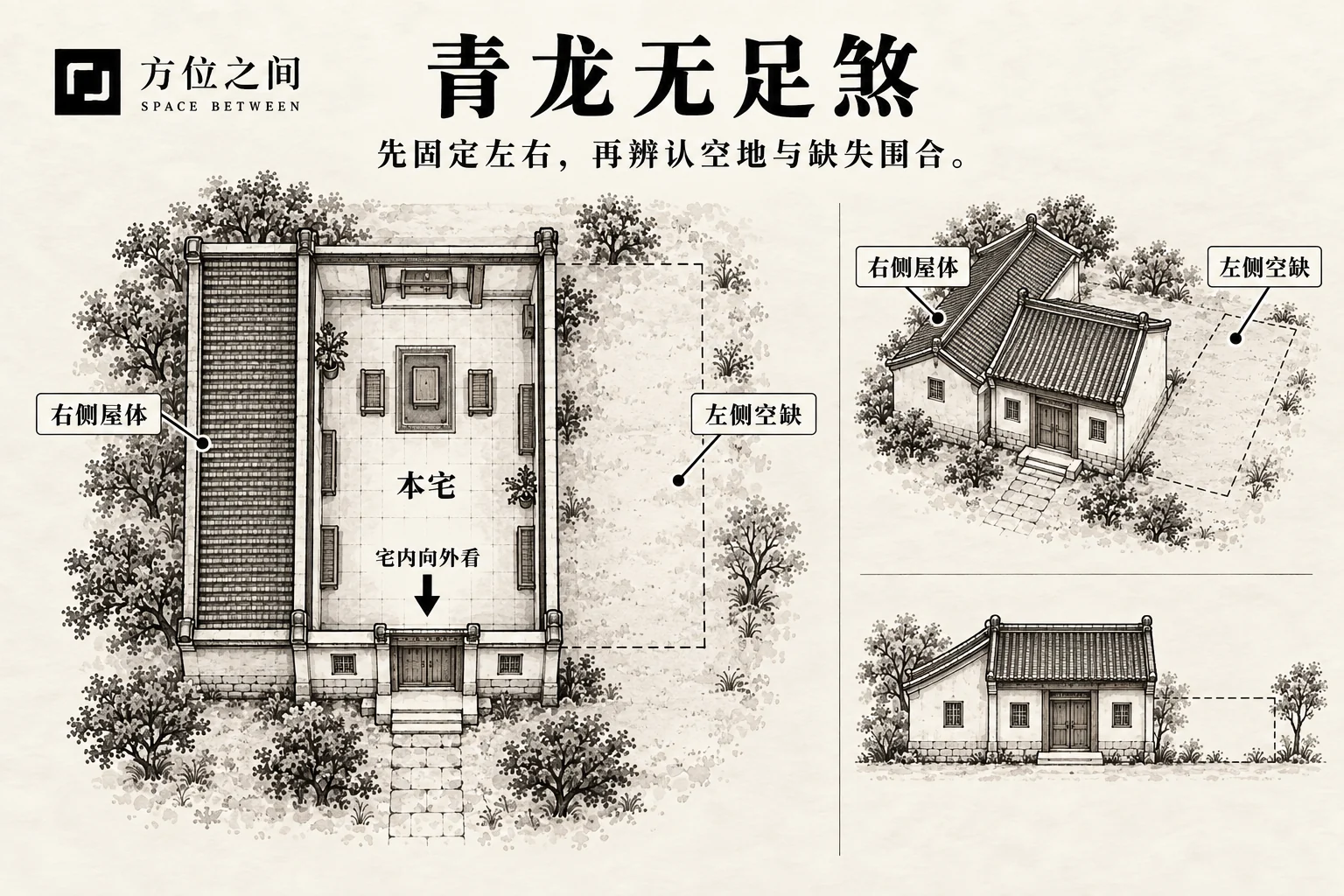
Face the front from inside the main house and use that left-hand side. Keep an orientation arrow on the plan so a rotated photograph does not change the convention.
Does Azure Dragon without feet require filling open land?
No. Establish land use, rights and the actual problem first. Access or daylight space can serve essential functions; visual completeness alone does not justify construction.
Name and specific form
Left and right are defined from inside the main house looking toward its front. Mark the house, front and left boundary on a plan first. Turning around outside reverses the sides in a photograph. The Azure Dragon side is not always east, and a small opening visible from a window does not establish that the entire side is unbuilt.
How to identify and record it
Record the left side in three parts: beside the entrance, beside regularly used windows and near the rear connection. For each, note whether it is a garden, neighboring land, a passage or a demolition site, together with boundaries, access and drainage. Keep separate records when their uses differ rather than calling the whole side empty.
- Use the same orientation arrow on the plan, photographs and notes.
- If a building exists but is damaged, also compare the entry for a damaged left wing instead of recording only an absent building.
Sources, versions and related names
The cited list gives “no building or a gap on the left” but no universal dimension threshold or authenticated diagram. The four-animal discussion in Dili Nangjin Jizhu explains the positional metaphor; it does not establish a complete classical test for this particular name. Keep differing definitions alongside their wording and sources.
Folk meanings and limits of interpretation
“Without feet” uses a bodily image for a side lacking an adjoining mass, reflecting a traditional preference for enclosure and support. It is not evidence of foot disease, a missing family member or financial loss. The Azure Dragon label alone cannot establish that an open side is favorable or unfavorable.
Practical observation: what determines the effect
Suppose the left side is an access passage also faced by a bedroom window. Observe daylight and sightlines during the day, then passage lighting at night. If access and privacy work well, the open space may serve a necessary function. Record the location and timing of any pooling water or overlooking. This is a hypothetical observation example, not a survey of a real home.
Improvements and what they cannot replace
Confirm the use, address the specific disturbance, then revisit the same observation point. Start with blind angles, seating or outdoor storage while retaining access. Do not build an extension or seal an opening merely to “fill the left side.” Boundaries, drainage and structural work need separate site and management checks. Repeating the observation shows whether the identified problem changed.
Sources and further reading
These sources help clarify the concepts and their origins. Explaining a traditional term does not establish that it can predict outcomes.