
Questions and answers
How is the right side defined?
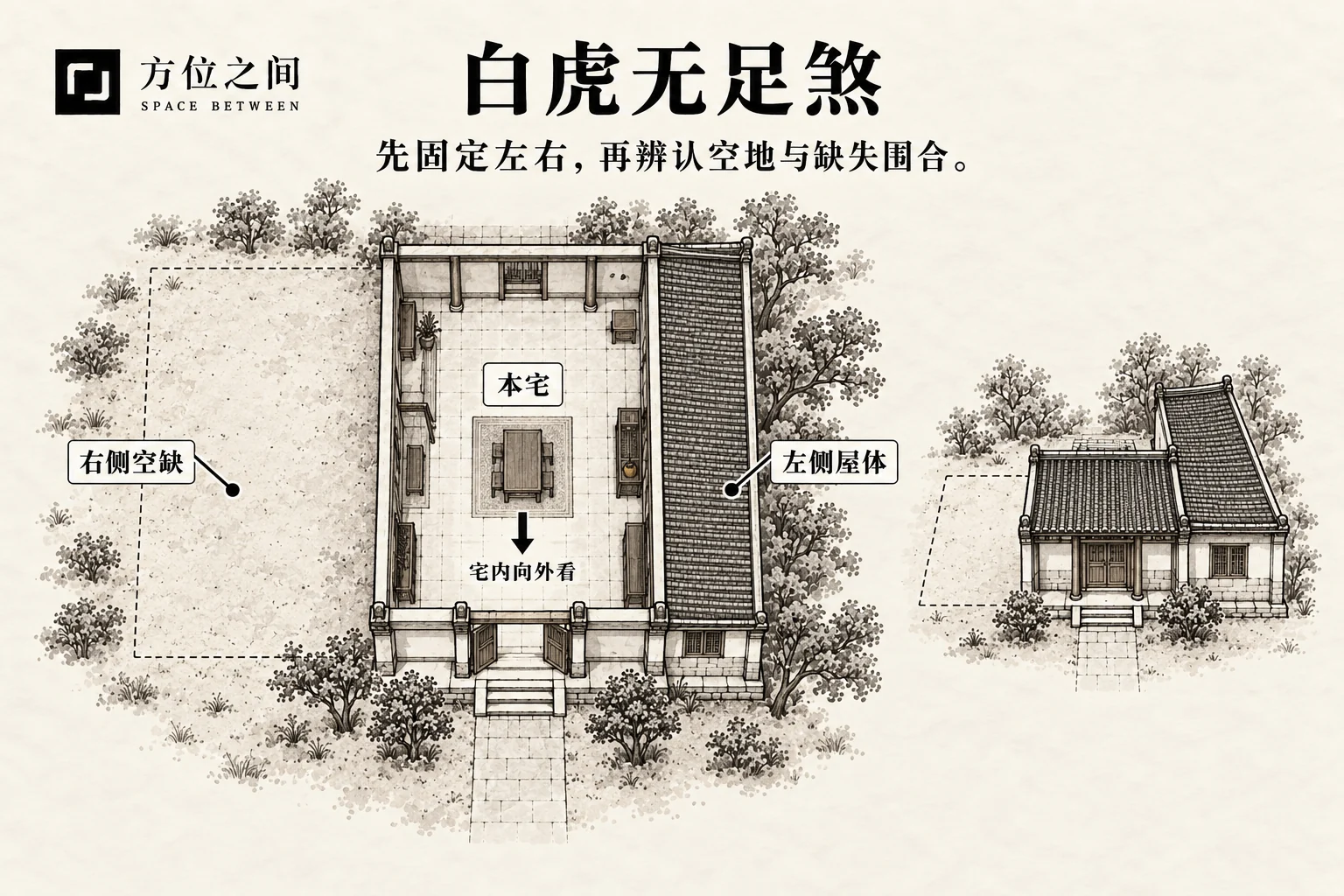
Face the front from inside the main house and use that right-hand side. Keep an orientation arrow on the plan so a rotated photograph does not change the convention.
Does White Tiger without feet require filling open land?
No. Establish land use, rights and the actual problem first. Access or daylight space can serve essential functions; visual completeness alone does not justify construction.
Name and specific form
Identify the front of the house, then face it from inside: the right-hand side is the White Tiger side used here. Confirm buildings using the plan, site and boundary. Trees hiding a neighbor, a lower adjoining plot or a cropped photograph can all create the impression of an empty right side.
How to identify and record it
Check three questions: is the image mirrored or rotated; who owns and uses the open area; and is it planned open space or a construction phase? If the last point is unknown, record the date, current condition and use to confirm. Do not change boundaries with planting or fencing before checking ownership and building plans.
Sources, versions and related names
This page cites a modern list’s right-side interpretation; older four-animal texts provide background only. “Without feet,” “without a head” and “broken arm” are not interchangeable: they concern the presence of side buildings, differing meanings of a principal building, and damage to an existing wing. A name without a diagram or original wording leaves uncertainty.
Folk meanings and limits of interpretation
The traditional image uses White Tiger to mark a side and “without feet” for a missing companion mass. It does not establish that right is more dangerous than left, or justify conclusions about residents’ gender, birth order or marriage. The pair helps locate an observation; it cannot turn one spatial issue into two deterministic predictions.
Practical observation: what determines the effect
Hypothetical comparison: the right side of Home A is a designated emergency access area, while Home B has an untidied demolition plot. Both can look unbuilt. A needs clear access; B needs checks of remaining elements, barriers and drainage. Use and condition determine the next action more clearly than the silhouette. “No building” alone is not a shared reason for alteration.
Improvements and what they cannot replace
Write a recommendation as object–action–verification: for a right-side window overlooked by passers-by, try adjustable blinds and check daylight and privacy from the usual seat. For shared access or neighboring land, contact the responsible party before making changes. The left-side entry uses the same orientation convention, but keep photographs and notes for this home’s actual right side.
Sources and further reading
These sources help clarify the concepts and their origins. Explaining a traditional term does not establish that it can predict outcomes.