
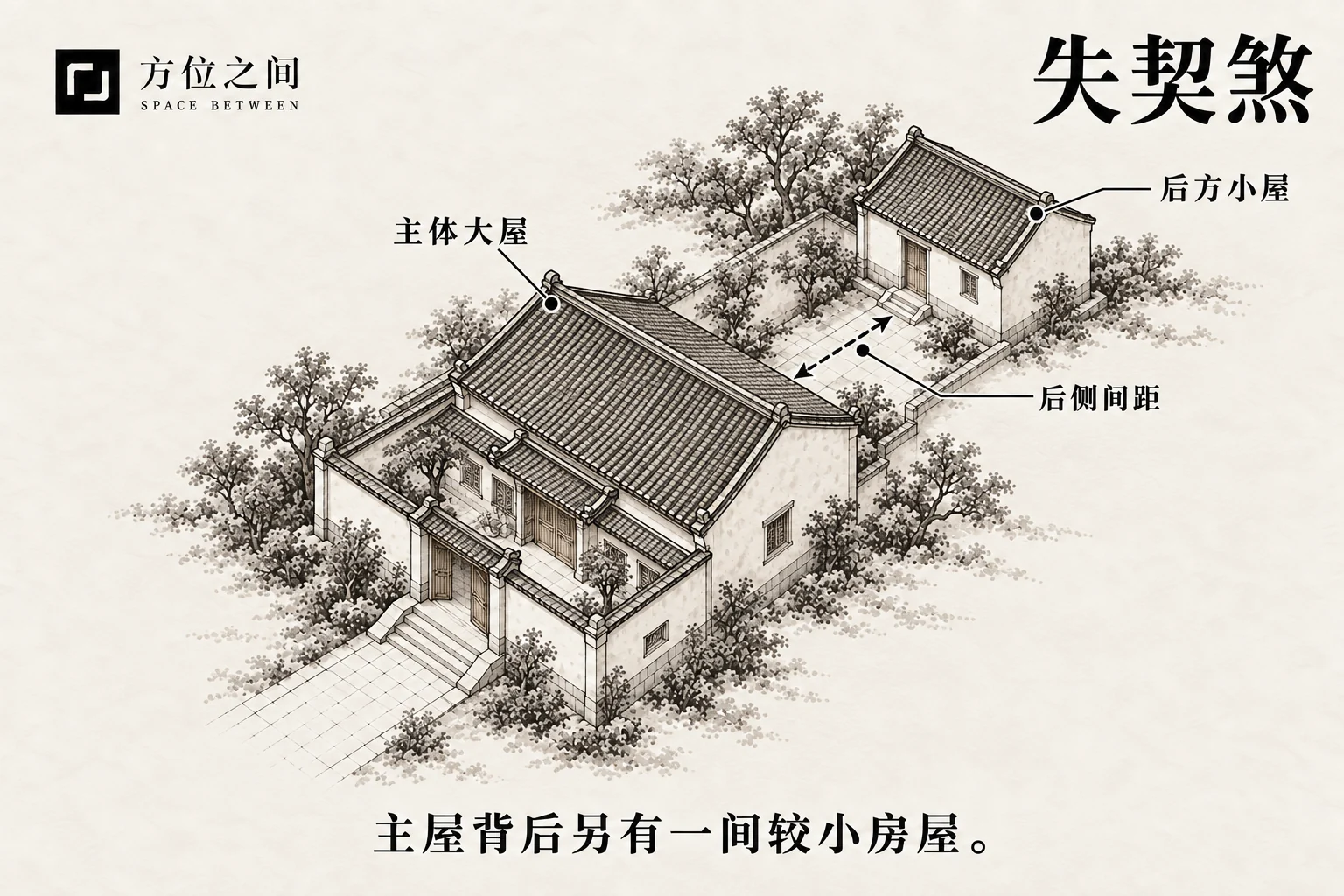
Name and specific form
In this list, Black Tortoise hiding its head describes a smaller house behind the main building. Black Tortoise marks the rear; hiding the head is imagery within the name. It does not require the annex to be completely hidden, attached to the main building, below a particular eaves line or concealed behind a hill.
How to identify and record it
Mark the entrance and rear of the main house, then draw the small building’s boundary, spacing and connections. Establish whether it is an annex, detached structure or another household’s home. A front photograph may not show it adequately; use a plan and side information obtained with permission.
- Record the small building’s relative height, depth and actual use.
- State whether the buildings touch and whether access and light gaps remain.
- Check rear openings, drainage paths and maintenance access.
Sources, versions and related names
This entry follows the supplied rear-small-house definition. The Shiqi entry describes a comparable object, but that does not establish a common origin for the two names in every version. Hiding the head can mean something else in landform writing; a modern annex illustration cannot prove every historical use.
Folk meanings and limits of interpretation
The name personifies a rear mass as hidden or withdrawn. It does not establish loneliness, loss of influence or changing family fortune because there is one more room behind a house. Normal plant rooms and stores should not acquire disaster predictions through this label.
Practical observation: what determines the effect
Check whether the annex blocks an important rear window, narrows maintenance access, changes roof drainage or interferes with use. With suitable connections and spacing it can serve a useful function. Being visually hidden behind the home is not a building-defect classification.
Improvements and what they cannot replace
Begin by clearing access between the buildings and checking water paths and maintenance reach, then adjust lighting or storage. New openings, corridors or demolition require ownership and construction checks, not simply a traditional label.
- Record use, connections and circulation, distinguishing a house from a temporary shelter.
- Address specific obstruction and maintenance issues, then review everyday usability.
- Do not arbitrarily increase height, pile soil or add loads to reveal a “head” or create backing.
Sources and further reading
These sources help clarify the concepts and their origins. Explaining a traditional term does not establish that it can predict outcomes.