
Defining features
This group explains waterside structures before the entrance only, not water-method calculations using orientation, incoming water and outflow. Water levels, access and building maintenance require separate observation.
How to recognize it
Fix the building’s front, rear, left and right before recording dimensions, positions and uses. Photographs have perspective limits; verify with a plan and section when needed.
Common confusions
One name can refer to different objects and one form can have different names. Preserve each version’s definitions rather than deriving new rules from a single character.
Folklore and sources
The same Gugua name also describes facing small front buildings in the catalog. These are different objects and cannot share one merged illustration or justify judgments about marriage and family.
Traditional responses and practical improvements
Traditional front-of-house preferences concern proportion and openness. Practical improvements should address waterside protection, drainage, maintenance and access. No basis is offered here for worship, protective objects or wealth rituals.
Unresolved Boat or Boat-House Form (Zhangchun)
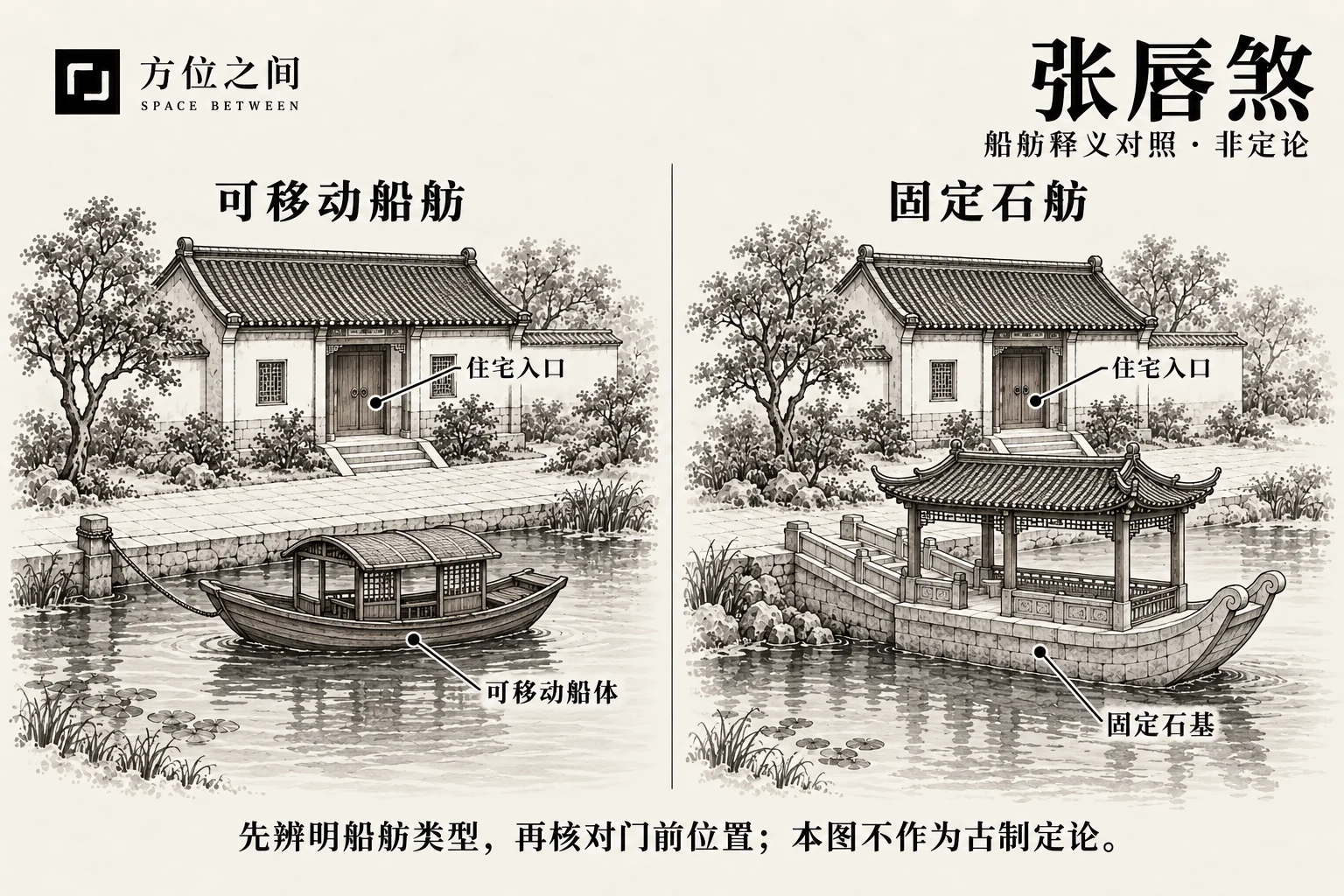 Enlarge diagram
Zhang Chun appears in modern house-form lists with the brief explanation of a boat before the door. Fang generally means a boat, but gardens also contain fixed stone boats. Identify the actual object before discussing its relationship to the entrance, bank and circulation.
Name and form characteristics
Zhang Chun is a house-form name. The modern wording examined here gives only the relationship of a boat before a door, without fixing bow direction, distance or bank shape. The word lip therefore does not justify inventing a mouth-shaped pond, protruding bank or a fixed alignment angle.
The Ministry of Education's Revised Mandarin Dictionary records meanings of fang including joined boats and boats generally, supporting a boat-based reading. The dictionary does not define Zhang Chun sha. Although a stone boat also has boat form, whether it is included in a particular retelling depends on that source's definition.
How to identify and record it
Photograph outward from the main entrance and add a side view of the bank. Distinguish a movable floating boat from a fixed stone boat or boat-shaped pavilion; maintenance and use differ.
- Relationship: is the object in the entrance sightline, on the access route or on distant water, and does it actually obstruct entry?
- Change: is the boat temporarily moored or permanently berthed, and does its position change with water level?
- Conditions: are waterfront access, protection, drainage and maintenance responsibilities clear? Record more than appearance.
Differences from waterside pavilions, directed water and mouth-shaped water features
A waterside pavilion stands beside or over water and need not be boat-shaped. Directed-water sha concerns actual water direction and speed, not simply a boat before the door. The stone boat is a comparison object; it does not establish that every waterside garden structure has the same traditional meaning.
Folk accounts and limits of attribution
Modern lists connect Zhang Chun with official disputes, litigation or household loss. These are circulating symbolic folk judgments, without evidence that a moored boat before a door causes lawsuits or financial loss.
No early original diagram has been verified that fixes one boat form and distance condition. This page provides a qualified interpretive image to clarify terminology and site differences, not a claimed reconstruction or an invented story of an ancient master's remedy.
Modern observation: using the waterfront outside an entrance
Check obstructed access, poor nighttime waterfront visibility, slippery paving and routine care of boats or fixed structures. Seeing a distant boat with no effect on access, views or use is different from a vessel permanently close to an entrance route.
Practical improvement and the meaning of remedy
Address demonstrable issues first: organize access, improve nighttime lighting, and maintain edge protection and drainage. If mooring obstructs entry, discuss changes with the responsible manager. Do not independently remove a stone boat or garden installation because of its name.
Folk remedies often broadly suggest avoidance, screening or organizing the entrance environment, which can mean adjusting use relationships. Screens and plants must not block necessary routes, views or protective facilities. No reliable basis for a Zhang Chun-specific protective object has been established, and ornaments cannot be promised to prevent lawsuits.
Gugua Sha
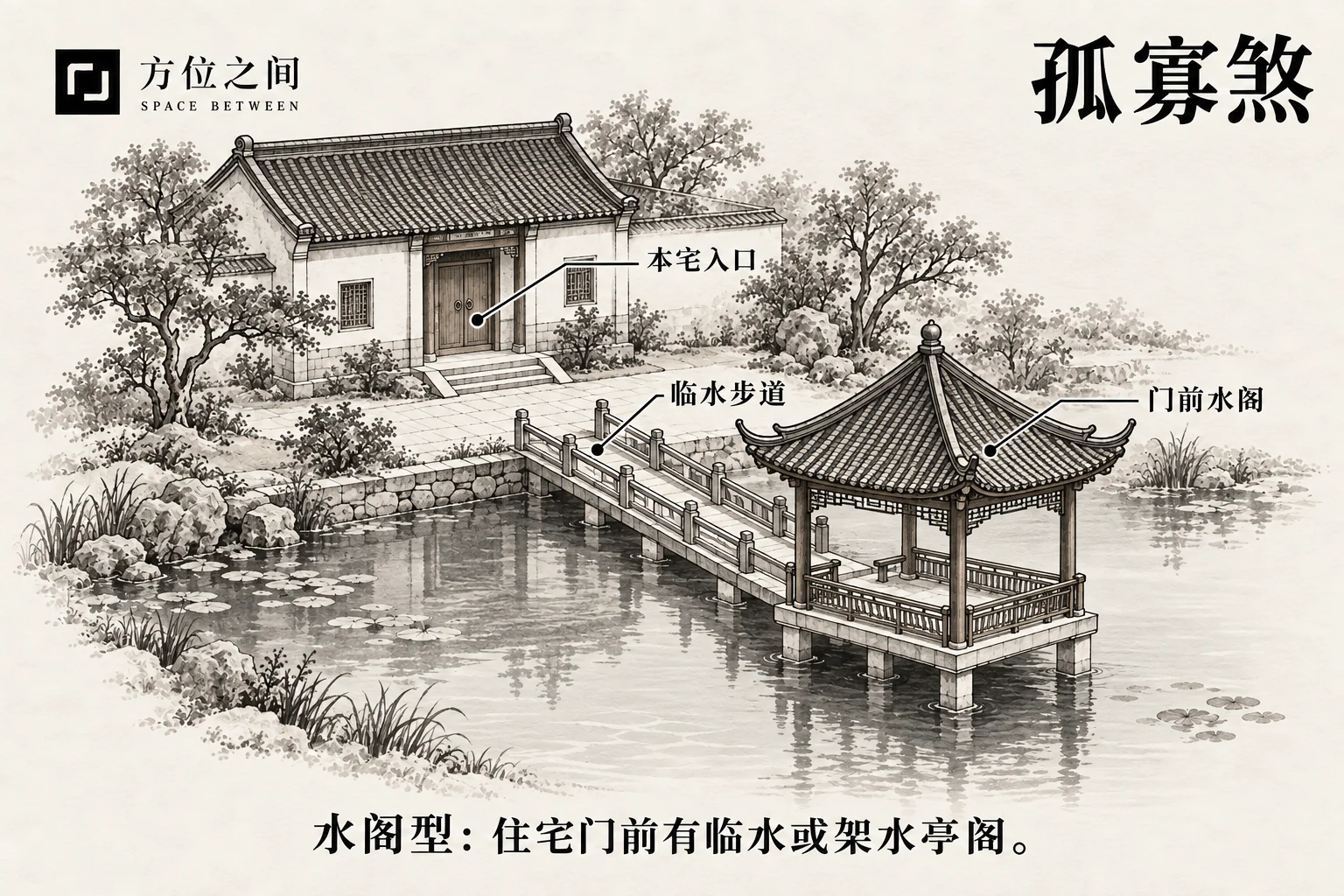 Enlarge diagram
A pavilion beside or over water stands before the house. This water-pavilion form is distinguished from the catalog’s other Gugua meaning. Record the pavilion relative to the main entrance, its shore connection and water level. Do not add an imaginary pond to an ordinary dry-ground garden shelter to fit the name.
Defining features
A pavilion beside or over water stands before the house. This water-pavilion form is distinguished from the catalog’s other Gugua meaning.
How to recognize it
Record the pavilion relative to the main entrance, its shore connection and water level. Do not add an imaginary pond to an ordinary dry-ground garden shelter to fit the name.
A pavilion connected to the front garden by a path calls for checking edge protection and water-level change. If it is merely a shelter on the bank, state that it does not stand over water rather than changing the scene to match the term.
Common confusions
The front-small-building Gugua shares the name but not the object, and neither is the isolated-tower Guasu. A water pavilion cannot substitute for assessment of the whole setting.
Folklore and sources
The traditional label does not mean residents will live alone or lose relatives. It gives no reason to treat garden water pavilions universally as unsuitable architecture.
Traditional responses and practical improvements
Check edge protection, slip resistance, standing water and component maintenance. Suitable use and landscape conditions may justify retention despite the historical negative name.
Sources and further reading
These sources help clarify the concepts and their origins. Explaining a traditional term does not establish that it can predict outcomes.
- Modern house-form catalog: names and definitions, not proof of ancient attribution
- Comparison of modern house-form lists: circulating descriptive versions, not proof of classical attribution
- Ministry of Education Revised Mandarin Dictionary: meanings of fang, not proof of the definition of Zhang Chun sha