
Name and specific form
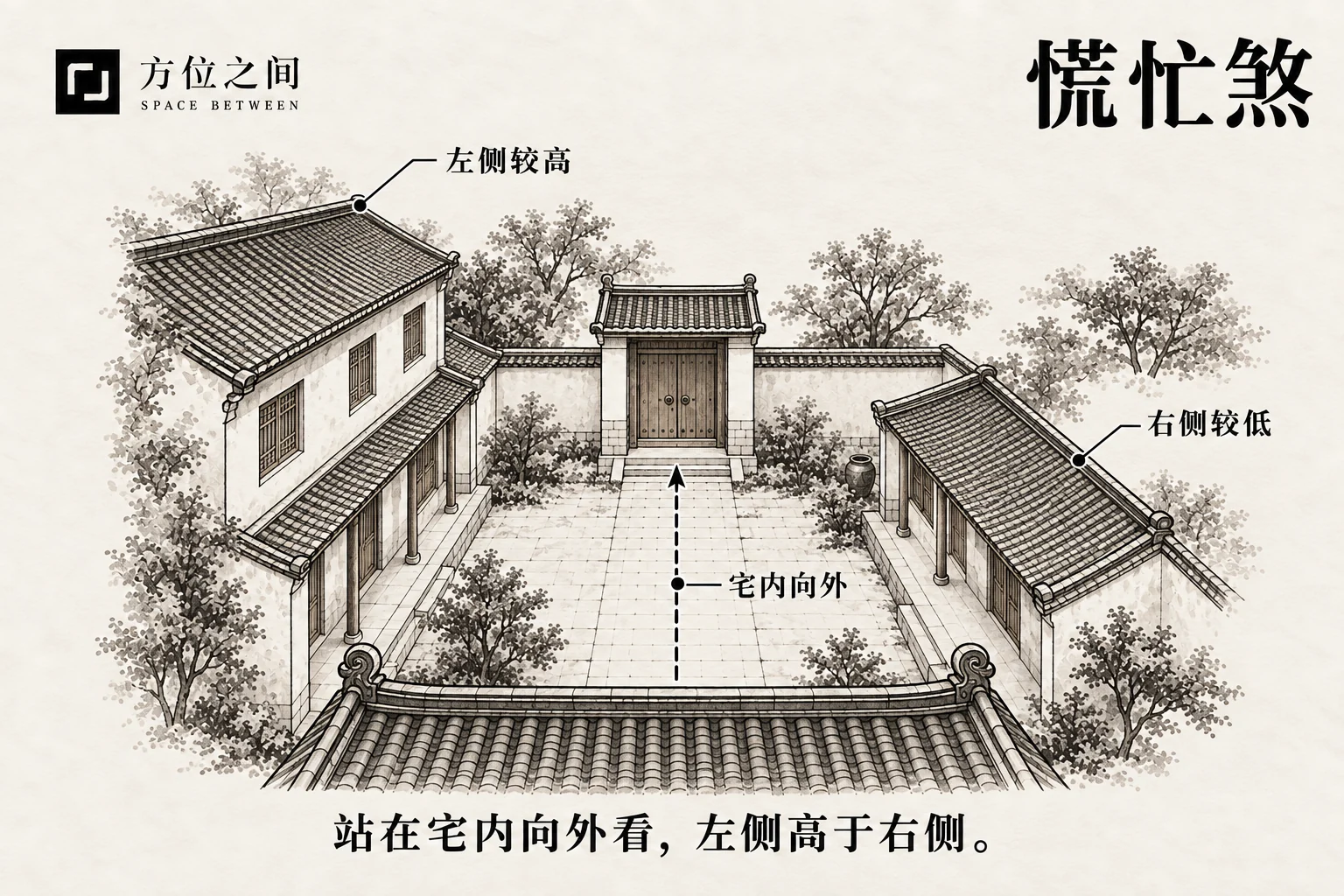
This list simplifies Azure Dragon envying the host to higher left, lower right. Left and right are defined while looking outward from inside the main home: Azure Dragon is left and White Tiger right. This describes relative height only, without distance, form, connections or opening relationships.
How to identify and record it
Mark an outward arrow on the plan, then compare roofs or landforms against the same ground datum. Looking inward from outside reverses left and right. Combining photographs taken at different distances can also create a misleading height contrast.
- Identify the comparison objects as side buildings, wings or hills.
- Record floor, eaves and ridge levels, excluding slope and perspective differences.
- Check whether the left object actually shades openings, approaches them closely or affects access.
Sources, versions and related names
The relevant historical “envying the host” passage in Zhai Zang Shu Shi Yi Zhong concerns burial-site hills, focusing on a left hill rising in an unyielding posture. This list’s higher-left, lower-right description is a much shorter modern account. Two building heights do not demonstrate every original condition.
Folk meanings and limits of interpretation
The jealous-host metaphor personifies massing as guest–host hierarchy. It cannot identify a jealous neighbor or assign inevitable outcomes to male, female or younger relatives. House heights do not verify a causal link between this name and interpersonal events.
Practical observation: what determines the effect
A higher side is not necessarily uncomfortable. Effects depend on its distance from occupied rooms, daylight paths, openings and routes. Asymmetry can also reflect sensible functional design. Look for specific conditions that can be described and checked again.
Improvements and what they cannot replace
For shading or close overlooking, adjust room use, lighting and moderate screening. Clear movable obstacles where circulation is tight. Do not build up the right side merely to match the left, or use the height metaphor to blame family members.
- Draw both elevations against one reference and record real experience.
- Prioritize particular openings, drainage and circulation issues.
- Preserve version differences instead of treating mirrored height arrangements as a universal good–bad rule.
Sources and further reading
These sources help clarify the concepts and their origins. Explaining a traditional term does not establish that it can predict outcomes.