
Name and specific form
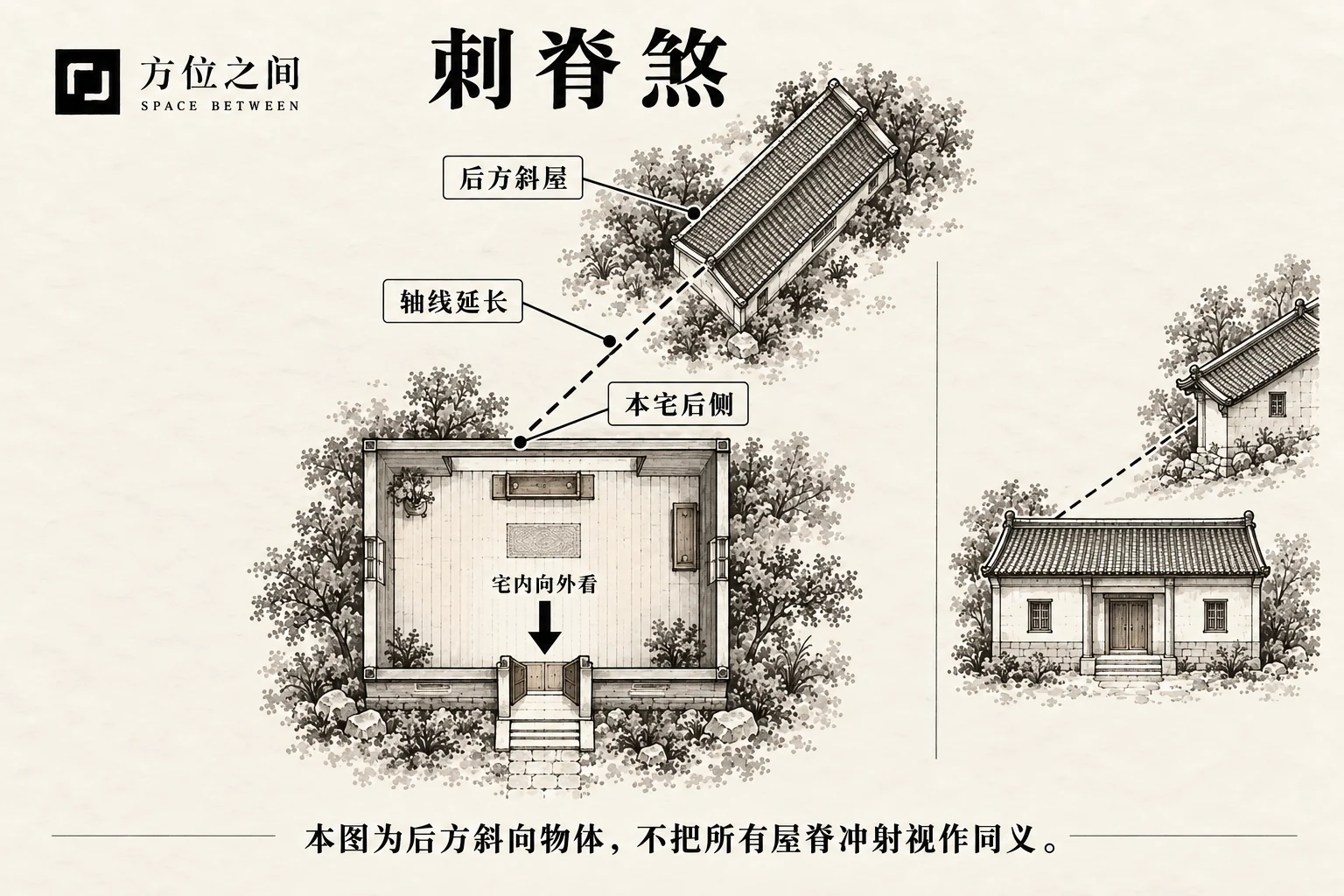
In this supplied list, Ciji describes a building or other object facing the rear of a home at an oblique angle. This is broader than a rear roof ridge alone. Identify the object and its direction; the word “spine” cannot replace a precise description or make every object visible behind the house part of the same form.
How to identify and record it
Fix the home’s front and rear, then draw rear openings, nearby objects and their extended directions separately. Perspective can make parallel lines converge in photographs. Check oblique relationships against a plan and the observer’s position.
- Distinguish a whole rear building, roof ridge, wall edge, pole or other object.
- State whether it is behind or diagonally behind the home, and whether its extended axis actually crosses a main opening.
- Record distance, visible extent, actual shading or looseness, and leave uncertain details explicitly unresolved.
Sources, versions and related names
Modern Cibei descriptions often refer to an oblique rear building or ridge, while some texts overlap this with the dark-arrow name. This page follows the broader objects in the supplied list. It does not claim that Ciji, Cibei and dark arrow are equivalent in every version; specific historic meanings still need the original diagram and context.
Folk meanings and limits of interpretation
Piercing, back and spine form a bodily metaphor of something approaching from behind, inviting associations with hidden disturbance. This is traditional symbolism, not evidence of hostile neighbors or a prediction of injury or illness. Keep the name separate from the observable spatial relationship.
Practical observation: what determines the effect
Rear shading, overlooking, equipment noise and maintenance can be checked separately. A silhouette pointing toward a rear wall does not establish an actual effect. An infrequently used blank rear elevation and a frequently opened bedroom window also require different observations; alignment alone is not a ranking of impact.
Improvements and what they cannot replace
Choose a response for the actual object. Adjust seating or curtains for troublesome sightlines; ask the responsible party to maintain loose parts, damaged walls or drainage. Hiding a shape from view does not repair a physical defect.
- Compare a front–rear reference plan with site photographs rather than judging one image.
- Record each inconvenience separately and prioritize verifiable problems.
- Do not alter neighboring buildings or hang heavy objects that could fall from the rear wall.
Sources and further reading
These sources help clarify the concepts and their origins. Explaining a traditional term does not establish that it can predict outcomes.