
Defining features
Oblique alignment is used below as a modern subdivision while retaining the historical scope of the names. Specify whether the geometry concerns a building axis, roof ridge or eave corner; do not merge them into one supposed influence line.
How to recognize it
For example, if a neighboring house lies behind the main house and is rotated about thirty degrees, separately check whether its ridge extension reaches the dwelling outline. Nonparallel buildings and a pointing ridge are not the same condition.
Folklore and sources
Visual checking of Yangzhai Cuoyao confirms that a ridge pointing at the back of the main hall is called Anjian, also named Cibei. These names cannot be forced into separate direct and oblique categories in every version.
Traditional responses and practical improvements
Fortune predictions in an old text do not amount to a verified specific remedy. The changes below concern real obstruction, water and falling-material problems, not claims to block an energy.
Oblique Frontal Ridge (Cimian)
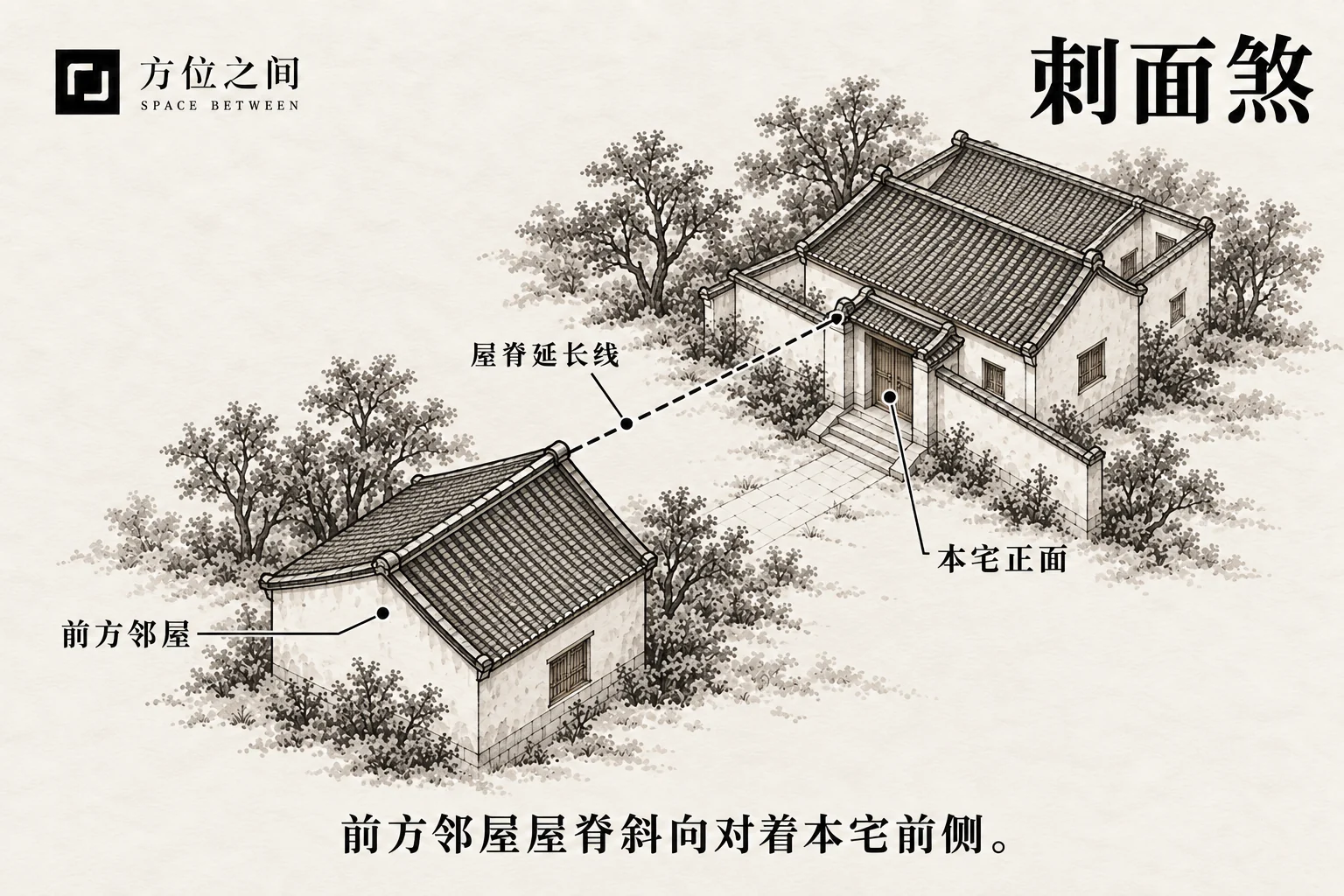 Enlarge diagram
Modern lists use this name for a neighboring building or roof ridge facing the dwelling obliquely from the front. Mark the dwelling’s front on a plan, then extend the neighboring ridge axis. A pointed shape seen in perspective does not establish an intersection in plan.
Defining features
Modern lists use this name for a neighboring building or roof ridge facing the dwelling obliquely from the front.
How to recognize it
Mark the dwelling’s front on a plan, then extend the neighboring ridge axis. A pointed shape seen in perspective does not establish an intersection in plan.
A neighboring house can rotate thirty degrees while its ridge extension passes across the open forecourt rather than through the dwelling. If the line reaches the front wall, record that location. Equal rotation angles do not establish equal spatial relationships.
Common confusions
The category can overlap with directly facing frontal ridges. A diagonally placed house need not have a sharp corner, and not every triangular roof belongs here.
Folklore and sources
The face metaphor helps explain the frontal position. It does not justify predictions concerning appearance, illness or accidents.
Traditional responses and practical improvements
If glare or privacy loss is real, suitable shading or curtains may help. Falling eave materials or cross-boundary runoff require property management or professional attention.
Rear Ridge Alignment (Cibei)
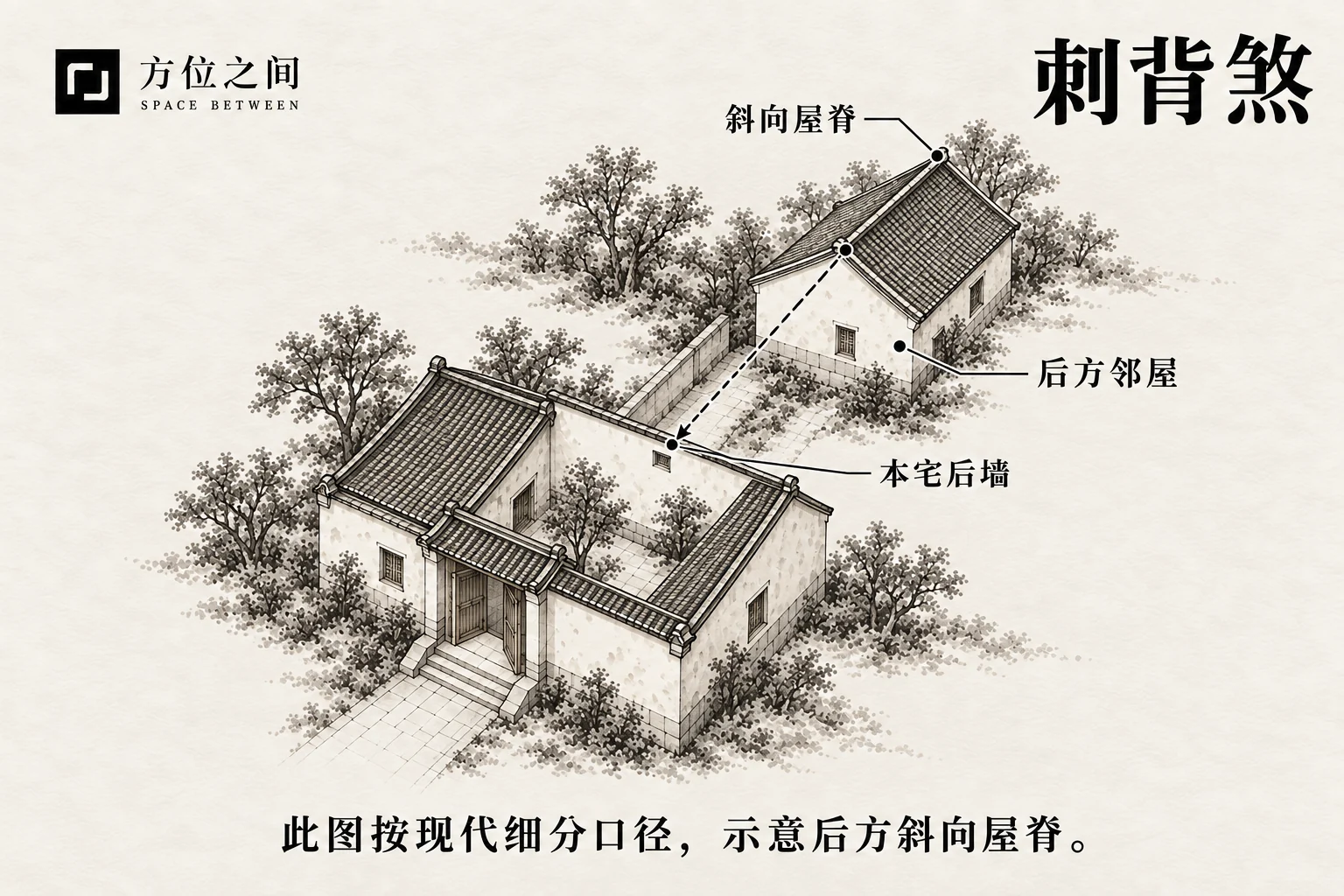 Enlarge diagram
A modern subdivision uses Cibei for oblique alignment from behind. The historical text also uses Anjian as another name for the same rear-ridge relationship. Record the rear facade, neighboring ridge axis and observation position, and state which textual definition you follow. Being behind the house alone is insufficient.
Defining features
A modern subdivision uses Cibei for oblique alignment from behind. The historical text also uses Anjian as another name for the same rear-ridge relationship.
How to recognize it
Record the rear facade, neighboring ridge axis and observation position, and state which textual definition you follow. Being behind the house alone is insufficient.
When a rear roof ridge points toward the dwelling’s back wall, the verified historical text supports the paired names Anjian and Cibei. A modern oblique-only subdivision additionally needs an angle and version. Different names do not imply an additional risk.
Common confusions
The historical source explicitly links this name with Anjian. An oblique illustration explains a modern subtype; it does not claim the old book separated the two rigidly.
Folklore and sources
PDF page 44 of Yangzhai Cuoyao directly shows the paired names Anjian and Cibei. Its statements about consequences remain traditional beliefs.
Traditional responses and practical improvements
Inspect rear access, drainage and window light first. Planting or screening may ease visual discomfort while preserving fire access and maintenance space.
Sources and further reading
These sources help clarify the concepts and their origins. Explaining a traditional term does not establish that it can predict outcomes.