
Defining features
The dwelling’s front is the reference. State whether the observation is from inside the door, the courtyard or an upstairs window, and whether the facing object is a gable, ridge or whole facade.
How to recognize it
A reproducible record includes a viewpoint photograph, plan distance and obstruction height. Two observers using the same axis and object should be able to describe the same relationship.
Folklore and sources
Modern lists call nearer facing buildings Cixiong and farther ones Cile, but distances vary by version. Five meters is neither a universal historical standard nor a daylight or safety boundary.
Traditional responses and practical improvements
The original list provides no verifiable dedicated ritual procedure. Traditional avoidance of direct opposition can prompt a review of entrance use, but improvements should be checked through light, views and access.
Near Facing Buildings (Cixiong)
 Enlarge diagram
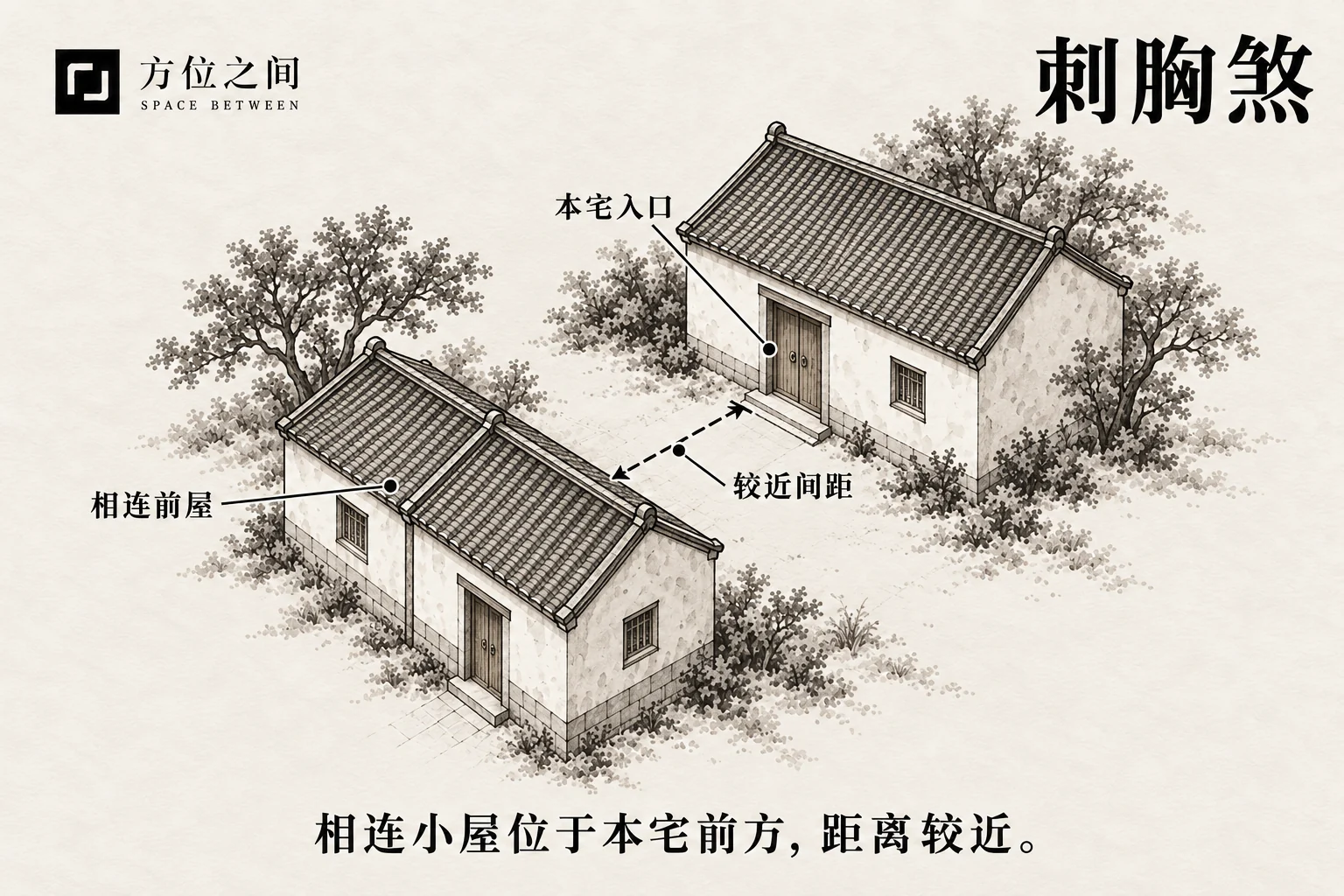
Two connected buildings stand relatively close in front of the dwelling, facing the area before its hall. Identify which two buildings are joined, then record their alignment with the entrance hall and clear separation. Distance describes the scene but does not determine an outcome.
Defining features
Two connected buildings stand relatively close in front of the dwelling, facing the area before its hall.
How to recognize it
Identify which two buildings are joined, then record their alignment with the entrance hall and clear separation. Distance describes the scene but does not determine an outcome.
If linked buildings stand four meters before the entrance but their axis misses the doorway, record nearby front buildings rather than forcing a direct-alignment label. More distant buildings can still align directly. Distance and alignment require separate records.
Common confusions
This differs from a roof ridge pointing toward the front. Some modern material mentions five meters, but no sufficiently consistent primary threshold has been verified.
Folklore and sources
The chest metaphor expresses a feeling of proximity at the front of the hall. It cannot support predictions about chest illness or family events.
Traditional responses and practical improvements
If the entrance is genuinely crowded, clear stored objects and the door-swing area. Where the relationship is visual and use is normal, mirrors or new walls are unnecessary.
Distant Facing Buildings (Cile)
 Enlarge diagram
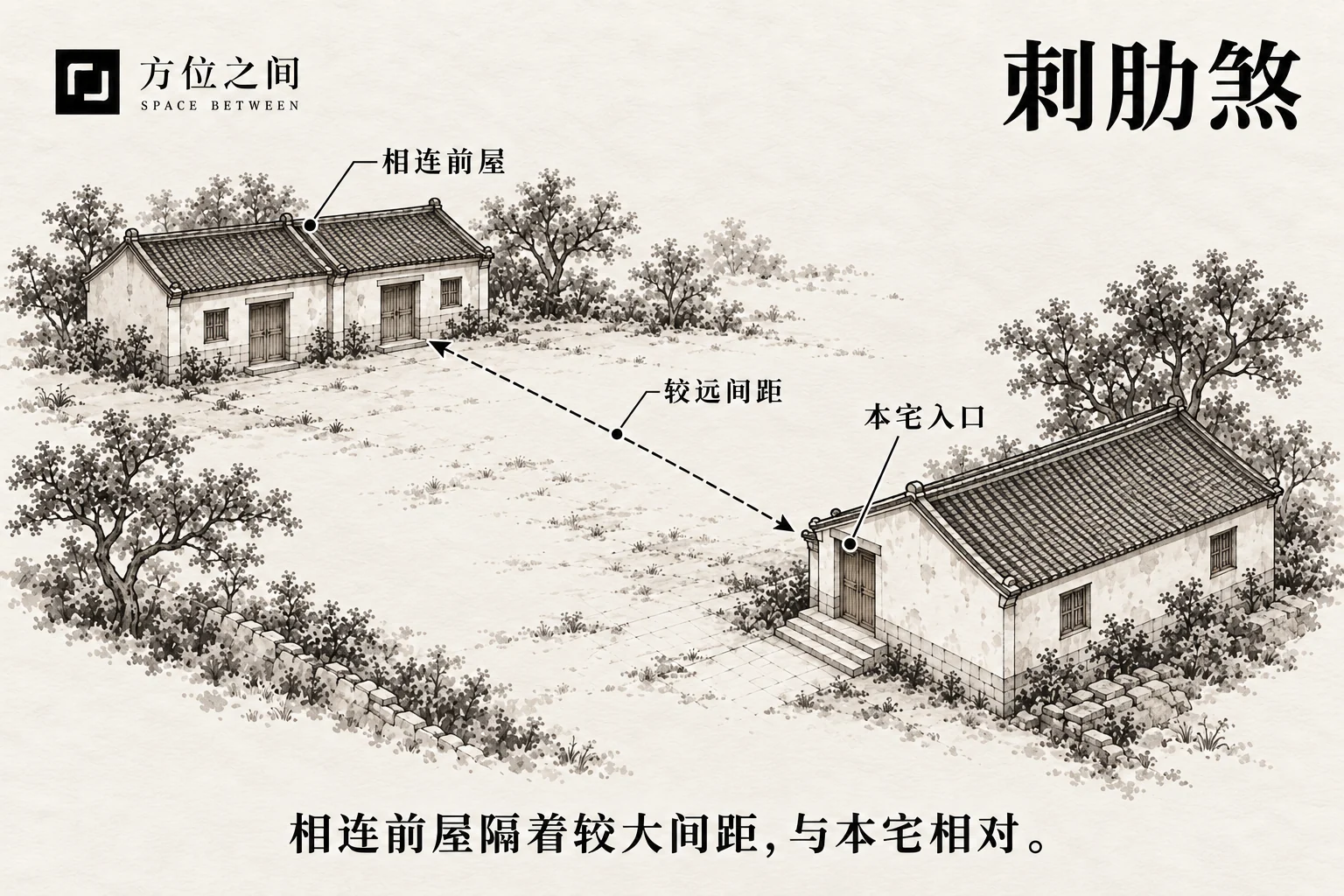
This uses a similar frontal relationship to Cixiong, but modern lists apply a separate name when the buildings are farther away. Record the distant buildings along the same viewing axis and identify the intervening road, courtyard or open ground. The name cannot replace a site description.
Defining features
This uses a similar frontal relationship to Cixiong, but modern lists apply a separate name when the buildings are farther away.
How to recognize it
Record the distant buildings along the same viewing axis and identify the intervening road, courtyard or open ground. The name cannot replace a site description.
A pair of buildings may face the house across an open courtyard without shading windows or obstructing entry. That confirms a distant facing relationship only. Do not invent a distance boundary simply to distinguish this term from Cixiong.
Common confusions
The rib metaphor does not necessarily mean a strike from the side: this version still describes buildings in front. Do not illustrate it as an arrow against a side wall.
Folklore and sources
The bodily analogy lacks a stable quantitative boundary between near and far. Treat it as version-specific language, not a separately computable severity level.
Traditional responses and practical improvements
Check whether the distant object actually causes shading or noise. Address a specific source when a problem exists; otherwise the arrangement may remain.
Frontal Obstruction (Saixiong)
 Enlarge diagram
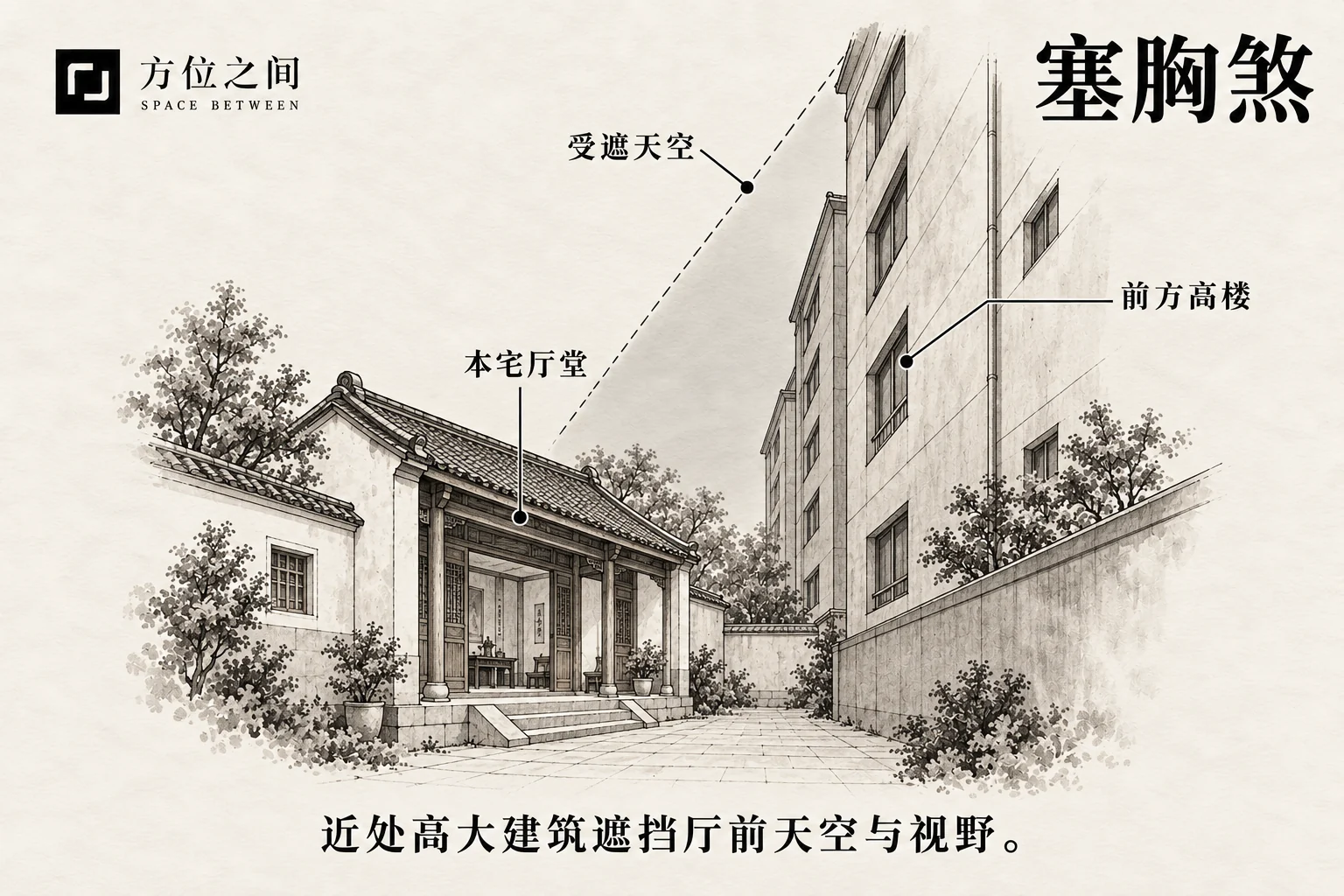
A tall nearby building stands before the hall, blocking sky and views from the dwelling’s main opening. Photograph the scene from the usual occupied position and record obstruction angle, distance and time. A facing facade without lost light requires a different description.
Defining features
A tall nearby building stands before the hall, blocking sky and views from the dwelling’s main opening.
How to recognize it
Photograph the scene from the usual occupied position and record obstruction angle, distance and time. A facing facade without lost light requires a different description.
At the same eight-meter distance, a six-meter building and a twenty-meter building obstruct the sky differently. Actual daylight also depends on window orientation and time of day. Proximity alone is insufficient.
Common confusions
This concerns a large mass in front, not necessarily enclosure on all sides. Story count alone cannot determine indoor sunlight.
Folklore and sources
The image of a blocked chest conveys spatial pressure. A folk name may express an experience but cannot replace health or daylight assessment.
Traditional responses and practical improvements
Consider room use, openings, lighting and ventilation. Disputes concerning neighboring buildings or planning should rely on measurements and applicable requirements.
Sources and further reading
These sources help clarify the concepts and their origins. Explaining a traditional term does not establish that it can predict outcomes.