
Name and specific form
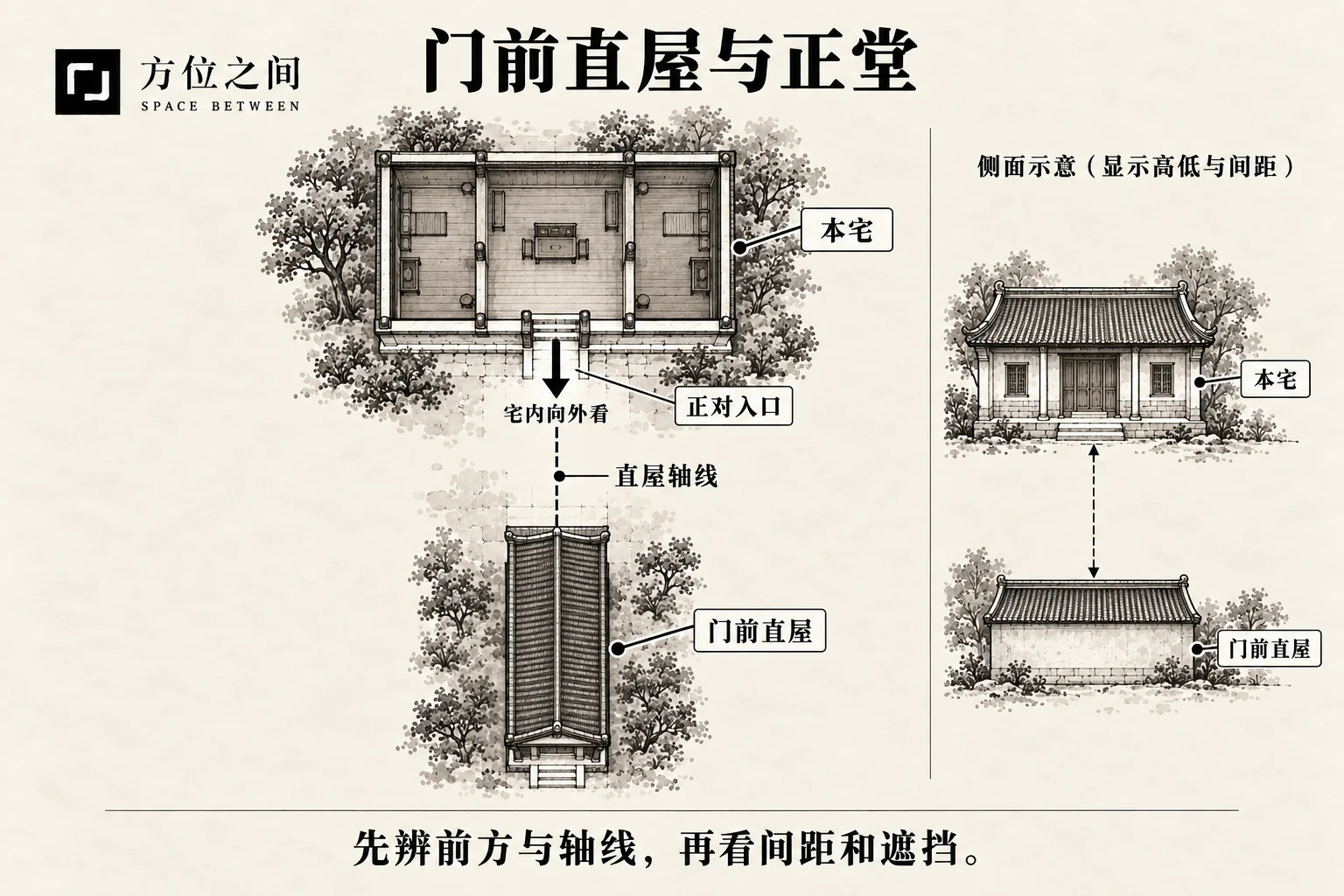
In this list, Mingtang sha describes an elongated building directly before a hall, oriented toward the dwelling. The subject is the relationship between the entire front building and the space before the hall. Mingtang can also mean an open forecourt; having a forecourt or front building alone does not establish an unfavorable arrangement.
How to identify and record it
Mark the hall, main entrance and front building’s long axis on a plan, then observe from a regularly occupied position inside the hall. “Clash” here describes direction and alignment; it does not mean an invisible force has passed through walls.
- Identify whether the front building faces the dwelling, points along its long axis, or merely exposes a ridge tip.
- Record the distance to doors and windows and any courtyard, road or screening between them.
- Check sky visibility, sightlines and circulation separately instead of drawing only a red arrow.
Sources, versions and related names
This definition follows the supplied modern list of forms. Traditional discussions use Mingtang at different scales and for different objects, so they cannot all be merged. This list also describes Vermilion Bird protruding tongue as a straight building before the door. Ridge alignment concerns only the ridge and should not be substituted for the whole building.
Folk meanings and limits of interpretation
Traditional dwelling language often describes a projecting mass facing the home as pressing toward it and prefers a spacious, buffered frontage. This is a convention of form assessment, not a basis for predicting litigation, injury or wealth. It also does not show that a neighbor intends harm.
Practical observation: what determines the effect
A nearby front building may obstruct sky views, create overlooking or squeeze a courtyard route. A small or distant building that leaves openings unaffected creates a different experience. Geometric alignment alone does not establish discomfort; assess actual occupied positions and different times of day.
Improvements and what they cannot replace
Define the problem before choosing a response: modest curtains or planting may address sightlines, an organized forecourt may improve access, and poor lighting requires examining available light. Screening must preserve road visibility, ventilation and necessary entrances.
- Take a normal eye-level photograph from the hall and pair it with a dimensioned plan.
- Try movable furniture and screening first, then record any change in comfort.
- Do not alter neighboring buildings or public roads yourself; address structural issues through the appropriate process.
Sources and further reading
These sources help clarify the concepts and their origins. Explaining a traditional term does not establish that it can predict outcomes.