
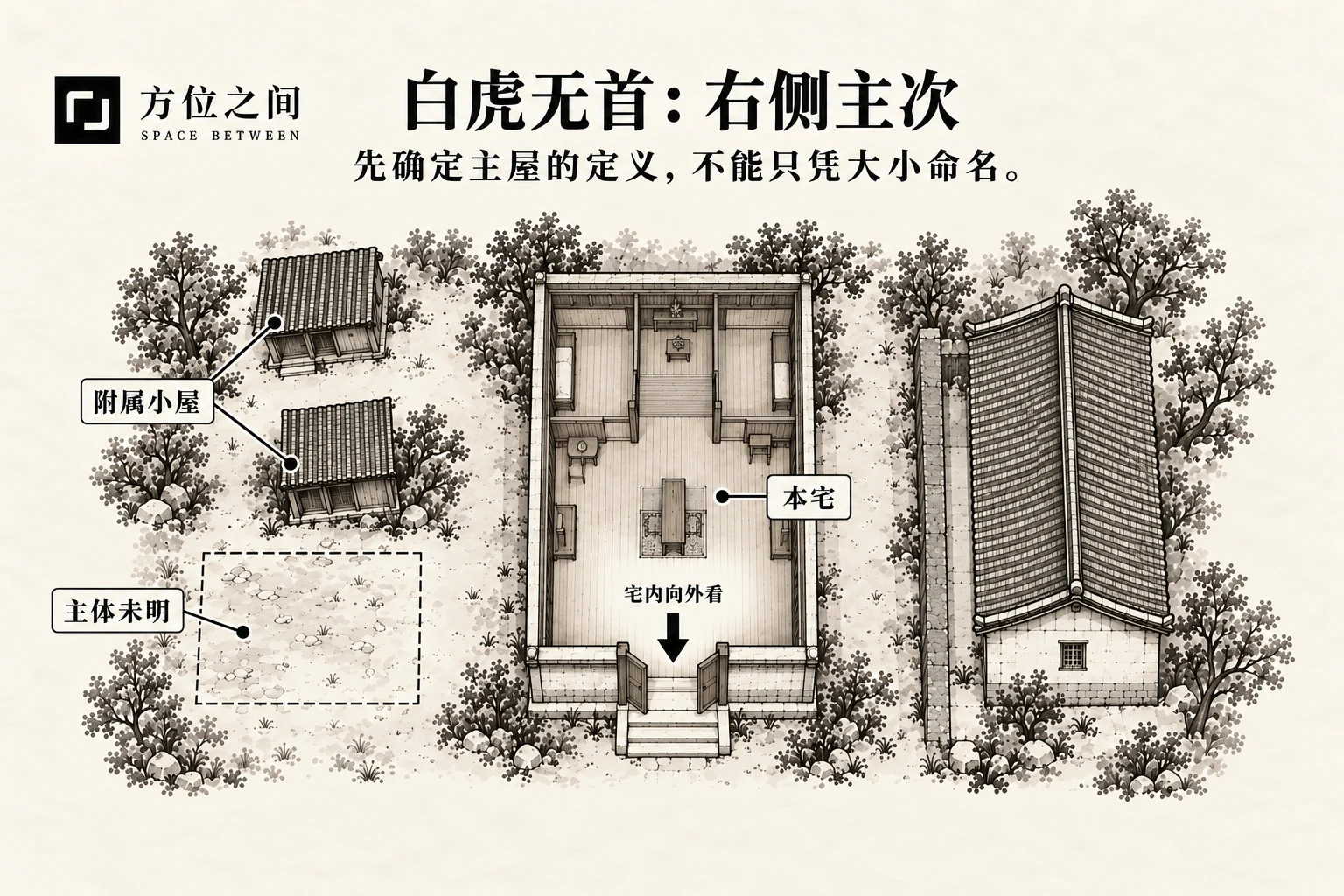
Name and specific form
This list explains White Tiger without a head as no principal building on the right. Principal building may mean the whole dwelling’s main hall or the main part of a side wing. Without clarification, it does not identify a fixed missing corner. This entry preserves that uncertainty and asks readers to draw the hierarchy being used.
How to identify and record it
Name the main building, hall, right annexes and entrance separately, then determine which the source calls principal. No building anywhere on the right is a side gap; an unbuilt central hall concerns a different construction sequence.
- Define the principal building by function, position and evidence, not size alone.
- Separate an entirely empty wing from a wing lacking its dominant mass.
- Check construction stage and use to distinguish planned openness from unfinished work.
Sources, versions and related names
This entry follows the supplied White Tiger without a head wording, without establishing one historic meaning of principal building. The older no-host entry specifically concerns an unbuilt central hall with completed side buildings. Shared “no principal” wording does not make a central-gap illustration universally appropriate here.
Folk meanings and limits of interpretation
The head symbolizes hierarchy and leadership in traditional personification of buildings. It does not show that a household lacks a head, that elders will fare badly or that residents lack judgment. Explain this as human imagery rather than an assessment of a real family.
Practical observation: what determines the effect
Actual questions concern clear functions, a legible entrance and convenient connections between rooms. A layout without a dominant building may be a sensible distributed modern design. Unfinished work should be managed as construction, not treated as a permanent pattern of fate.
Improvements and what they cannot replace
Improve wayfinding and access through signs, lighting and functions first. Building changes require an actual use and a feasible authorized plan. Do not add a principal building or remove rooms while the term is unresolved, or promise that tablets or ornaments restore a symbolic head.
- Keep the wording, chosen definition of principal building and complete plan for review.
- Separate verified access or maintenance issues from unresolved historic meanings.
- Respect useful multi-center layouts rather than forcing a hierarchy to match an old name.
Sources and further reading
These sources help clarify the concepts and their origins. Explaining a traditional term does not establish that it can predict outcomes.