
Name and specific form
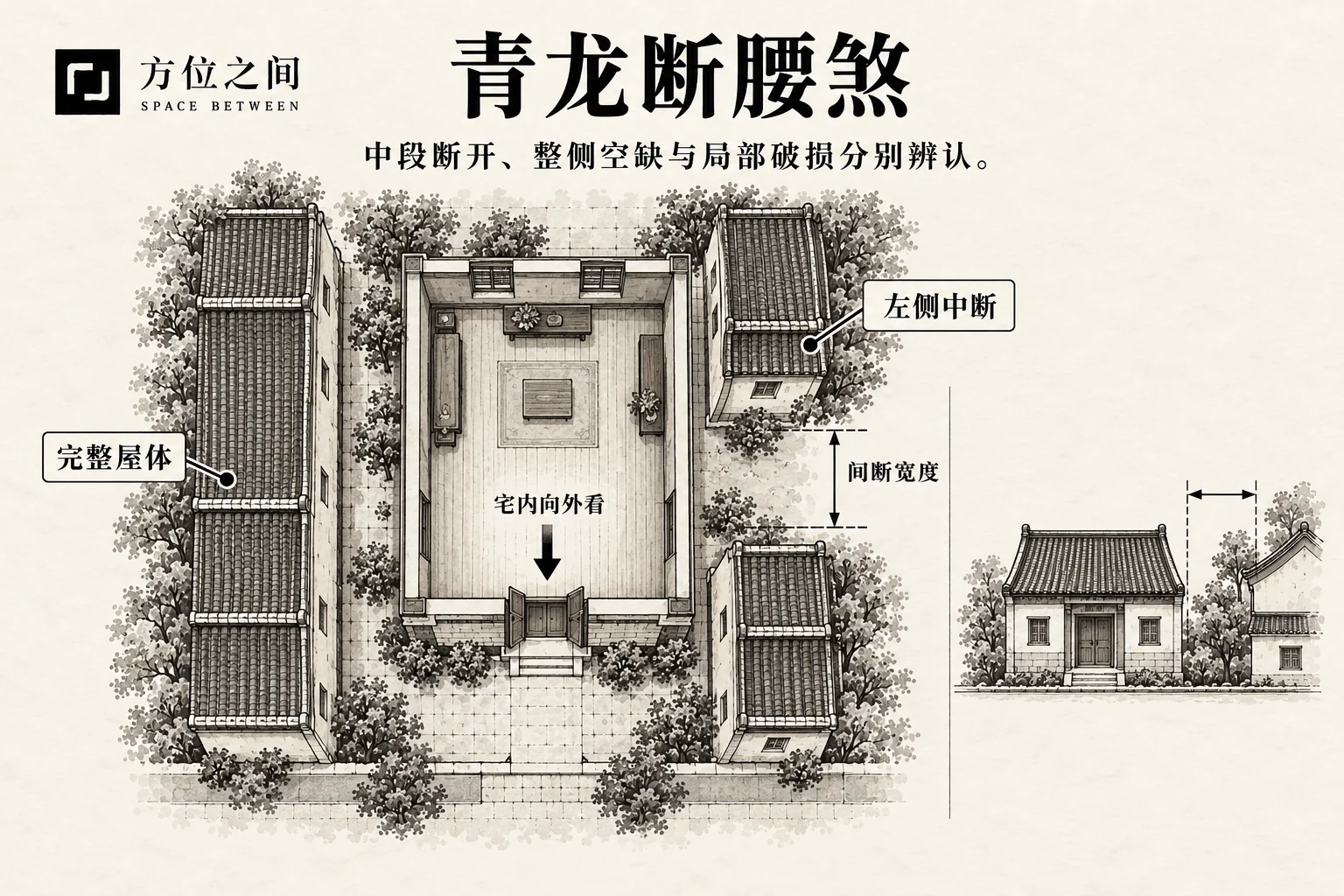
This list uses Azure Dragon with a broken waist for a break in the middle of a building mass on the left. The gap may separate two independent buildings or follow demolition or damage to one building. Similar outlines from above do not make these the same condition.
How to identify and record it
Fix the home’s orientation, then trace the left front segment, middle gap and rear segment, marking remaining walls, roofs or corridors. A part hidden in a photograph is not necessarily a physical break.
- Identify an original separation joint, courtyard opening, removed section or damaged section.
- Record whether the gap provides access, drainage or maintenance space.
- Where components or residual walls are exposed, record materials, apparent condition and responsibility separately.
Sources, versions and related names
This entry follows the supplied brief definition of Azure Dragon with a broken waist, without inventing a universal gap length or historic ratio. Without feet concerns an entirely unbuilt side; broken arm usually concerns side-building damage. Conditions can coexist, but broken waist specifically focuses on continuity through the middle.
Folk meanings and limits of interpretation
The waist compares the building’s middle to a bodily connection, making the break symbolize discontinuity. It cannot predict back illness, interrupted careers or family separation. Ordinary structural movement joints should not be labeled inauspicious for the same reason.
Practical observation: what determines the effect
Check whether routes detour, water concentrates, remaining components need maintenance and the two building sections function together. An intentional gap may improve light and service access. An opening left by damage requires a response to the actual damaged fabric.
Improvements and what they cannot replace
Balance useful connections with necessary separation. Improve routes, lighting, drainage and boundaries between sections. A new connecting corridor or repaired segment needs appropriate structural and building conditions; do not seal every gap to “repair the waist.”
- Compare the current condition with the original plan and retain evidence of how it formed.
- Address an access gap and structural damage as different problems.
- A bridging board or protective ornament cannot replace a proper connection or repair plan.
Sources and further reading
These sources help clarify the concepts and their origins. Explaining a traditional term does not establish that it can predict outcomes.