
Questions and answers
What does Azure Dragon open mouth mean?
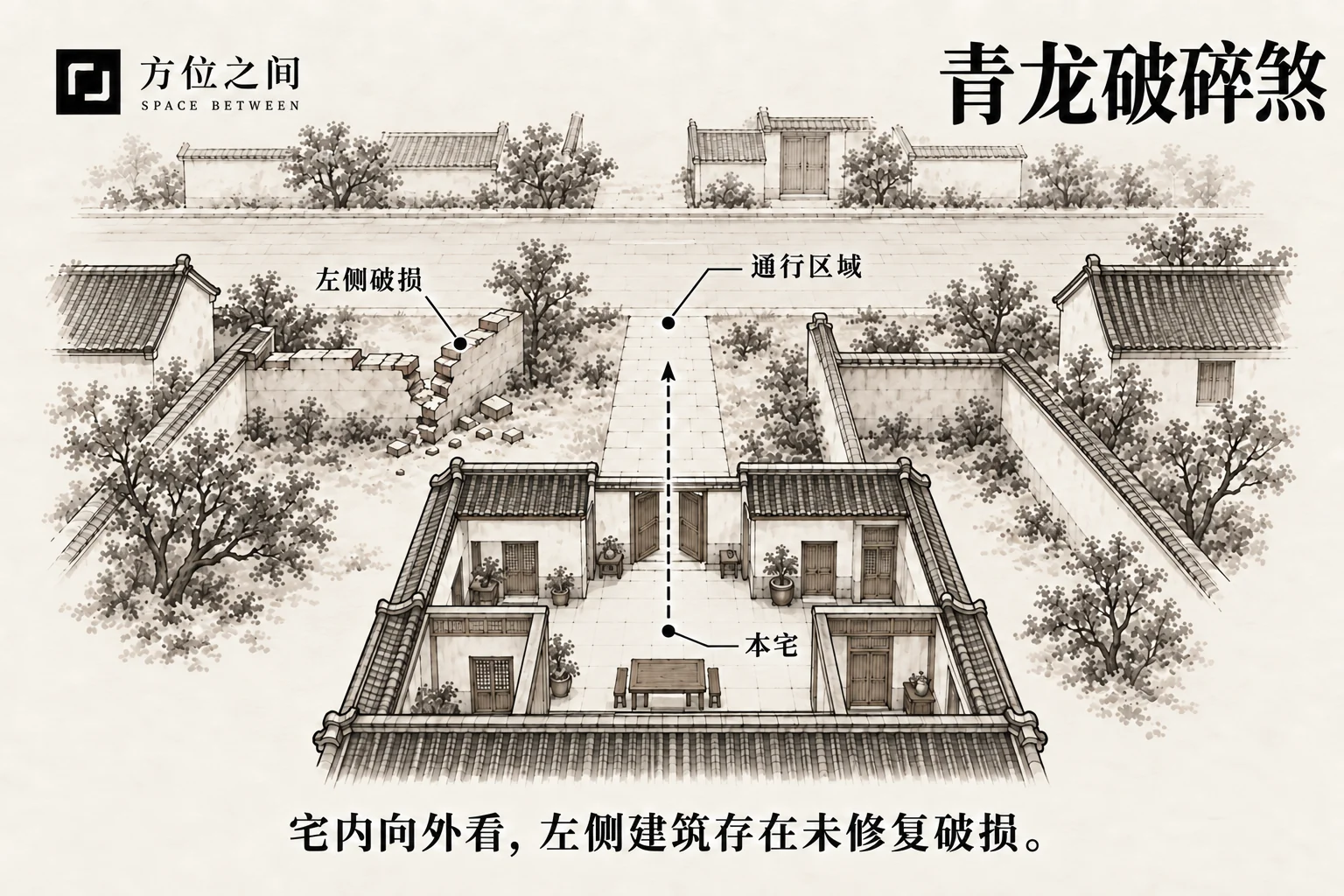
In this list, Azure Dragon opening its mouth describes a deteriorated building on the left side of the home. “Opening its mouth” is figurative dwelling language. The subject is the location of neglected or damaged fabric, not every visible window, operating door or normally open courtyard. Identify the physical condition before applying the name.
Read the full explanationWhat should I check first when examining Azure Dragon open mouth?
Fix front, rear, left and right while looking outward from the home, then mark the damaged building on the left and its distance. Observe only from safe, permitted positions; do not enter an abandoned building to obtain a complete photograph. Old finishes, vacancy and damaged components must be recorded separately.
Confirm that the building is on the home’s left, not merely on that side of a photograph taken after turning around.
Distinguish peeling finishes, cracked walls, missing roofing and ordinary open windows.
Read the full explanationWhat is often confused with Azure Dragon open mouth?
This entry follows the supplied modern definition of Azure Dragon opening its mouth, not a name established uniformly across old texts. Damaged buildings on the front or right side need their own location record. The common open-mouth term can also describe a door facing an elevator, which is a different object.
Read the full explanationName and specific form
In this list, Azure Dragon opening its mouth describes a deteriorated building on the left side of the home. “Opening its mouth” is figurative dwelling language. The subject is the location of neglected or damaged fabric, not every visible window, operating door or normally open courtyard. Identify the physical condition before applying the name.
How to identify and record it
Fix front, rear, left and right while looking outward from the home, then mark the damaged building on the left and its distance. Observe only from safe, permitted positions; do not enter an abandoned building to obtain a complete photograph. Old finishes, vacancy and damaged components must be recorded separately.
- Confirm that the building is on the home’s left, not merely on that side of a photograph taken after turning around.
- Distinguish peeling finishes, cracked walls, missing roofing and ordinary open windows.
- Record whether loose parts are near openings or access routes and identify who manages the site.
Sources, versions and related names
This entry follows the supplied modern definition of Azure Dragon opening its mouth, not a name established uniformly across old texts. Damaged buildings on the front or right side need their own location record. The common open-mouth term can also describe a door facing an elevator, which is a different object.
Folk meanings and limits of interpretation
The mouth metaphor associates incompleteness or lost enclosure with unease and can invite traditional ideas of unsettled household fortune. Such imagery does not establish that a nearby ruined house causes conflict, illness or financial loss, nor that anyone has malicious intent.
Practical observation: what determines the effect
On the left, compare the side window and courtyard boundary. Suppose one older house outside a living-room window has an intact boundary wall and no visible falling material, while another has a roofless room open to a shared yard. Both may receive the folk label “open mouth,” yet the records differ: view and experience in the first case; visible damage, boundary management and rainwater paths in the second. “Left” alone says nothing about an individual family member’s fate.
Improvements and what they cannot replace
Address verifiable maintenance impacts on the left by contacting the party authorized to inspect and repair. If temporary avoidance is needed, preserve normal circulation and visibility. A curtain changes the view; it does not repair a physical defect next door.
- Do not enter a derelict building with unclear ownership or structural condition, or remove loose parts yourself.
- Keep your own routes clear and ask the responsible party for suitable protection and lighting when needed.
- Combine repair records with a later check of actual conditions; ornaments are not maintenance.
Sources and further reading
These sources help clarify the concepts and their origins. Explaining a traditional term does not establish that it can predict outcomes.
- Dili Nangjin Jizhu, volume 1: context for Four Symbols positions and protection imagery, not proof of this name’s universal origin
- Comparing modern dwelling-form lists: evidence of circulating wording, not authenticated historic attribution
- Hong Kong Buildings Department: common building defects and maintenance (modern maintenance reference, not the origin of the sha term)