
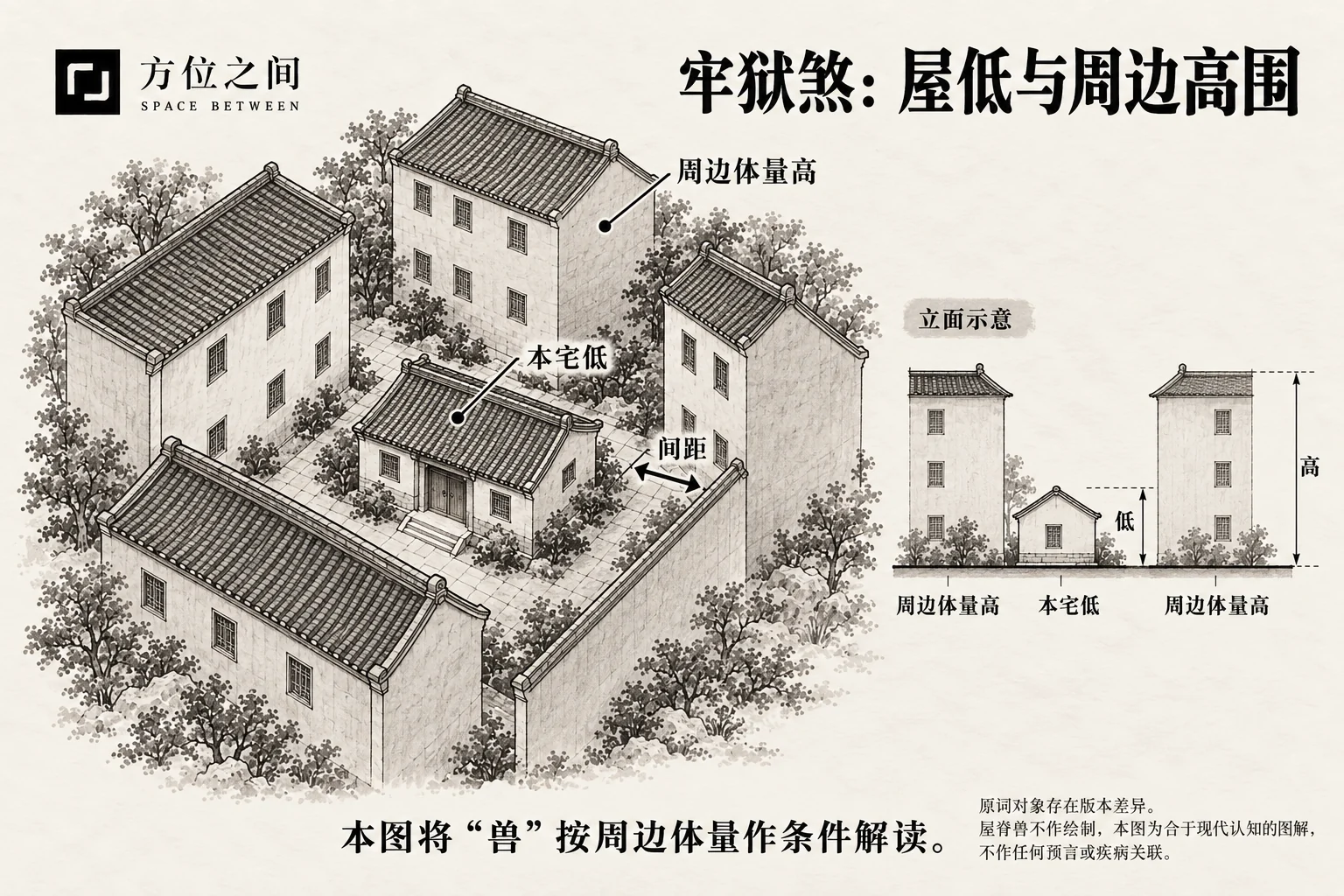
Name and specific form
The supplied list explains Laoyu sha only as “low house, high beasts.” House normally means the dwelling under observation, while beasts may signify surrounding landforms, side wings or nearby masses. Those four words do not establish a unique plan. This entry retains the name and identifies the objects before interpreting them.
How to identify and record it
First determine what “beasts” means in the source, then plot those objects and the house in plan and section. Describe tall surrounding buildings as buildings; if the objects are hills, record the terrain separately. Do not silently exchange hills and buildings in the same illustration.
- Label the actual houses, landforms or side wings instead of drawing mythical animals in their place.
- Compare heights against one datum and record spacing and openings as well.
- Check visible sky, enclosure and exit routes from regularly used rooms.
Sources, versions and related names
Historic discussions often use the Four Symbols for relative position and protection, not four literal creatures around a dwelling. “Low house, high beasts” is this modern list’s wording; it has not been established as the universal Laoyu diagram. Low homes among tall surroundings offer a useful comparison, but do not prove the term’s origin.
Folk meanings and limits of interpretation
The prison metaphor conveys enclosure and restricted movement; it does not mean the dwelling causes crime or imprisonment. Inferring a resident’s character or punishment from building form is unsupported. This page explains the metaphor without endorsing a predictive effect.
Practical observation: what determines the effect
A low house may be shaded, or it may retain good light with adequate spacing. Feelings of enclosure also depend on view distance, courtyard openings and personal preferences. Hillsides and tall buildings have different maintenance concerns, so identifying the actual object is essential.
Improvements and what they cannot replace
Reversible changes include relocating primary activities, adding appropriate lighting, clearing exits and improving the use of window areas. Suspected damage to retaining structures, slopes or buildings requires the relevant inspection; a ritual “release from prison” cannot replace physical repair.
- Give each comparison object a clear site name before applying a traditional label.
- Keep necessary openings and access; do not seal every window to hide tall surroundings.
- Do not use this name to label a family member’s behavior or fate.
Sources and further reading
These sources help clarify the concepts and their origins. Explaining a traditional term does not establish that it can predict outcomes.