
Name and specific form
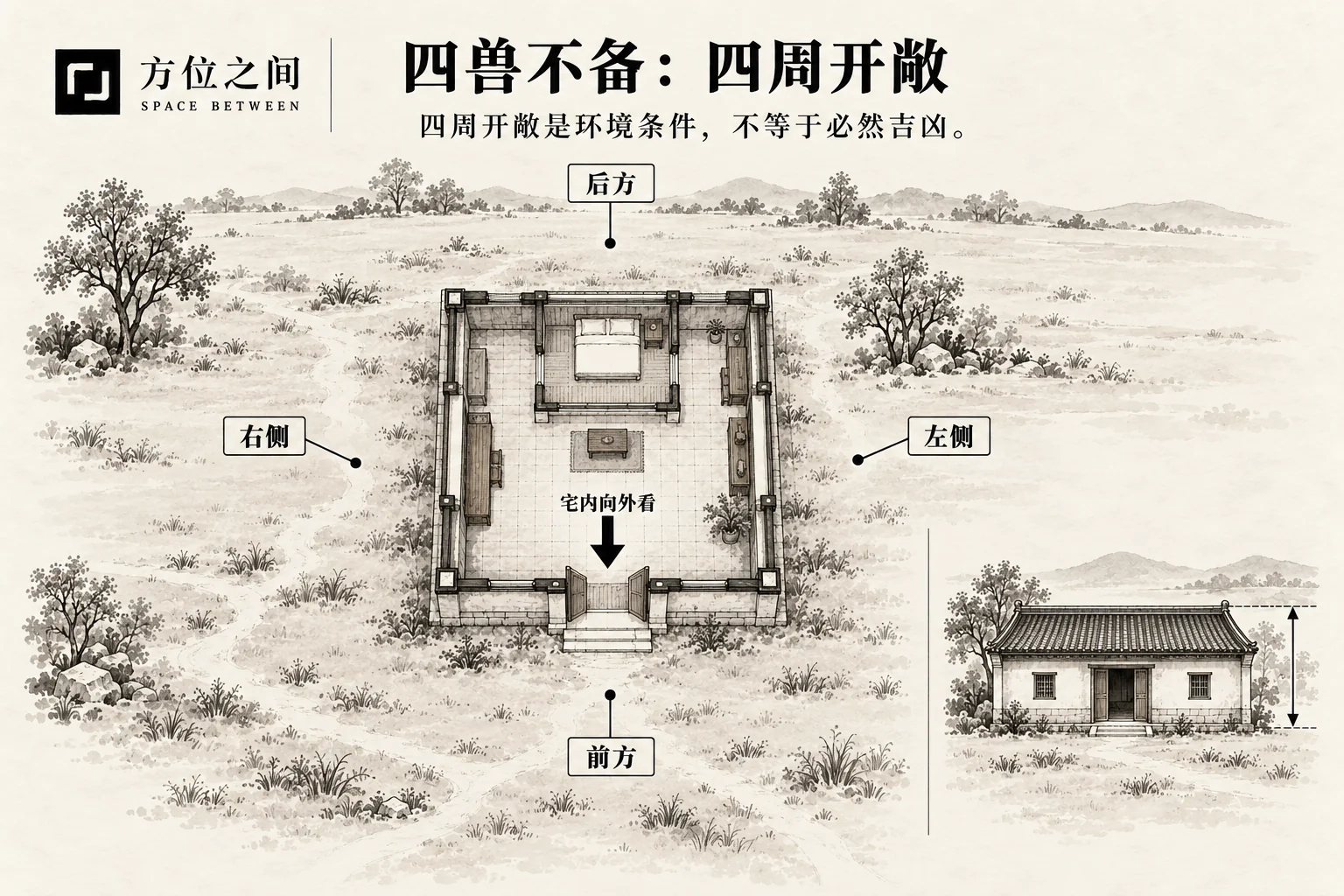
In this list, the Four Symbols incomplete summarizes a lack of protection at front, rear, left and right. Protection may refer to landforms, surrounding buildings or a sense of enclosure, so identify the intended meaning first. Open land around a detached house should not be translated directly into real-world danger.
How to identify and record it
Fix all four sides using the home’s outward axis, then record actual terrain, buildings, enclosures, open land and roads on each side. Incomplete is relative to an idealized model; it does not require four animal ornaments or blocking every direction.
- Define the physical object called protection and compare all four sides at the same scale.
- Separate visible distant scenery from near objects that actually affect openings.
- Check wind comfort, privacy, access and site management rather than counting buildings alone.
Sources, versions and related names
Dili Nangjin Jizhu explains that the Four Symbols take their names from protection, not literal creatures. Yusui Zhenjing also cautions against forcing names into a fixed count. This entry explains the supplied modern label without claiming that all traditions require equal numbers and heights in four directions.
Folk meanings and limits of interpretation
Incompleteness expresses traditional preferences for enclosure, correspondence and wholeness. It does not establish absent relatives, benefactors or safety. Nor does building observation support turning the metaphor into a requirement to buy four objects.
Practical observation: what determines the effect
Openness on four sides can provide broad views, daylight and independent space while increasing wind exposure or visibility at particular locations. Actual needs depend on the site, openings and lifestyle. Dense enclosure is not necessarily more comfortable, and one term cannot replace specific conditions.
Improvements and what they cannot replace
Where a clear issue exists, choose suitable shading, privacy, landscape or management measures side by side, preserving ventilation and access. New fixed enclosures need a real function and appropriate building conditions. Do not blindly add walls, rocks, dense trees or sealed windows to complete the Four Symbols.
- Use a four-side condition record rather than scoring the number of mythical creatures.
- Improve particular places of use first, then review whether more adjustment is needed.
- Respect cultural preferences without guaranteeing changed fortune through completing the Four Symbols.
Sources and further reading
These sources help clarify the concepts and their origins. Explaining a traditional term does not establish that it can predict outcomes.