
Defining features
Occupancy, damage and absent services each require checking. Closed doors and windows do not establish vacancy, and vacancy does not establish danger.
How to recognize it
Fix the building’s front, rear, left and right before recording dimensions, positions and uses. Photographs have perspective limits; verify with a plan and section when needed.
Common confusions
One name can refer to different objects and one form can have different names. Preserve each version’s definitions rather than deriving new rules from a single character.
Folklore and sources
Modern catalogs retain Kongwang and Xulao, but the possible Xulao-Xupi character relationship lacks a verified original page. Traditional predictions cannot replace structural, health or social assessment.
Traditional responses and practical improvements
Traditional preferences favor inhabited settings with mutual support. Practical concerns are management, maintenance, lighting and communication. These names must not stigmatize people living alone or owners of vacant property.
Detached Single-Room House (Kongwang)
 Enlarge diagram
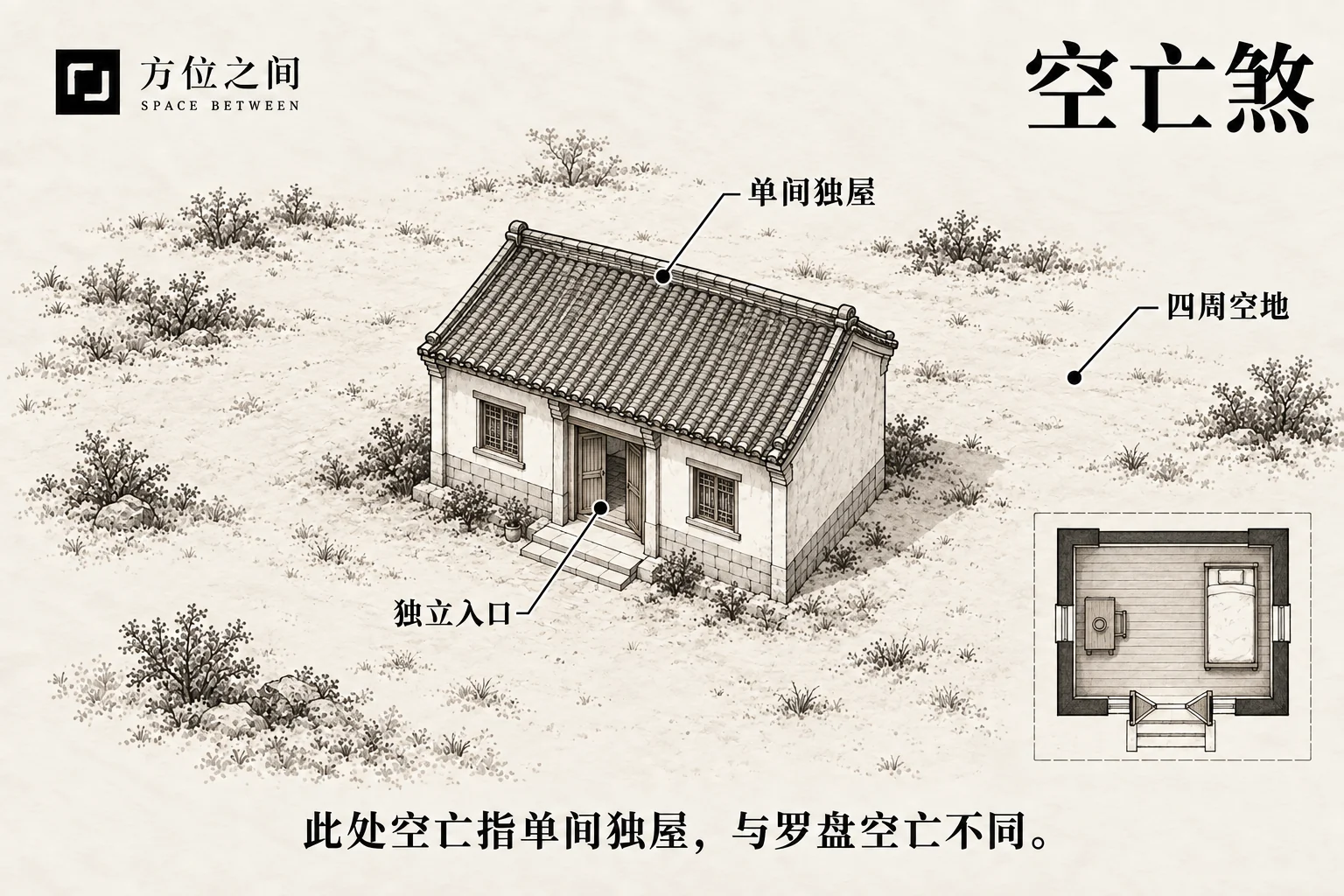
This modern explanation concerns a detached house with one principal internal space, not a directional boundary on a compass. Check the plan and partitions to distinguish a one-room building from a detached home containing several rooms. Record ancillary facilities honestly rather than forcing a one-room count.
Defining features
This modern explanation concerns a detached house with one principal internal space, not a directional boundary on a compass.
How to recognize it
Check the plan and partitions to distinguish a one-room building from a detached home containing several rooms. Record ancillary facilities honestly rather than forcing a one-room count.
A detached studio with adequate light and facilities can be described by its one-room form. It differs from an abandoned one-room shed; equal room counts do not justify equal judgments about living conditions.
Common confusions
This differs from compass void boundaries, calendrical empty branches and an isolated tall tower. Formulas cannot transfer between systems merely because a name is shared.
Folklore and sources
The old name can suggest isolation, but a one-room house does not thereby acquire a fixed disaster outcome. A brief modern phrase is not a complete account of an ancient institution.
Traditional responses and practical improvements
Check ventilation, daylight, water supply and access, and arrange everyday communication and maintenance. Small detached dwellings can be reasonable; adding rooms to remove a label is unnecessary.
Neighboring Empty Rooms (Xulao)
 Enlarge diagram
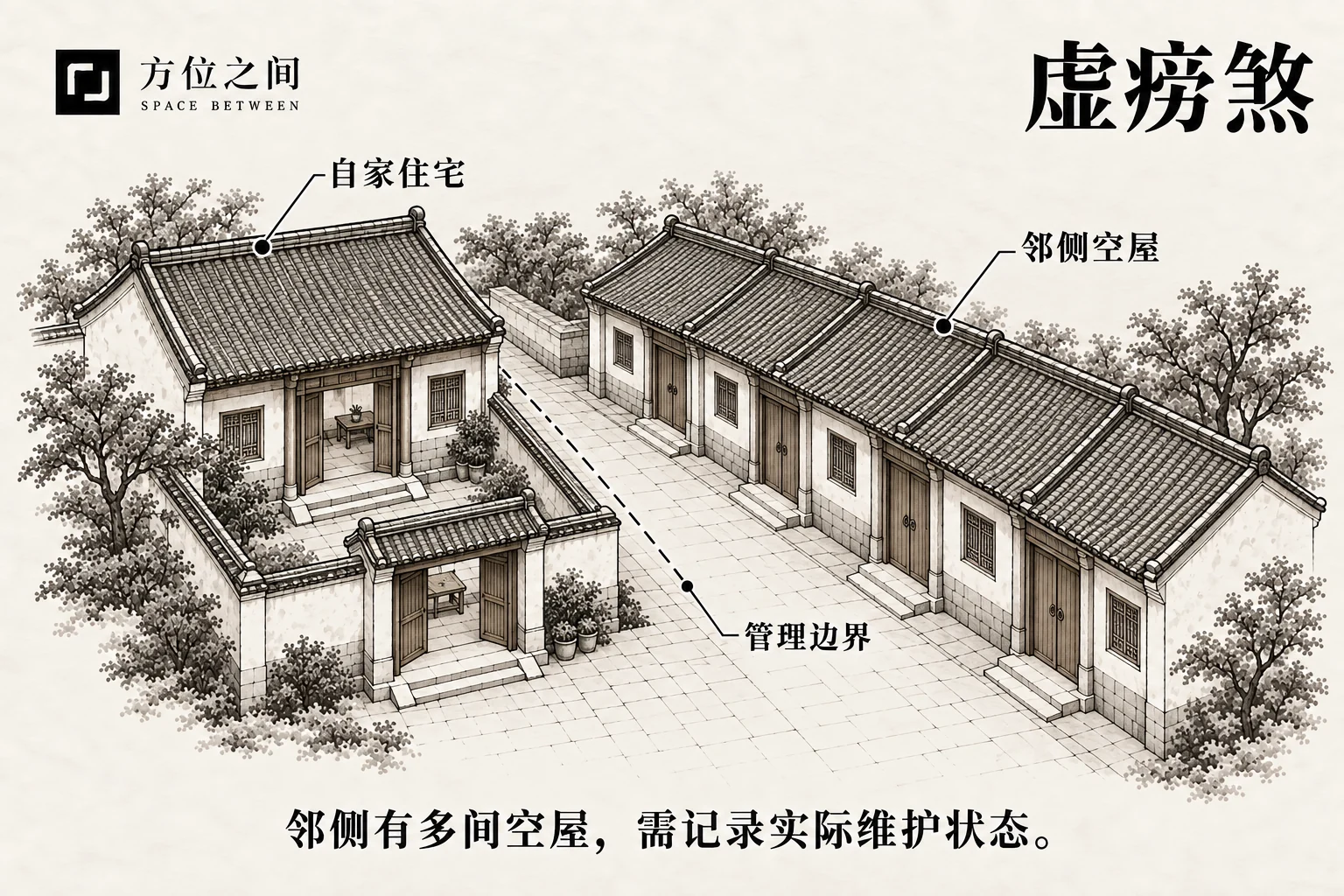
The explanation concerns several vacant rooms on one or both sides of the home. The key is neighboring vacancy, not the room count inside the dwelling. Confirm vacancy through verifiable use or management information. Record location, damage and enclosure; absence of lights at night does not prove a building is unoccupied.
Defining features
The explanation concerns several vacant rooms on one or both sides of the home. The key is neighboring vacancy, not the room count inside the dwelling.
How to recognize it
Confirm vacancy through verifiable use or management information. Record location, damage and enclosure; absence of lights at night does not prove a building is unoccupied.
Five temporarily unused neighboring rooms with regular maintenance differ from roof-damaged unmanaged properties. Vacancy count is descriptive; action should follow condition rather than a four-or-five-room threshold.
Common confusions
The Xulao and possible Xupi character variants lack verification against an original page. Four or five rooms is wording in a version, not a danger threshold.
Folklore and sources
The name evokes weakness or illness, but empty houses do not establish a particular disease cause. Unverified spelling must not become a definitive ancient term or medical explanation.
Traditional responses and practical improvements
Check for loose materials, leaks, standing water or absent management and contact the responsible owner or manager. Well-maintained vacancy alone needs no supposed suppression ritual.
Sources and further reading
These sources help clarify the concepts and their origins. Explaining a traditional term does not establish that it can predict outcomes.