
Defining features
These names concern related spatial relationships. Each original label and observed object is preserved below; similar names are not automatically merged into one shape.
How to recognize it
Fix the building’s front, rear, left and right before recording dimensions, positions and uses. Photographs have perspective limits; verify with a plan and section when needed.
Common confusions
One name can refer to different objects and one form can have different names. Preserve each version’s definitions rather than deriving new rules from a single character.
Folklore and sources
Yangzhai Cuoyao links meeting drip water with Anjian and joined construction with Poji. Its destiny claims remain traditional beliefs, not modern roofing inspection criteria or proof that every eave junction has the same consequences.
Volume 5 of Duoneng Bishi discusses joined buildings and conflicting eave water, providing comparisons for old-new junctions and runoff. Read its predictions as historical beliefs, not modern repair standards.
Traditional responses and practical improvements
The best-grounded improvements concern runoff, flashing, junction details and maintenance. Traditional preferences for clear roof relationships can be addressed through leak inspection and repair rather than symbolic ornaments.
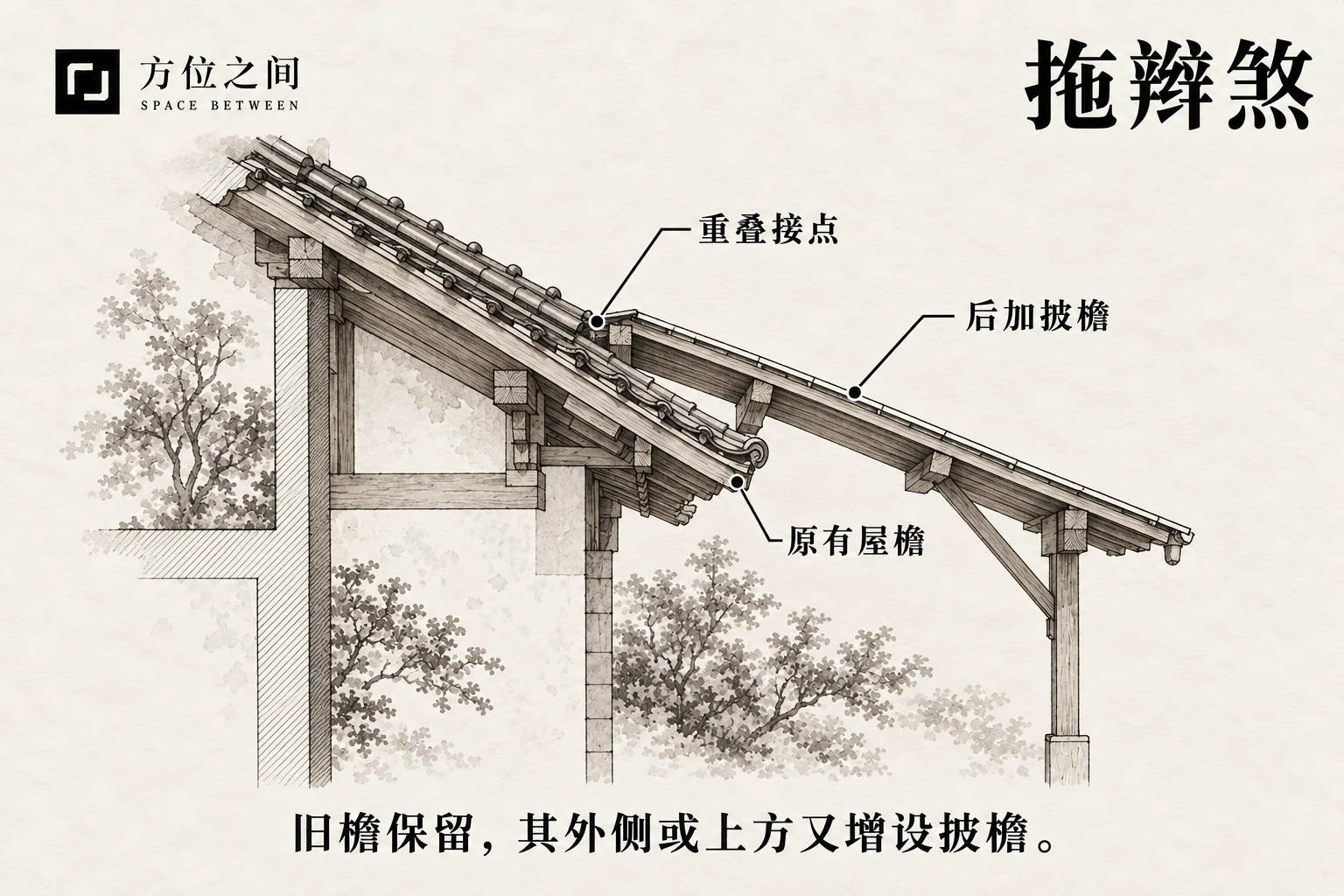
Overlapping Eaves (Tuobian)
 Enlarge diagram
An old eave remains while a new lean-to or roof extension is added outside or above it, creating overlapping roof edges. Use a section or close photograph to establish the connection and runoff. Distinguish a small canopy from a complete room rather than relying on two visible edge lines.
Defining features
An old eave remains while a new lean-to or roof extension is added outside or above it, creating overlapping roof edges.
How to recognize it
Use a section or close photograph to establish the connection and runoff. Distinguish a small canopy from a complete room rather than relying on two visible edge lines.
If a new canopy covers an old gutter, check whether the gutter remains cleanable and where water goes. An originally designed double eave with complete independent drainage is not the same problem merely because it overlaps visually.
Common confusions
Modern lists also use Tuoban. Their relationship to an original textual spelling is unverified, and a designed double eave differs from an undesigned later junction.
Folklore and sources
Tuobian and Tuoban reflect differences in modern transmission. The original name’s etymology is unconfirmed, so no braid-based fable or taboo story is invented.
Traditional responses and practical improvements
Check added loads, fixings and drainage effects on the old eave, and repair actual leaks. Do not cut members that may serve structural or waterproofing functions.
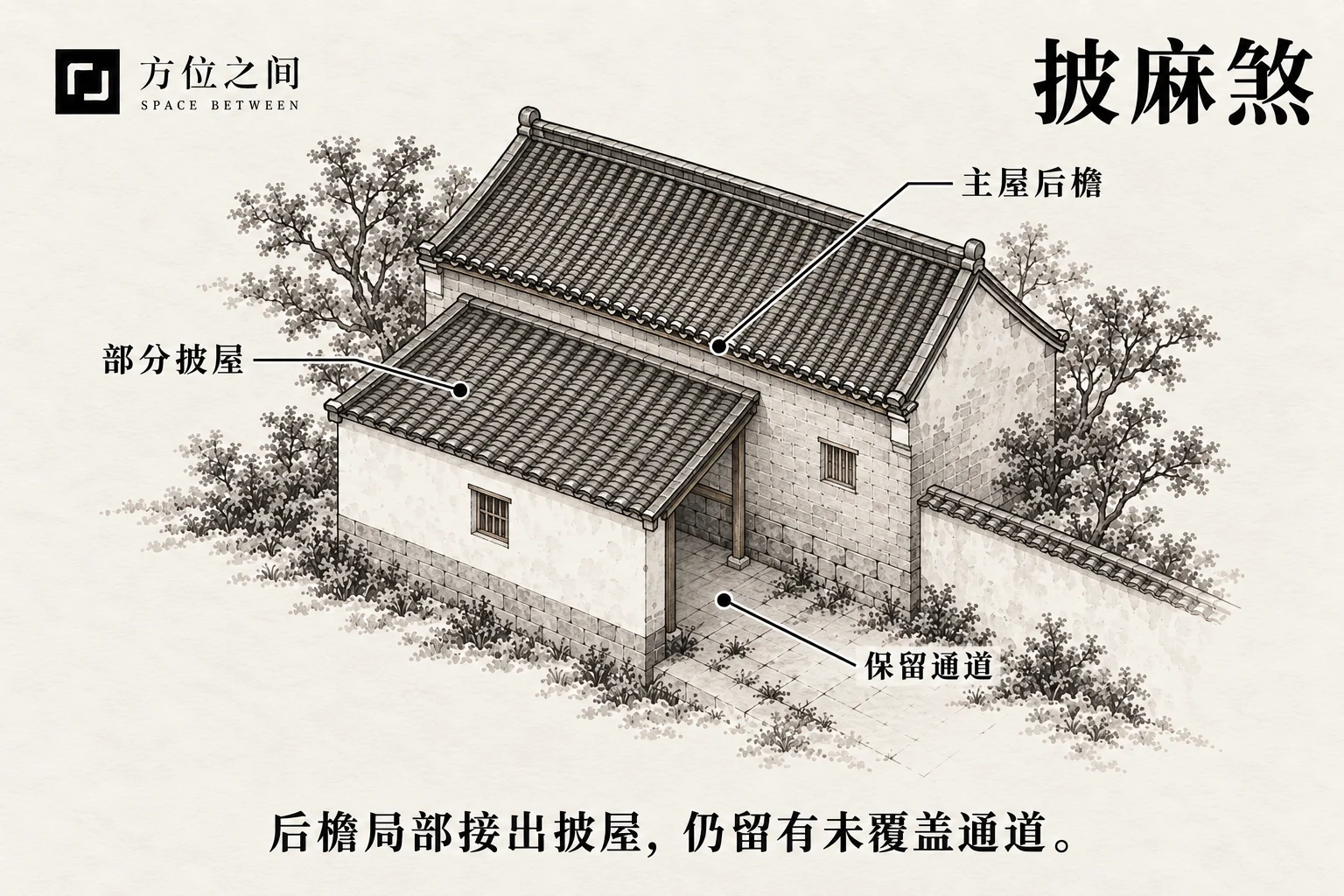
Partial Rear Lean-To (Pima)
 Enlarge diagram
A low lean-to joins the rear eave without covering the entire rear area. Different materials or walls make the old-new interface apparent. Check the rear eave, lean-to depth, remaining passage and joints. Different materials are not themselves a defect; record actual leaks, looseness or obstruction.
Defining features
A low lean-to joins the rear eave without covering the entire rear area. Different materials or walls make the old-new interface apparent.
How to recognize it
Check the rear eave, lean-to depth, remaining passage and joints. Different materials are not themselves a defect; record actual leaks, looseness or obstruction.
If only half the rear wall receives a lean-to while the remainder stays a passage, draw the end of the junction. A different full-width arrangement should not be treated as identical to this partial example.
Common confusions
Modern explanations vary in coverage and depth. Not every rear canopy belongs here, and this is different from a complete small room built atop the main roof.
Folklore and sources
The mourning-cloth metaphor is a traditional negative association, not a prediction of bereavement. Unverified dimensions are not presented as universal prohibitions.
Traditional responses and practical improvements
Check waterproofing, ventilation and passage at the annex-wall interface and repair joints and drainage. Different materials with sound function do not require demolition for visual uniformity.
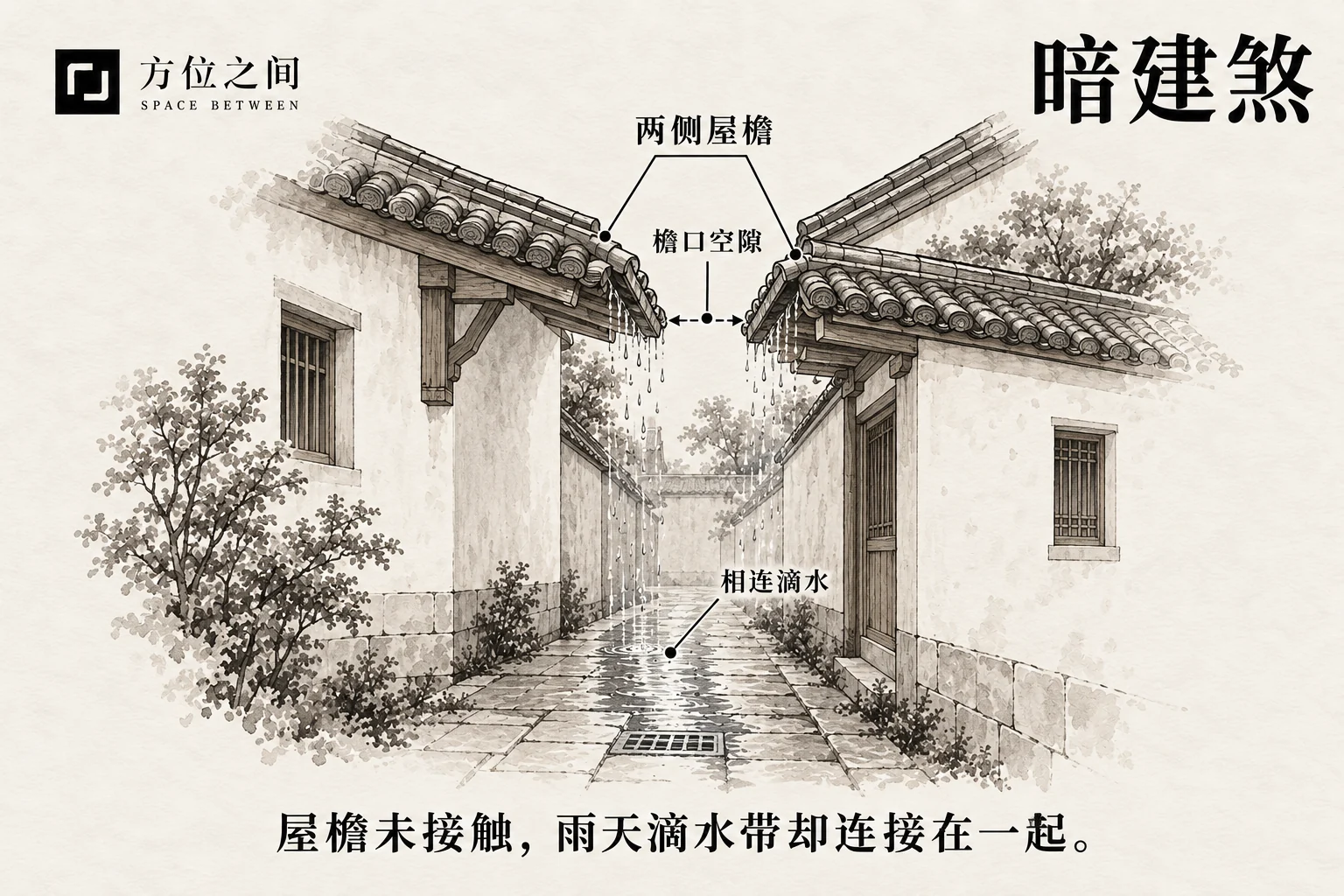
Meeting Eave Drips (Anjian)
 Enlarge diagram
Two eaves do not physically join, but their falling rain or drip bands meet. The observation concerns water paths rather than walls. Observe actual dripping safely in rain or inspect runoff marks. Eave spacing on a dry day cannot establish whether water really meets.
Defining features
Two eaves do not physically join, but their falling rain or drip bands meet. The observation concerns water paths rather than walls.
How to recognize it
Observe actual dripping safely in rain or inspect runoff marks. Eave spacing on a dry day cannot establish whether water really meets.
If a gap remains between eaves and their drip bands merge only in heavy rain, record that condition. Two adjacent enclosed drainpipes do not mean water falls directly from one eave into the other’s drip band.
Common confusions
This differs from Xiangji’s opposing water streams. Rain entering a properly designed shared drain is not automatically harmful cross-boundary runoff.
Folklore and sources
Yangzhai Cuoyao names connected dripping as Anjian, confirming the name-to-form relationship. Its illness associations do not establish medical causation.
Traditional responses and practical improvements
Use appropriate gutters, downpipes and ground drainage to organize water and address persistently wet wall bases. Coordinate with neighbors rather than redirecting water onto their land.
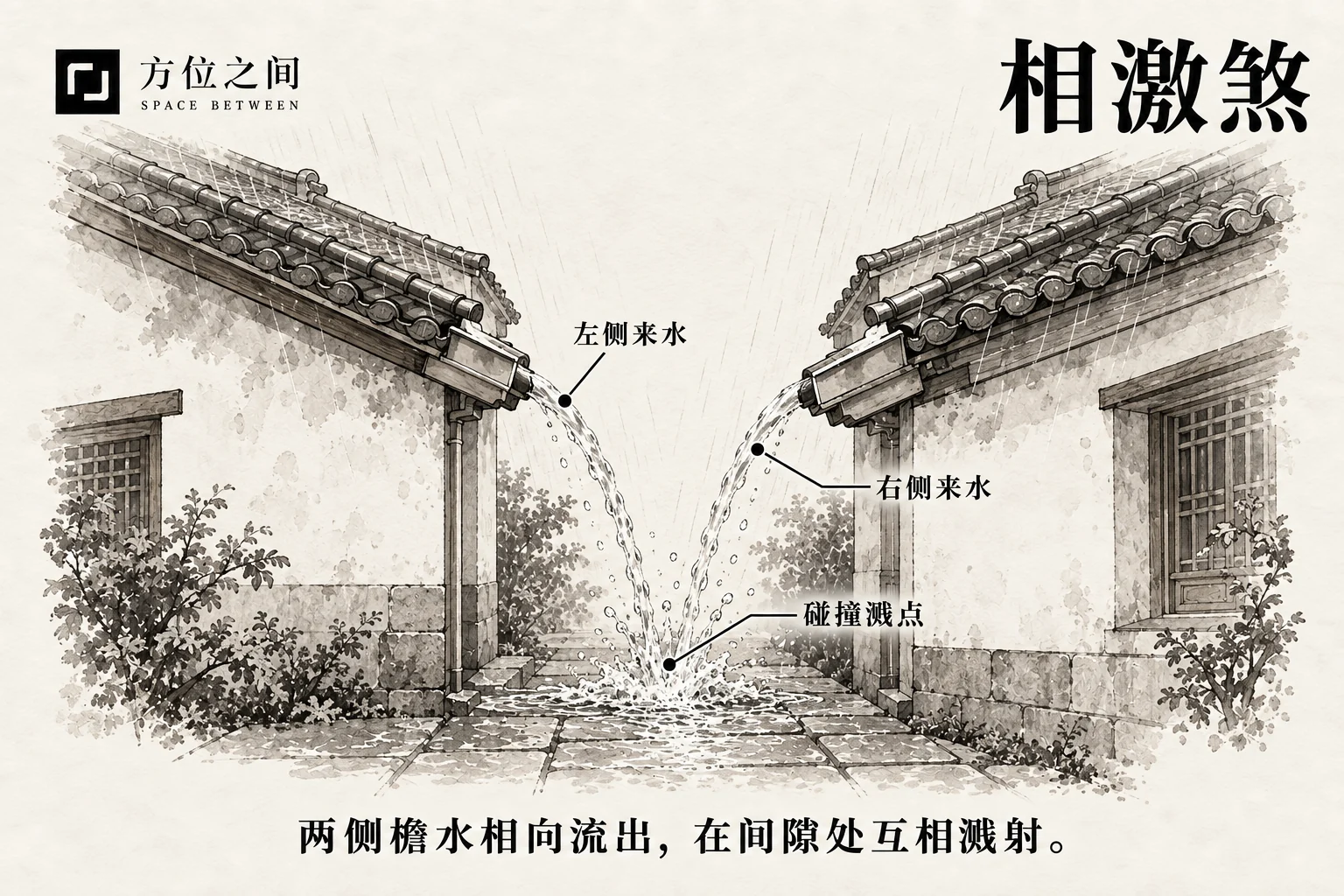
Conflicting Eave Runoff (Xiangji)
 Enlarge diagram
Water discharged from opposing eaves visibly moves toward the other side or collides, so the key is interference between moving streams. Under actual rainfall or controlled maintenance conditions, establish flow direction, strength and splash points. Record wet windows or water entering joints.
Defining features
Water discharged from opposing eaves visibly moves toward the other side or collides, so the key is interference between moving streams.
How to recognize it
Under actual rainfall or controlled maintenance conditions, establish flow direction, strength and splash points. Record wet windows or water entering joints.
If two facing outlets splash onto a shared wall base, the issue is outlet direction and collection. After directing water into suitable drainage, inspect it again in rain to determine whether the change works.
Common confusions
This differs from drip bands merely meeting. Streams entering one designed collection channel and draining successfully do not become an engineering problem merely because they join.
Folklore and sources
The name associates colliding water with arguments between people. That symbolic analogy cannot establish that household members will quarrel.
Traditional responses and practical improvements
Adjust drainage details so runoff enters gutters or downpipes reliably. Check overflow routes too, avoiding transfer of the problem to adjacent buildings.
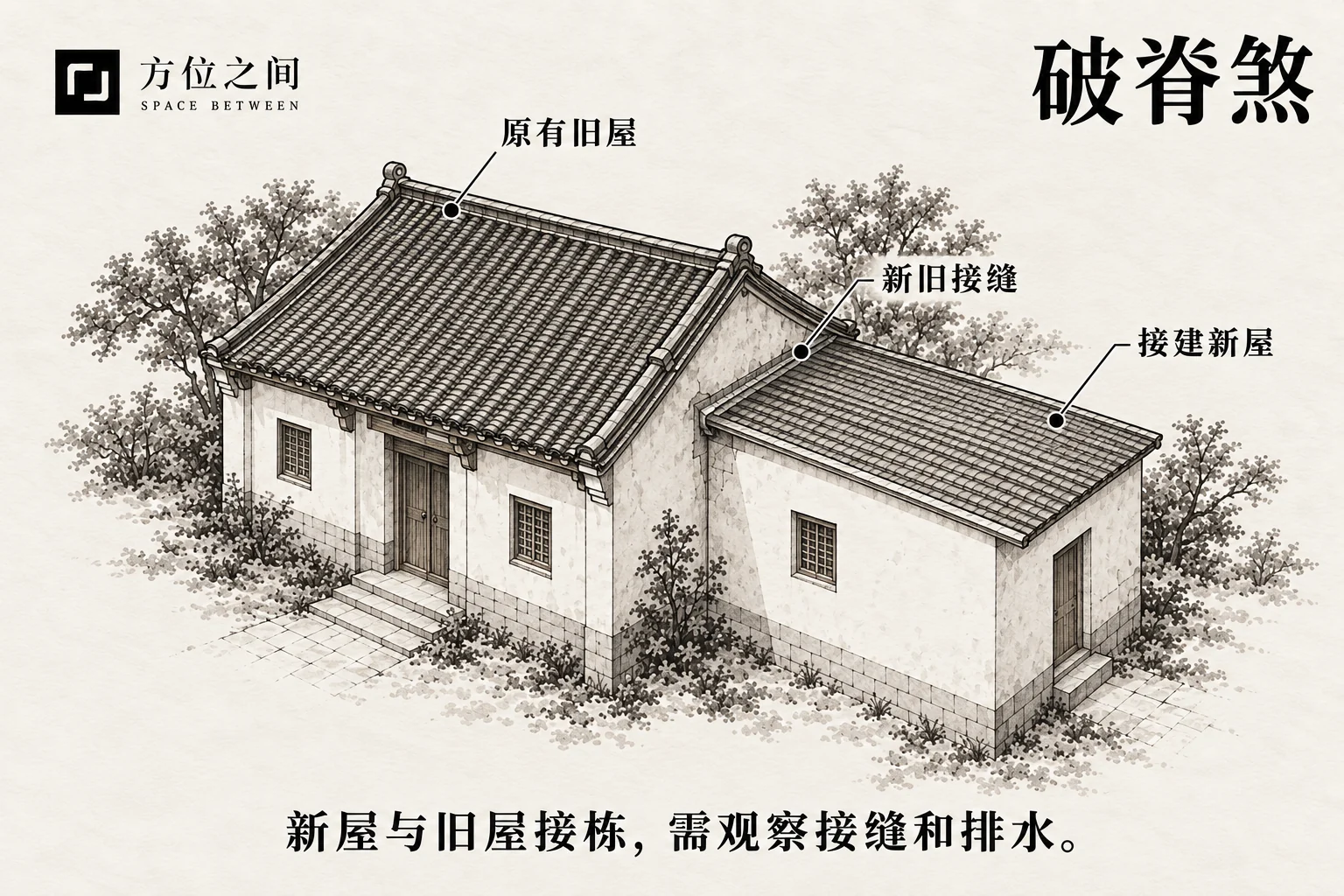
New-to-Old Roof Junction (Poji)
 Enlarge diagram
A new building connects to an existing house that remains standing, bringing new roofs, walls or structural parts directly against older fabric. Check construction order and drawings, recording junction walls, joints, roof levels and shared loading. Different paint ages do not establish the structural connection.
Defining features
A new building connects to an existing house that remains standing, bringing new roofs, walls or structural parts directly against older fabric.
How to recognize it
Check construction order and drawings, recording junction walls, joints, roof levels and shared loading. Different paint ages do not establish the structural connection.
A new house with a deeper foundation and roof meeting the old house needs separate checks of foundation effects and roof waterproofing. Different finishes on structurally independent buildings do not prove a shared load path.
Common confusions
The historical phrase about joining buildings is briefer than the modern explanation of adding before demolition. It does not assign identical outcomes to all extensions and does not mean a ridge beam has broken.
Folklore and sources
Yangzhai Cuoyao links joined construction with Poji as a traditional evaluation. The name is not a modern diagnosis of structural cracking or fracture.
Traditional responses and practical improvements
Assess differential settlement, waterproofing and load transfer at old-new junctions. Professionals should identify the nature of cracks; changing signs or applying charms does not replace repairs.
Sources and further reading
These sources help clarify the concepts and their origins. Explaining a traditional term does not establish that it can predict outcomes.