
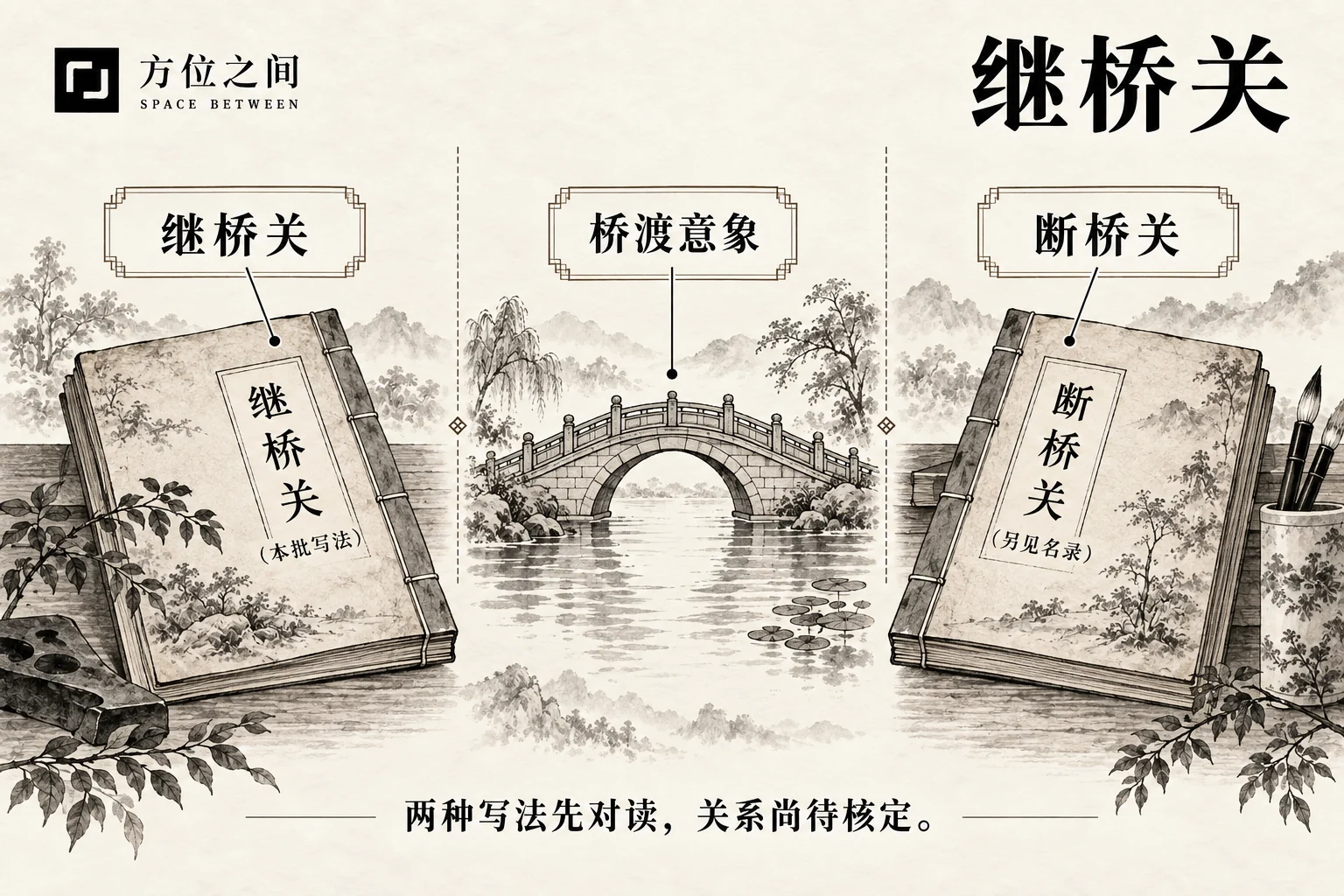
Name and meaning
Jiqiao Guan is the wording in the submitted material, suggesting a bridge and connection; other common guan-sha sources use “Broken-Bridge Gate.” Both are presented for comparison, without silently changing the character or assuming identical stories and calculation rules across editions.
Sources and spelling variants
Dejiang ritual research records Broken-Bridge Gate and symbolic bridge passages, and modern lists contain that name. An original text independently establishing the history of “Continuing-Bridge Gate” has not yet been verified. A future page should be checked for lettering, context and transmission before classifying it as a variant, transcription error or local term.
Recognizing the context
Check the original image rather than copied text alone: traditional characters, scanning and oral retelling can alter wording. For real bridges, separately record structure, railings, access and management. A folklore term cannot replace site information, and its bridge need not refer to a literal bridge beside a home.
Folk interpretations and versions
Crossing a bridge readily symbolizes a transition, and local rites may express hopes for growth. Attribute regional explanations instead of equating a symbolic bridge with engineering safety or predicting a particular child’s fall. A rich cultural account does not require adding a disaster narrative.
Practical observation and limits
For bridges, steps and changes in level, assess actual access and adult supervision. Neither prohibit ordinary travel because of a label nor take risks to prove a remedy worked. If a child fears bridges, listen and explain practical arrangements without treating concern as destiny.
Reading and responding
Keep separate notes for the submitted spelling and the name found in other lists, explicitly marking their unverified relationship. Do not turn a local bridge-crossing rite into an obligatory procedure. Symbolic family wishes should be safe and voluntary, while real bridge problems belong with management and engineering channels.
Sources and further reading
These sources help clarify the concepts and their origins. Explaining a traditional term does not establish that it can predict outcomes.