
Read each entry
Open a name for its meaning, identification, diagram and practical responses. Different meanings of the same name are distinguished.
- Buried-child pass
- Collision-with-fate pass
- Hot-water-and-fire pass
- Heavenly-suspension pass
- Heavenly-dog pass
- Short-life pass
- Five-ghosts pass
- Ghost-gate pass
- Monk pass
- Thunder-deity pass
- Iron-snake pass
- Hasty-foot pass
- White-tiger pass
- Jiqiao, bridge pass (wording unverified)
- Deep-water pass
- Four-seasons pass
- Golden-lock pass
- Hundred-days pass
- Four-pillars pass
Start with sources: old texts also disagree
Volume 7 of Sanming Tonghui explains the pass metaphor and several methods, but also questions names such as Hundred Days, Iron Snake, Deep Water, Ghost Gate, Four Seasons and Four Pillars, saying many predictions did not hold. Recording a name is not unanimous endorsement or modern validation.
Nineteen is this collection’s scope, not a universal count. Lists of thirty-six passes or seventy-two sha vary with local rites and editions. Study a rule with its title, edition, page, inputs and interpretation rather than merging incompatible tables.
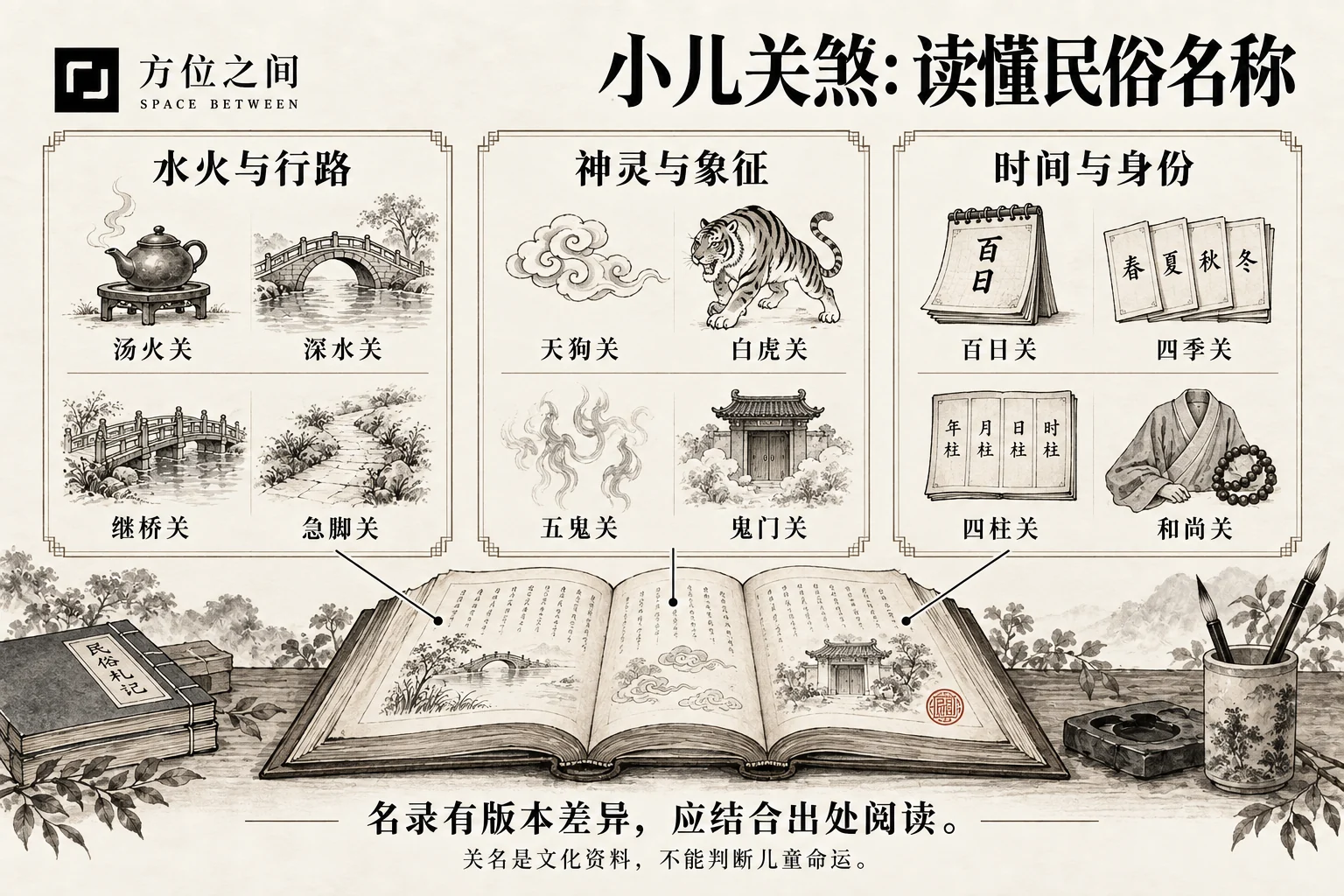
Water, fire and travel imagery
These are editorial reading groups, not a universal ancient taxonomy. Names use everyday dangers to express concern; they do not establish that a child born under particular conditions will face them.
- Hot-water-and-fire pass: imagery of hot liquid and fire expresses a familiar danger; it cannot assign burn risk by birth date.
- Deep-water pass: water-side activity appears in traditional interpretations. Actual water depth, barriers and supervision must be assessed independently.
- Jiqiao pass: this submitted spelling should be compared with the more common Broken-bridge pass. Their bridge-crossing imagery overlaps, but the wording is not assumed interchangeable in every edition.
- Hasty-foot pass: modern retellings associate hurried steps with falls. Such associations are not diagnoses of limb development or the nervous system.
Deities, animals and the language of fear
This group shows how folklore names uncertainty and anxiety. Symbols can be described without depicting a real harmful force acting on a child or assigning a disease.
- Heavenly Dog, White Tiger and Iron Snake passes use animal imagery. They are distinct from a dwelling’s White Tiger side, actual animal contact or metal exposure.
- Five Ghosts and Ghost Gate passes use supernatural gate imagery. If a child fears a place, explore the actual experience rather than intensifying fear with a label.
- Thunder-deity pass: compare the longer wording with Leigong pass. Thunder-god imagery cannot predict lightning injury, convulsions or brain damage.
- Heavenly-suspension pass: its wording suggests suspension or peril, but stories vary. Without a verified source, do not invent a specific accident narrative.
Names concerning life and identity
These names can evoke parents’ worst fears, so their historical status matters. They should not determine a particular child’s lifespan, family relationships or religious future.
- Buried Child, Short Life and Collision with Fate passes use forceful mortality imagery. Their transmission can be studied without predicting early death or imposing fear-based rescue rituals.
- Monk pass: monastic imagery does not mean a child must enter religious life, avoid monks or have weak family bonds.
- Golden-lock pass: the lock image can be read alongside motifs of restraint and thresholds. It does not establish that jewelry changes fate; assess wearing conditions separately.
Time and calculation labels
Names with numbers or time units may look precise, but remain labels within folklore. They do not set dates before which outings are forbidden or ages after which ordinary care is unnecessary.
- Hundred-days pass: a named early-life period, not a medical boundary at one hundred days.
- Four-seasons pass: a seasonal label that cannot replace local climate conditions or individual care needs.
- Four-pillars pass: a calendrical term associated with year, month, day and hour, not four building columns, corners or structural safety.
Traditional crossing-the-pass rites and reading today
Folklore research documents crossing-the-pass rites expressing hopes, family care and growing up. Cultural significance does not establish effects on lifespan or a substitute for medicine, nor make a local rite mandatory for every family.
Read in three steps: establish the wording and edition, record actual concerns separately, then address those needs. Questions about symptoms, development or safety belong in appropriate professional assessment and everyday care, without labeling the child or delaying help for a ritual.
Sources and further reading
These sources help clarify the concepts and their origins. Explaining a traditional term does not establish that it can predict outcomes.