
Name and meaning
The wording refers directly to hot water or soup and to fire; “gate” supplies the folklore metaphor of an obstacle. It places familiar hazards in a growing-up narrative, but does not mean heat harms only people with particular birth details, or that precautions can end after a ritual passage.
Sources and spelling variants
“Hot-Water-and-Fire Sha” also appears in modern lists; check the edition before treating it as an equivalent. Research on Dejiang Tujia gate-crossing rituals records local associations with scalds and fire. This is regional ethnography, not a universal interpretation or an accident-prediction rule.
Recognizing the context
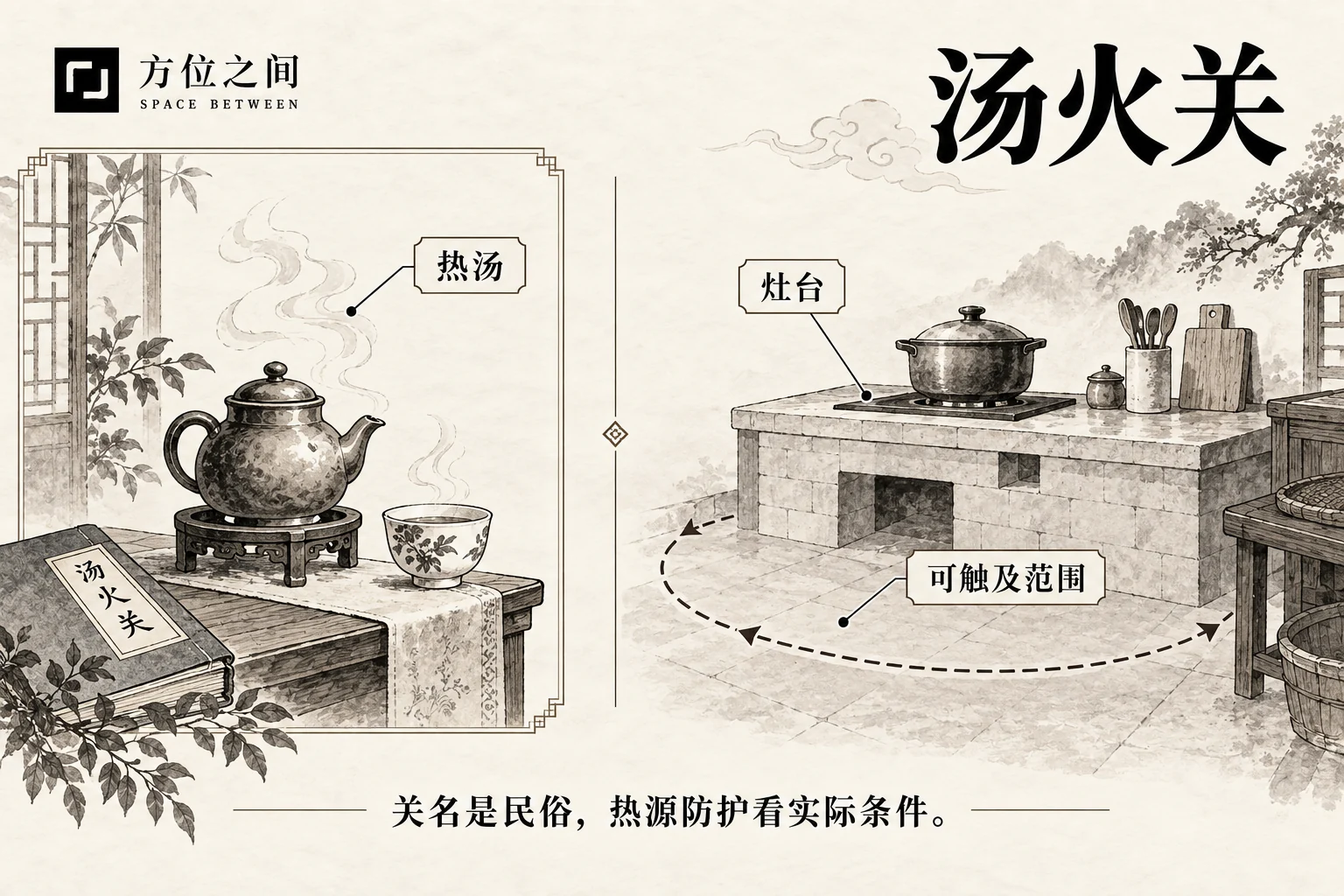
Draw the literary image and actual heat sources separately: one explains a term, while the other records hot drinks, stoves or heaters. Do not assign kitchen equipment a safety rating from a birth date, or disregard a child’s reaching, climbing or pulling because a chart does not list this gate.
Folk interpretations and versions
Ritual passages and wishes may express hopes for safe growth, but their social meaning is separate from protective effectiveness. Heat imagery can illustrate how experience enters folklore; it cannot establish that talismans, ornaments or rituals prevent burns. Children should never approach heat to prove a gate has been passed.
Practical observation and limits
Practical checks ask where heat is, who uses it, whether a child can reach it and whether adults understand handovers. Respond to an actual burn or fire according to the event and appropriate help, rather than investigating a folklore label first. This applies regardless of anyone’s entry in a chart.
Reading and responding
Keep the local source alongside an actual heat-source checklist; cultural documentation does not replace action. Keep hot items beyond reach, do not treat unattended heat sources as ordinary furnishings, and review household fire arrangements. This page gives no paper-burning or fire-testing ritual and promises no protective object.
Sources and further reading
These sources help clarify the concepts and their origins. Explaining a traditional term does not establish that it can predict outcomes.