
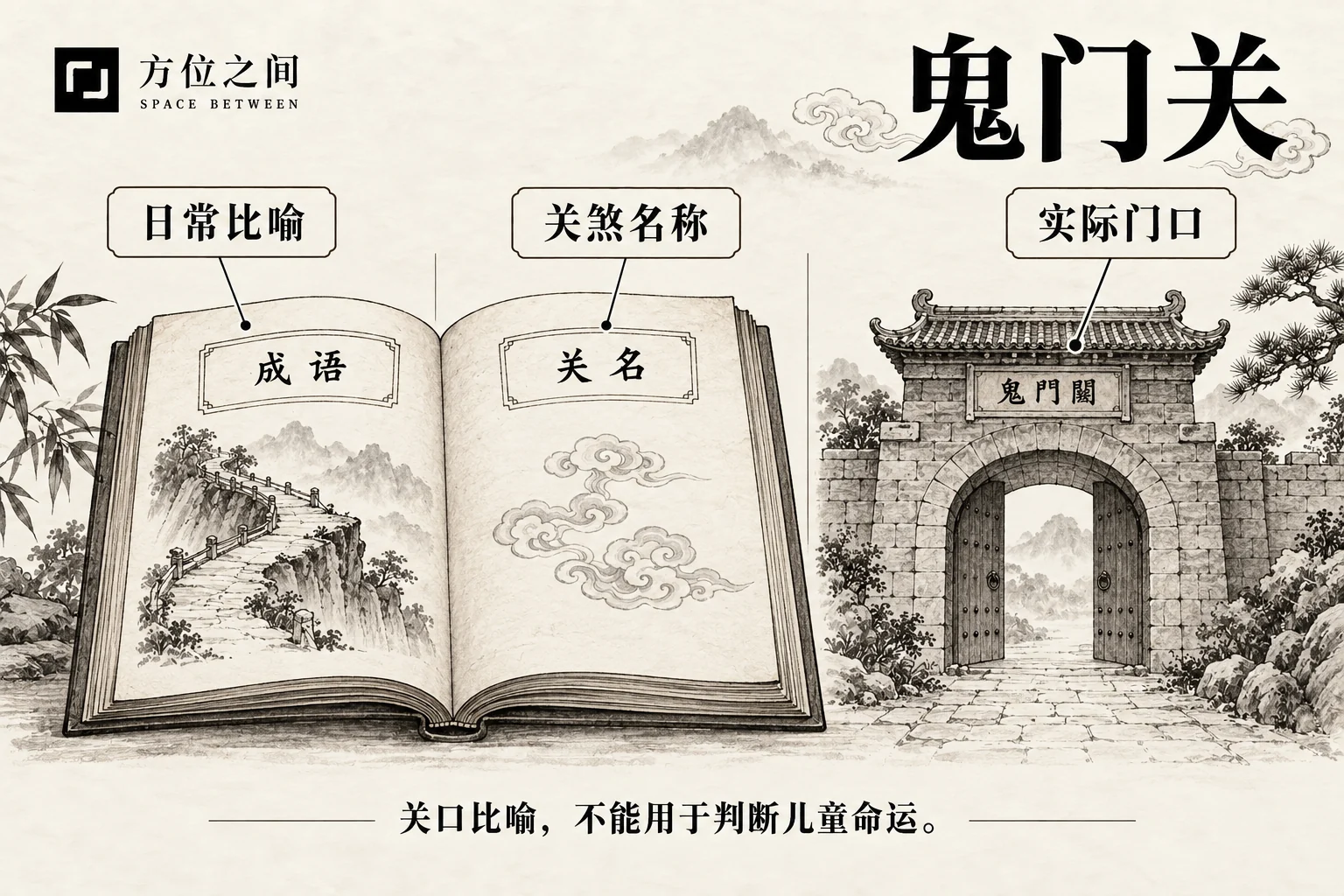
Name and meaning
Ghost Gate can be an everyday metaphor for danger and has different religious and folk narratives. Here it denotes an entry in childhood guan-sha lists. Its passage imagery is not a dangerous door necessarily present in a home; door color, orientation or a child’s reaction cannot identify this gate.
Sources and spelling variants
Volume seven of Sanming Tonghui mentions Guimen Guan among gate claims whose reliability it questions. This shows criticism within historical literature rather than unanimity. Accounts of a “ghost-gate” direction or temple imagery require separate attribution and cannot be combined into one rule solely through the name.
Recognizing the context
Preserve the full sentence: is it a metaphor for surviving illness, a divination entry or a local ritual? Real doorways call for checking access, locks, steps and lighting. A literary gate supplies none of that site information and is not sufficient reason to close an entrance.
Folk interpretations and versions
Gate-crossing narratives can represent growth as passing a doorway, with meanings of blessing and transition. Explaining that symbolism does not require showing a child claimed by an underworld or presenting one region’s rites as obligatory for every family. Regional and textual differences belong in the account.
Practical observation and limits
If the word or story makes a child fear going out, sleeping or passing a place, understand the source of that fear and offer steady explanation and practical support. Do not deepen it by declaring the child afflicted. Physical or continuing emotional concerns call for help based on the actual presentation.
Reading and responding
Keep metaphors, name lists and site observations separate. A symbolic blessing should help a child feel supported, without dangerous acts, restrictions on basic life or payments to remove fear. Repair real entrance problems for building and use needs, without promising that changing a door guarantees a different fate.
Sources and further reading
These sources help clarify the concepts and their origins. Explaining a traditional term does not establish that it can predict outcomes.