
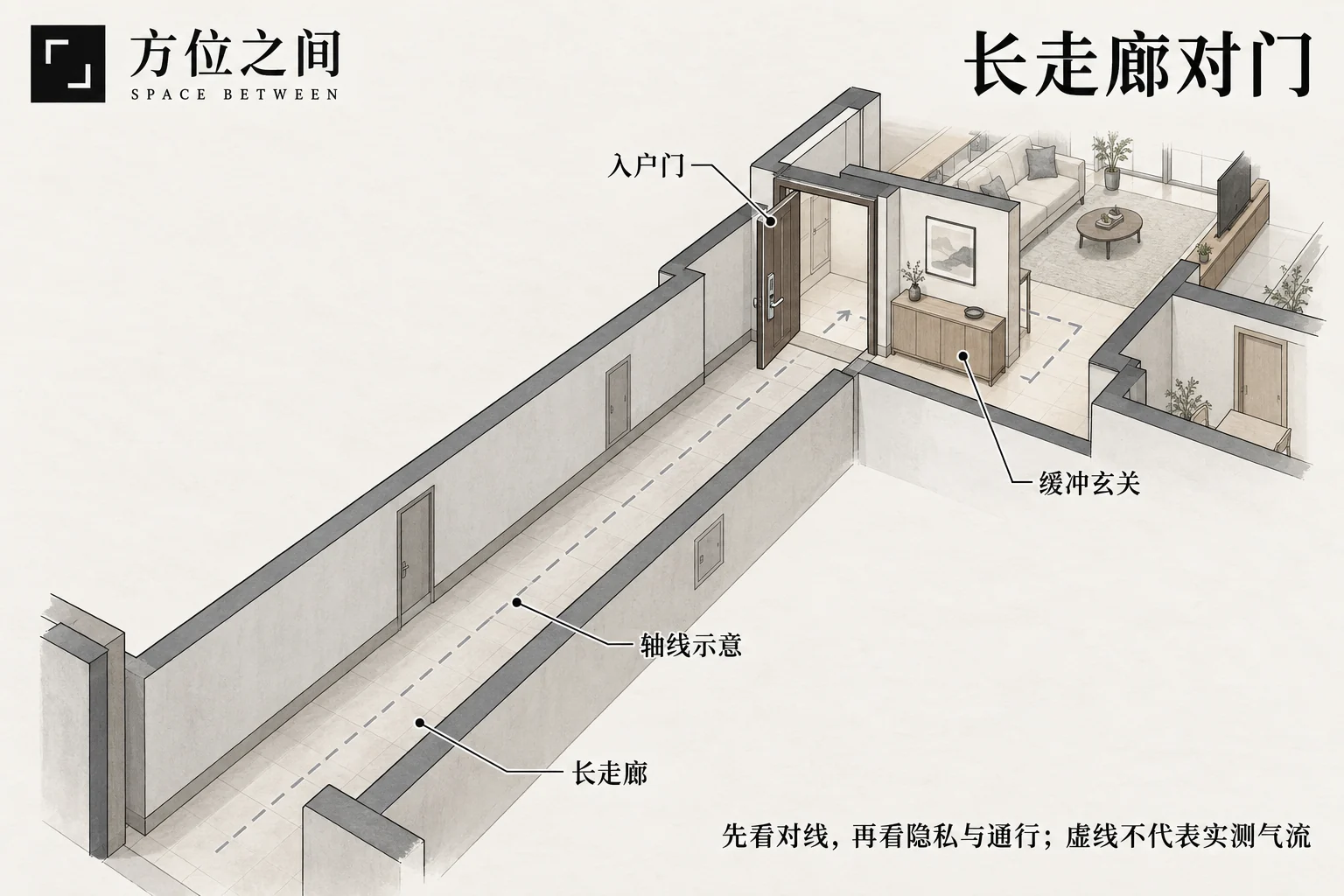
Name, characteristics and scope
In home-layout writing, the heart-piercing sword usually means a long straight corridor or passage whose extended axis points at the entrance. The straight sword is a metaphor for the relationship between passage direction and doorway. It differs from a tunnel passing under a building and from an unobstructed route between front and rear openings. Corridor length records physical scale; it cannot calculate good or bad fortune.
How to identify it step by step
Start from the position people actually use, recording shape, spatial relationship and duration separately. These checks distinguish conditions; they are not a universal formula for fortune.
- Photograph outward from the entrance, marking the doorway center, corridor axis and bends. Check whether the alignment is direct, offset or merely an overlap in the photograph.
- Distinguish a communal corridor, indoor passage and outdoor road. Record foot traffic, door-opening times and neighboring door positions separately.
- Observe from a usual indoor seat whether opening the door directly exposes the bedroom, dining table or personal belongings.
- Observe footsteps, lighting and drafts during daily use. An imaginary sightline is not an airflow measurement.
How to understand the folk account
Metaphors such as a straight road resembling a spear and the heart-piercing sword express traditional concern about direct approaches without a buffer. Financial loss, disputes and injury are common folk extensions, but there is no consequence scale calculated from corridor length. Texts may mix spear and sword terminology; first identify the actual passage being described.
What matters in present-day living
Entrance privacy, interference with circulation and incoming sound are more useful observations. A long corridor does not necessarily create a strong draft; openings, floor level and ventilation also matter. A quiet passage or a turn inside the entrance may mean visual alignment does not coincide with persistent discomfort.
Traditional responses and practical adjustments
Traditional ideas of avoiding, screening, buffering and separating can be understood as reorganizing sightlines, circulation and activity areas. Try small reversible changes first, then consider permanent alterations if they help.
- Use an existing entrance recess or furniture orientation indoors to soften a view straight through the home.
- Keep screens within your own usable space, leaving room for door movement and main circulation.
- Address door gaps, lighting and storage first, then assess whether professional door or window work is needed.
- Do not place mirrors, sharp ornaments or cabinets in communal corridors or occupy escape routes.
Common misreadings and related names
Through-draft sha concerns the connection between two indoor openings; this entry concerns corridor direction relative to the entrance.
Door clash concerns two doorways. One door aligned with a corridor need not also be classified as a two-door clash.
Sources and further reading
These sources help clarify the concepts and their origins. Explaining a traditional term does not establish that it can predict outcomes.