
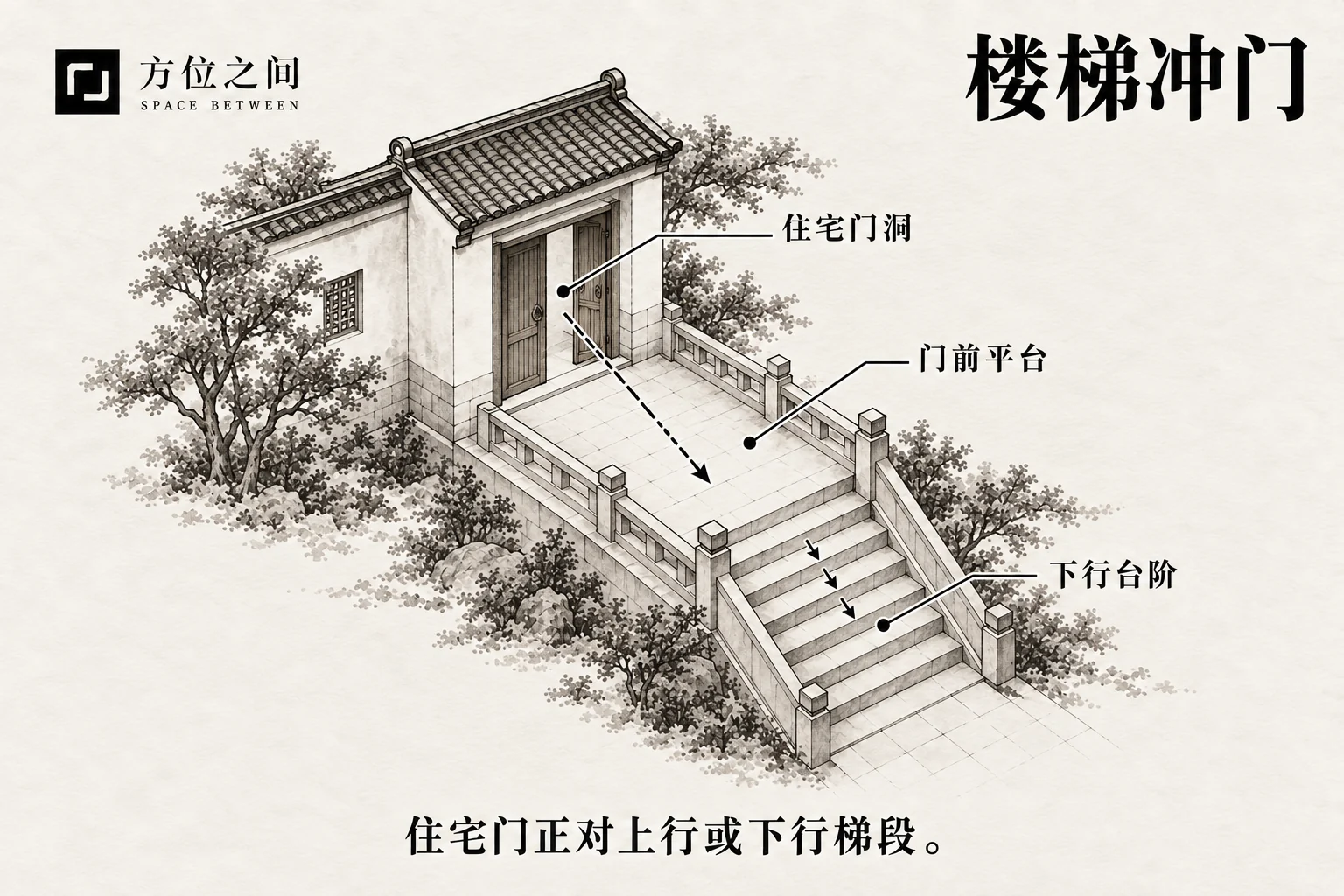
Name and background
Facing first means axial alignment, not physical impact. An ascending flight rises ahead; a descending one leaves the current floor downward. Seeing only the side railing with the flight crossing the doorway is adjacency rather than direct alignment. Similar names should not erase direction.
Typical form and comparisons
The landing between door and first step is crucial. Being able to stop before choosing a direction differs from meeting steps immediately. Whether the leaf occupies the landing, blocks a handrail or meets stair users matters more than a few centimetres of centreline offset.
A private duplex allows coordinated stair and foyer planning, but shared stairs serve several households. An upper-floor shop may combine queues, deliveries and stair traffic. A cabinet placed merely to conceal the flight can crowd an otherwise adequate landing.
Traditional reasoning and modern observations
Tradition treats stairs as a route between levels, imagining qi arriving or leaving along them. Descent suggests outward loss; ascent, approach or fluctuation. Yang Dengke distinguishes stairs facing an entrance from flight directions seen through room doors, so one wealth-loss story should not cover every case.
Practical use depends on space to pause and read the stair approach. Step visibility, secure handrails, slippery surfaces and door conflicts are inspectable conditions. CDC home fall-prevention guidance stresses lighting, rails and removing trip hazards, rather than assessing safety by doorway/stair alignment.
How to identify it
Use a plan for alignment, a section for level change and a site check for actual movement.
- Mark ascent, descent or crosswise travel from inside the door and show the first step’s connection to the floor.
- Draw leaf swing, landing, handrails and neighbouring doors together; consider two people passing and carrying goods.
- Check step edges, lights and rails by day and night, recording real difficulties rather than only an aligned photograph.
Common points of confusion
A lift has no flight of steps, a level corridor no level change, and a central stair concerns plan location. A sawtooth stair-side silhouette is another shape metaphor and need not provide direct access from the door. Distinguish objects before addressing views, movement or maintenance.
Effects described in traditional beliefs
Yang Dengke distinguishes entrance alignment and stair direction. These are his folk associations, not evidence that a layout causes financial loss, litigation or injury.
- Stairs facing the entrance: symbolic outward loss is linked to financial setbacks and family discord.
- Flight seen from a room door: ascent is associated with setbacks and disputes, descent with financial loss and harm; the narratives differ.
Traditional remedies and practical improvements
Create a private entry buffer while preserving the shared stair’s circulation function.
- For visual discomfort, move interior seating or add a partial screen outside the route, reflecting the traditional preference for a turn; do not place screens, stones or pots on shared landings.
- For door/traffic conflict, clear interior storage and review operation with management; changing swing requires fire/access consideration, without removing closers yourself.
- If edges are hard to see, repair lighting or obtain professional visibility improvements; repair loose rails and keep grasping surfaces free of decorative fabric.
- Remove loose mats, shoe boxes and ornaments from stairs and keep private flights dry and clear too; protective symbols belong securely inside, not as fall protection.
- An upper-floor shop should place queues and collection in adequately wide indoor space, not on the first step; stair or barrier alterations require professional assessment.
Illustrative example
Suppose a door faces descending stairs across a broad landing. An open shoe cabinet crowds turning space and a light has failed. The resident moves storage inside while management repairs the light and checks rails. Alignment remains, but the hypothetical intervention restores room to pause, see and pass without blocking stairs to address a wealth-loss belief.
Sources and further reading
These sources help clarify the concepts and their origins. Explaining a traditional term does not establish that it can predict outcomes.