
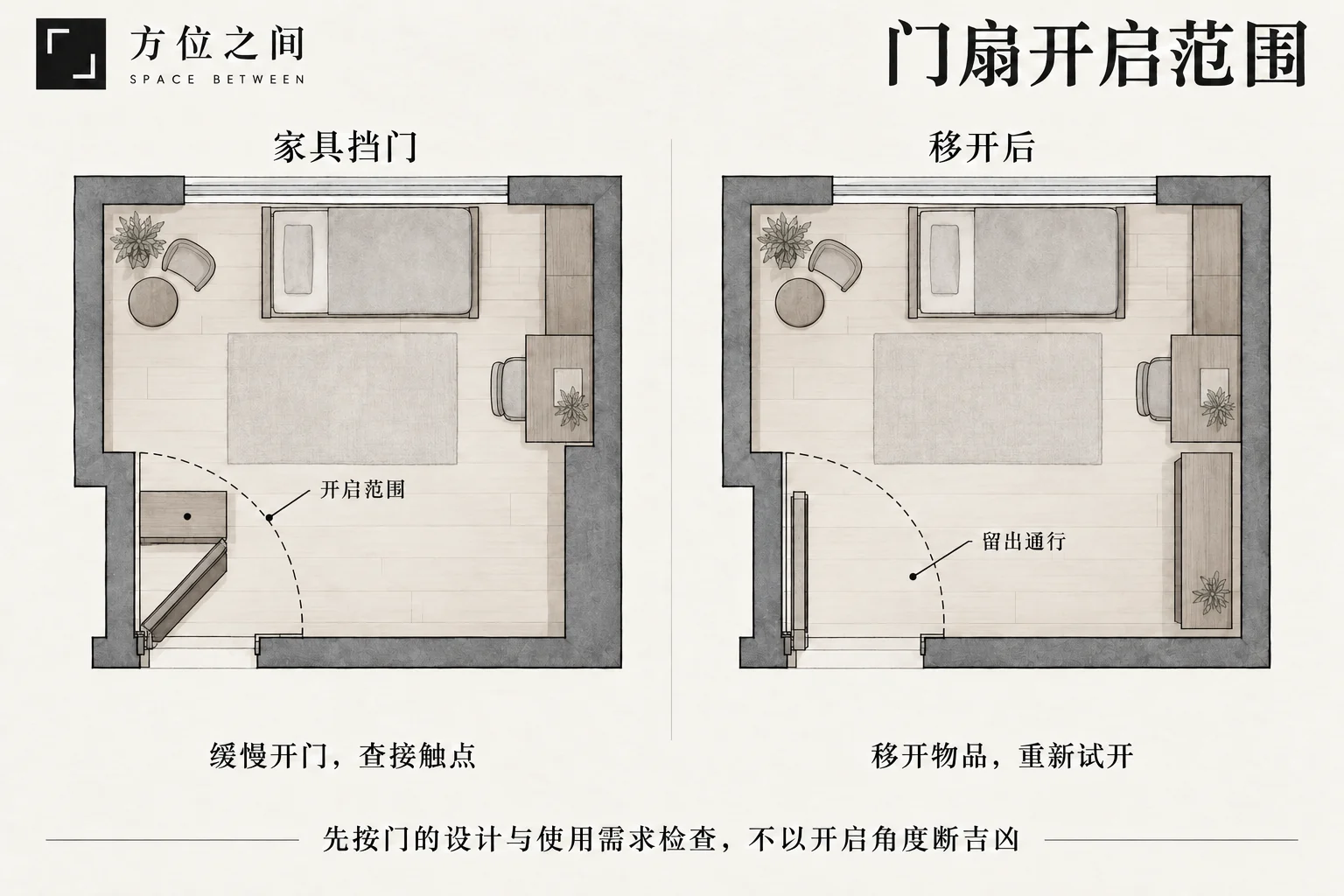
Name, characteristics and scope
A door cannot fully open when a shoe cabinet, bed, wall corner or other object blocks its intended range of movement. Distinguish temporary furniture obstruction, a normal doorstop and a deformed door. Obstruction is not automatically the traditional closed-qi condition; it is first a circulation problem that can be checked by operating the door.
How to identify it step by step
Start from the position people actually use, recording shape, spatial relationship and duration separately. These checks distinguish conditions; they are not a universal formula for fortune.
- Open the door slowly and locate its first point of contact. Do not force it against furniture or glass.
- Mark the door's swing arc on the plan and check whether cupboard doors and drawers collide when opened together.
- Simulate entering with everyday parcels, a stroller or assistive equipment, and record the narrowest point.
- Establish whether a frequently used entrance is obstructed or only an infrequently used storage door has limited movement.
How to understand the folk account
Folk tradition treats a door as the mouth for qi and movement, interpreting obstruction as difficulty in fortune. This symbolism can remind people to organize the entrance, but moving a cabinet does not prove a change in career or wealth. Traditional closed qi also concerns the proportions of doorway, courtyard and building, so it is not identical to a blocked door.
What matters in present-day living
Practical effects include collisions, difficult carrying, inaccessible cleaning areas and difficulty leaving quickly. If a door's swing direction has been changed, check adjacent doors, appliances and routes. Frame deformation or failed hardware needs repair, rather than rearranged ornaments.
Traditional responses and practical adjustments
Traditional ideas of avoiding, screening, buffering and separating can be understood as reorganizing sightlines, circulation and activity areas. Try small reversible changes first, then consider permanent alterations if they help.
- Remove mats, shoe racks and temporary piles first, then check the opening range again.
- Use shallower furniture or change its orientation so moving parts do not collide.
- Anchor tall furniture according to its installation instructions; do not omit required fixing to make room for a door.
- Ask qualified people to assess changes involving fire doors, load-bearing walls or door openings. Do not alter them yourself.
Common misreadings and related names
A reasonable doorstop limit or deliberately designed narrow-opening door should not be classified as sha solely from its angle.
This entry sets no lucky minimum opening angle. Check the product design and actual needs first.
Sources and further reading
These sources help clarify the concepts and their origins. Explaining a traditional term does not establish that it can predict outcomes.