
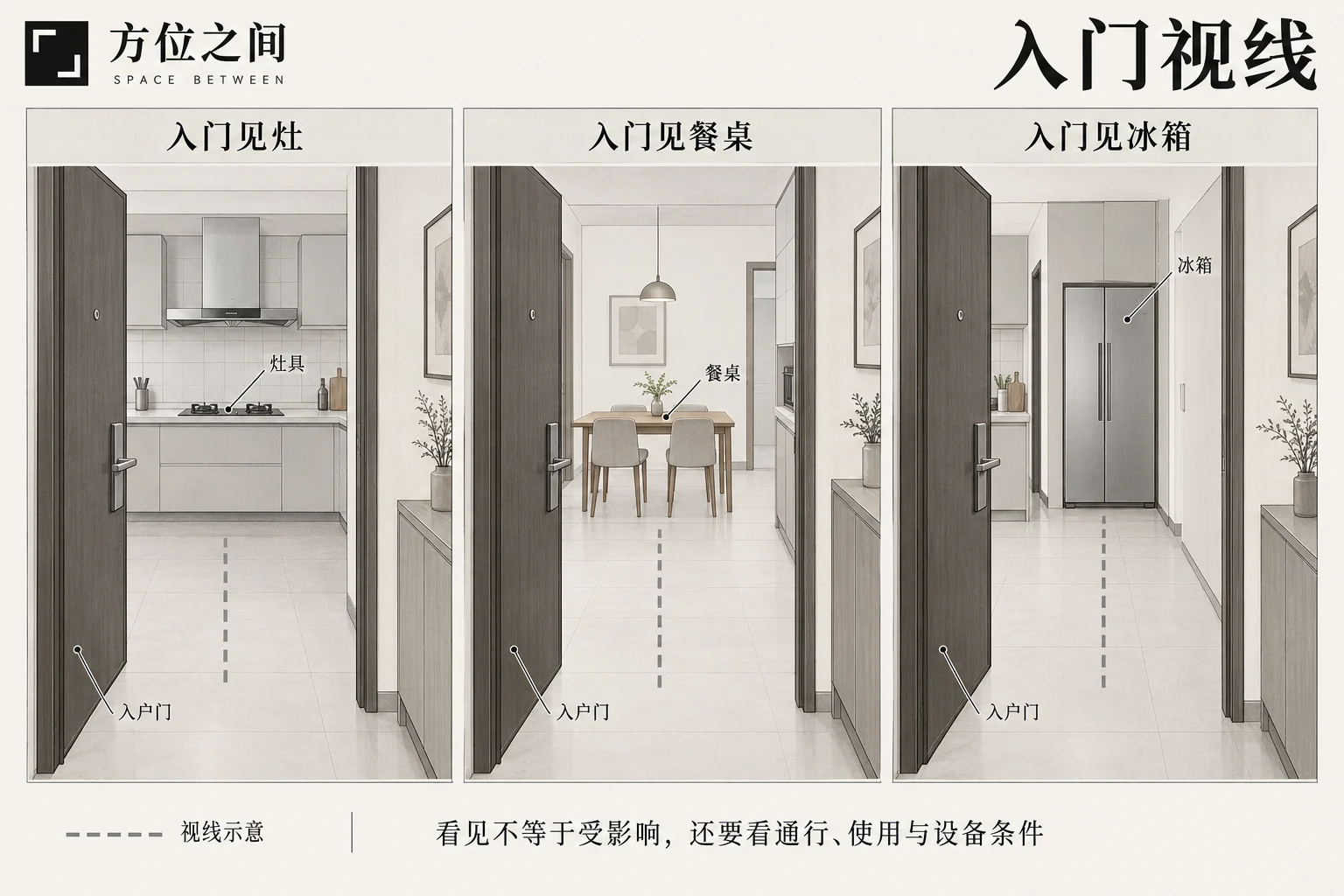
Name, characteristics and scope
Seeing a stove, dining table or refrigerator upon entering concerns the initial sightline, but each case has a different object. With a stove, confirm that its working area is actually visible. With a table, check whether seating occupies the circulation route. With a refrigerator, check door movement and ventilation. A doorway cutting a stove may mean an extended door or wall edge pointing at the counter, which differs from air blowing directly onto a flame.
How to identify it step by step
Start from the position people actually use, recording shape, spatial relationship and duration separately. These checks distinguish conditions; they are not a universal formula for fortune.
- Observe from outside the entrance, just inside and usual seats. A wide-angle photograph is not a substitute for the actual view.
- Mark the cooktop, pulled-out dining chairs, refrigerator door swing and the route used to set down groceries.
- Check whether air from the entrance actually blows toward a stove in use. Visibility and a strong air current are different conditions.
- Compare a brief door opening with leaving it open, noting actual effects on dining and cooking.
How to understand the folk account
The saying that a visible stove consumes wealth connects the hearth with household resources; dining tables and refrigerators also symbolize food supplies. Claims of inevitable financial loss or particular harm to the woman of the house are folk judgments, not reliable predictions about finances, gender or health. A modern open kitchen is not automatically poor because its stove is visible.
What matters in present-day living
Dining privacy, cooking interruptions, extraction and obstructed routes can be checked. Refrigerator placement should follow installation, heat-dissipation and power requirements, not merely its facing direction. A dining table near the entrance can be sensible in a small home if circulation and use remain convenient.
Traditional responses and practical adjustments
Traditional ideas of avoiding, screening, buffering and separating can be understood as reorganizing sightlines, circulation and activity areas. Try small reversible changes first, then consider permanent alterations if they help.
- Use a low cabinet, light-permitting divider or reoriented dining table to manage sightlines while preserving circulation.
- Reduce entrance clutter and leave room to open the refrigerator and retrieve items.
- Keep a clear working area around the stove and use appropriate extraction equipment.
- Changes to stoves, gas or extraction routes need professional assessment; ornaments cannot replace installation requirements.
Common misreadings and related names
The geometric edge in a door-cutting-stove description differs from a doorway facing the stove. Text and diagrams should explain them separately.
A taller or thicker screen is not necessarily better. Blocking daylight or narrowing circulation can worsen the original issue.
Sources and further reading
These sources help clarify the concepts and their origins. Explaining a traditional term does not establish that it can predict outcomes.