
Defining features
Operating state, fuel and discharge destination matter more than the number of visible pipes. Equipment vents must not be mistaken automatically for traditional stove chimneys.
How to recognize it
Fix the building’s front, rear, left and right before recording dimensions, positions and uses. Photographs have perspective limits; verify with a plan and section when needed.
Common confusions
One name can refer to different objects and one form can have different names. Preserve each version’s definitions rather than deriving new rules from a single character.
Folklore and sources
Modern lists use Huafen, Zhuque Tuqi and Xingzhang for decoration and chimneys. Their moral or illness claims are not scientific explanations. Decorative restraint cannot judge character, and chimney count cannot replace environmental measurement.
Volume 5 of Duoneng Bishi favors restrained, plain dwellings, offering historical context for criticism of decoration. It does not establish that Huafen, Zhuque Tuqi and Xingzhang all originated there.
Traditional responses and practical improvements
Decoration can remain according to care and aesthetic needs. Exhaust problems require inspecting facilities, odors, backflow and use. No evidence supports a single symbolic object solving combustion or flue problems.
Decorated Walls and Beams (Huafen)
 Enlarge diagram
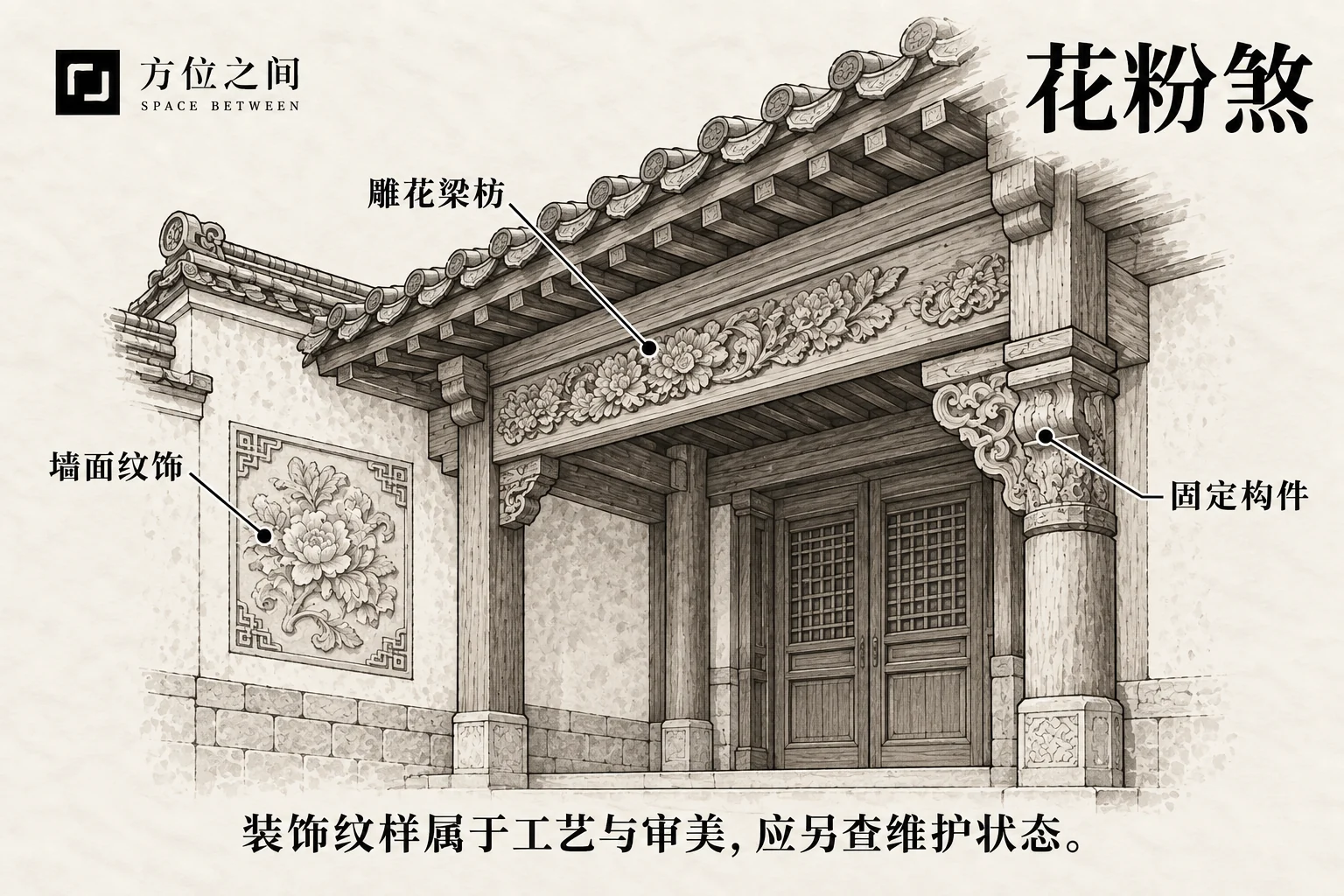
Walls, beams or columns carry carving, painting or ornament that this traditional entry evaluates negatively. Record the decorated element, material and attachment. Distinguish surface patterns, applied ornaments and actual cutting into load-bearing material.
Defining features
Walls, beams or columns carry carving, painting or ornament that this traditional entry evaluates negatively.
How to recognize it
Record the decorated element, material and attachment. Distinguish surface patterns, applied ornaments and actual cutting into load-bearing material.
An intact carved timber pattern and a loose applied panel both look decorative but require different maintenance. Inspect components and fixings instead of deciding removal by the motif.
Common confusions
The name here is not botanical pollen allergy. Flower motifs do not all share one meaning, and decoration quantity is separate from structural safety.
Folklore and sources
The label reflects a preference for simplicity in traditional aesthetics or ethics. It cannot accuse residents of misconduct or demonstrate fixed misfortune from a pattern.
Traditional responses and practical improvements
Sound craftsmanship need not be removed because of the name. Check fixings, dust and material care, respecting protection requirements where historic buildings are involved.
Chimney in Front (Zhuque Tuqi)
 Enlarge diagram
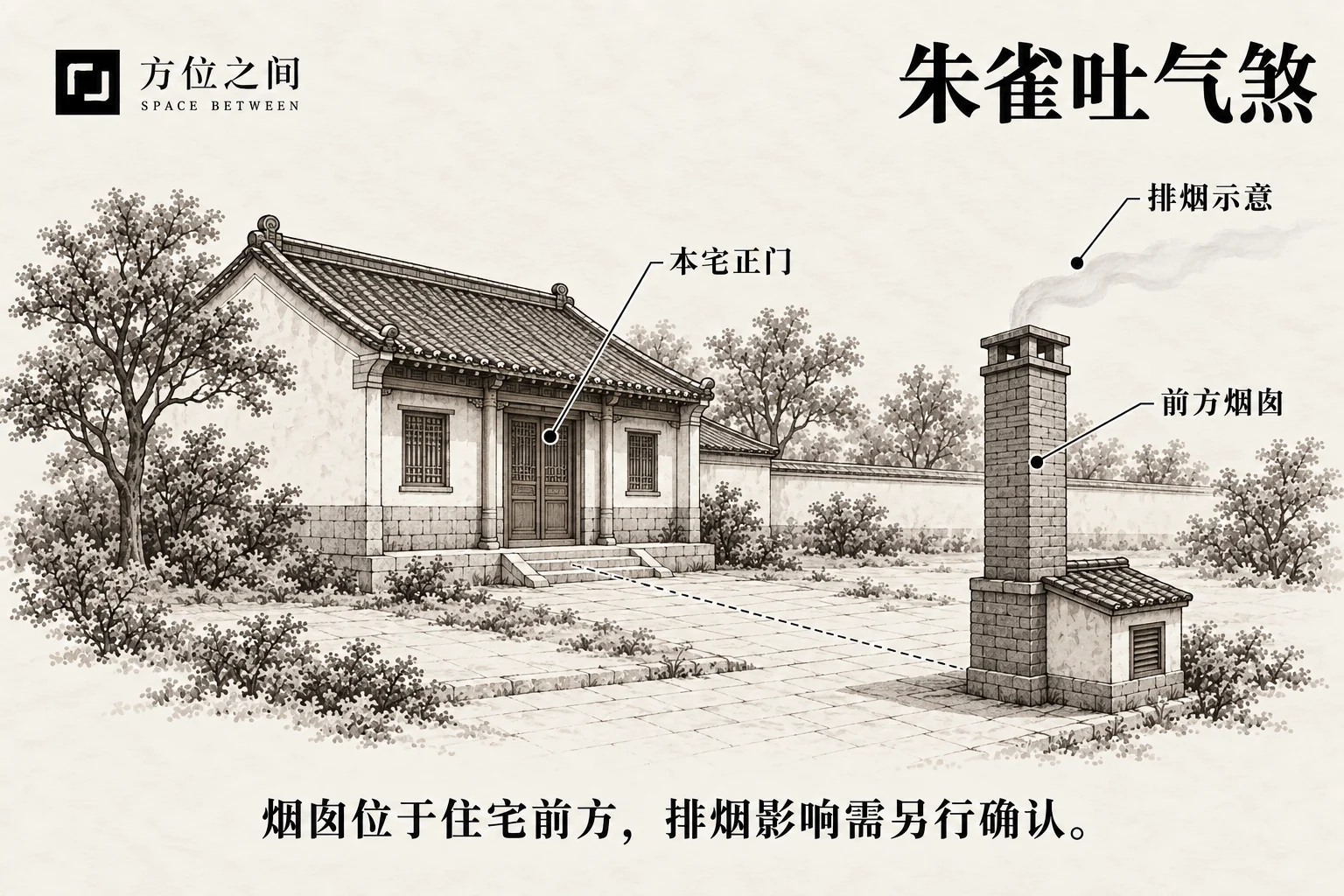
A chimney stands before the dwelling or hall in the main opening’s frontal view. Vermilion Bird is the traditional label for the front side. Establish whether the chimney operates, its distance and height relative to windows, and actual plume direction. Seeing it in front does not mean exhaust enters the house.
Defining features
A chimney stands before the dwelling or hall in the main opening’s frontal view. Vermilion Bird is the traditional label for the front side.
How to recognize it
Establish whether the chimney operates, its distance and height relative to windows, and actual plume direction. Seeing it in front does not mean exhaust enters the house.
A visible but disused chimney differs from an operating flue whose exhaust enters windows. Record operation and odor timing first, then decide whether facility inspection or a complaint is warranted.
Common confusions
This differs from a spire, lamp post or roof ridge. The bird is symbolic, not a drawing instruction, and an image of black smoke alone cannot establish emission levels.
Folklore and sources
The breathing-out name compares exhaust to a mouth action. It does not prove the facility will cause a particular family event.
Traditional responses and practical improvements
Where smoke, odor or backflow occurs, investigate the real source and ventilation and contact maintenance or management. Without operating exhaust, avoid pollution conclusions based on appearance alone.
Multiple Chimneys on a Small House (Xingzhang)
 Enlarge diagram
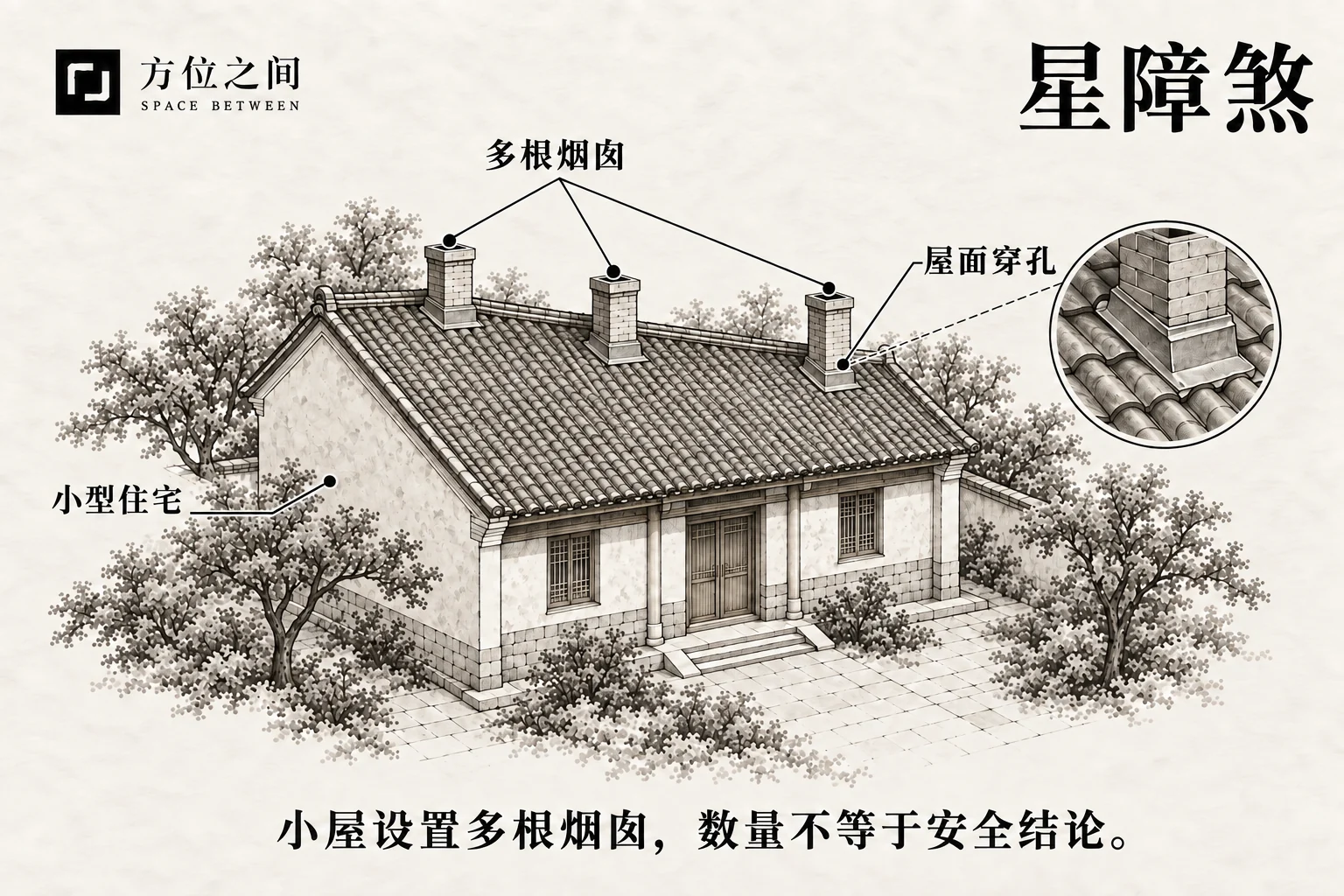
A small dwelling carries several chimneys. The traditional description concerns the relative number and building size; some versions give two or three as examples. Identify each flue’s use, connected equipment and operating state, and inspect roof penetrations. Decorative vent caps should not automatically be counted as stove chimneys.
Defining features
A small dwelling carries several chimneys. The traditional description concerns the relative number and building size; some versions give two or three as examples.
How to recognize it
Identify each flue’s use, connected equipment and operating state, and inspect roof penetrations. Decorative vent caps should not automatically be counted as stove chimneys.
Three pipes serving different appliances do not establish abnormal exhaust. A blocked single flue still needs attention. Use and condition guide improvement more effectively than counting.
Common confusions
Two or three is an example in a version, not a danger threshold. A large building can have one defective flue while a small house legitimately needs several.
Folklore and sources
The name and numerical interpretation need further primary-page checking. Illness or fertility claims are not adopted, and chimney count alone cannot establish health effects.
Traditional responses and practical improvements
Check clear flues, roof waterproofing and combustion ventilation according to the equipment. Before removing or blocking a chimney, identify what it serves.
Sources and further reading
These sources help clarify the concepts and their origins. Explaining a traditional term does not establish that it can predict outcomes.