
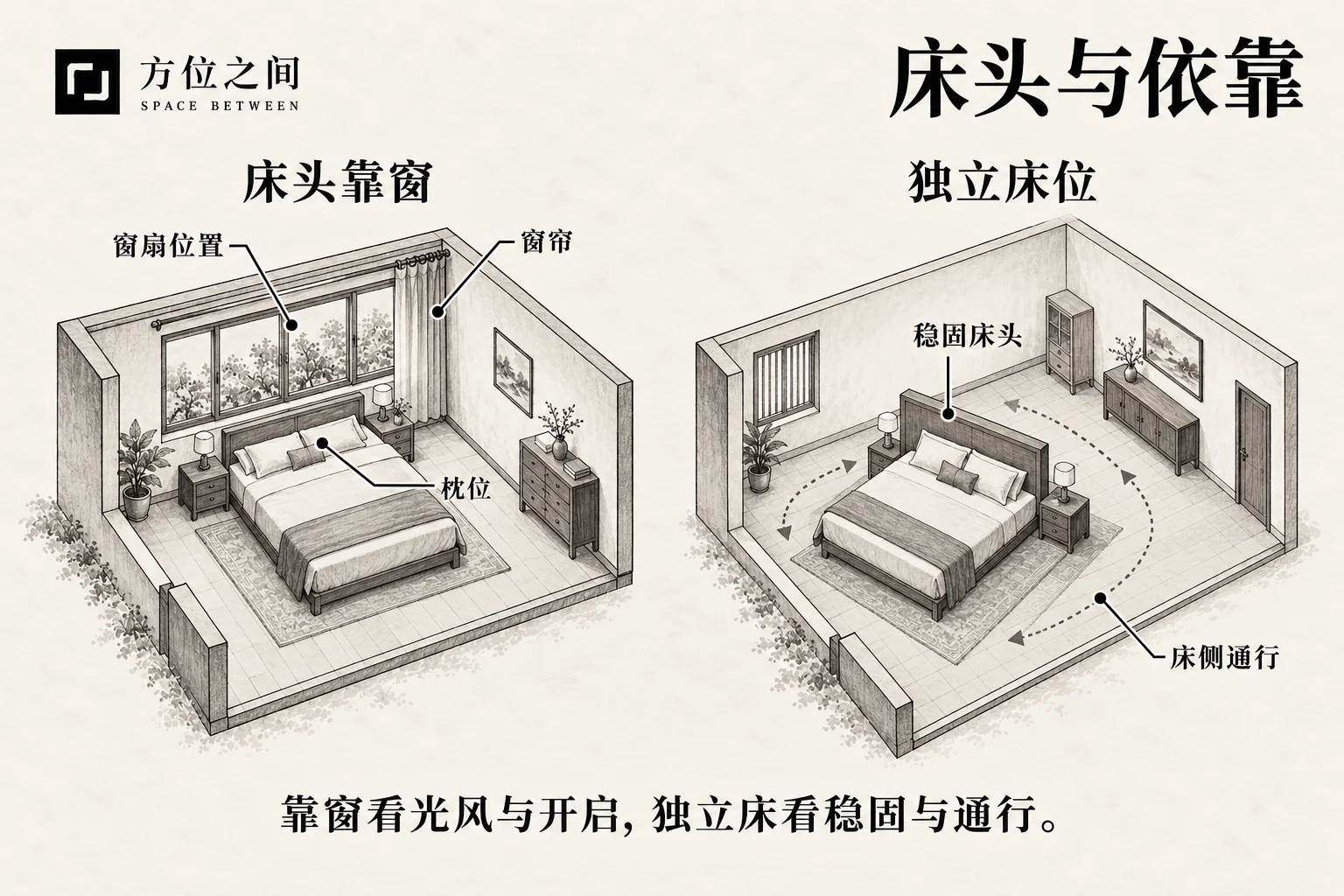
Name, characteristics and scope
A bedhead by a window places the pillow near a window opening. An unsupported bed often describes a bed centered in the room, lacking a stable headboard or accessible on all sides. Being beside a window differs from being away from a wall: check opening, shading and sealing for the former, and frame, headboard, circulation and preference for the latter.
How to identify it step by step
Start from the position people actually use, recording shape, spatial relationship and duration separately. These checks distinguish conditions; they are not a universal formula for fortune.
- Distinguish a solid low wall, floor-to-ceiling glazing and an operable window behind the bedhead.
- Observe nighttime light, curtain position, drafts at window gaps and whether the bed obstructs window operation.
- Gently check whether the frame and headboard are stable. Orientation is no substitute for a secure fixing check.
- Record everyday access on both sides, and whether central placement is an intentional layout choice.
How to understand the folk account
Traditional backing symbolizes stability, support and calm, while a window may be described as a disturbing qi opening. Extending the metaphor to inevitable career failure or lost wealth has no verified basis. Freestanding headboards, suites and open layouts require assessment of the specific design rather than a universal solid-wall rule.
What matters in present-day living
Light, drafts, curtain operation, cleaning and bed stability can be checked. Preferences for an open sleeping space vary; do not impose anxiety on someone who is comfortable. If the sill is damp or has condensation, investigate moisture and temperature differences separately rather than merely applying a label.
Traditional responses and practical adjustments
Traditional ideas of avoiding, screening, buffering and separating can be understood as reorganizing sightlines, circulation and activity areas. Try small reversible changes first, then consider permanent alterations if they help.
- Use a stable bed frame or headboard and adjust placement according to the occupant's experience.
- Choose appropriate shading while keeping window leaves, safety devices and maintenance access usable.
- After moving the bed, check power cords, bedside routes and air-conditioning airflow.
- Address actual leaks or failed seals in the window itself instead of placing symbolic objects.
Common misreadings and related names
A bedhead by a window is not the same as an exterior sharp corner aimed toward the window; assess each independently.
A bed away from a wall is not automatically dangerous. Instability, obstructed windows and trip hazards are identifiable concerns.
Sources and further reading
These sources help clarify the concepts and their origins. Explaining a traditional term does not establish that it can predict outcomes.